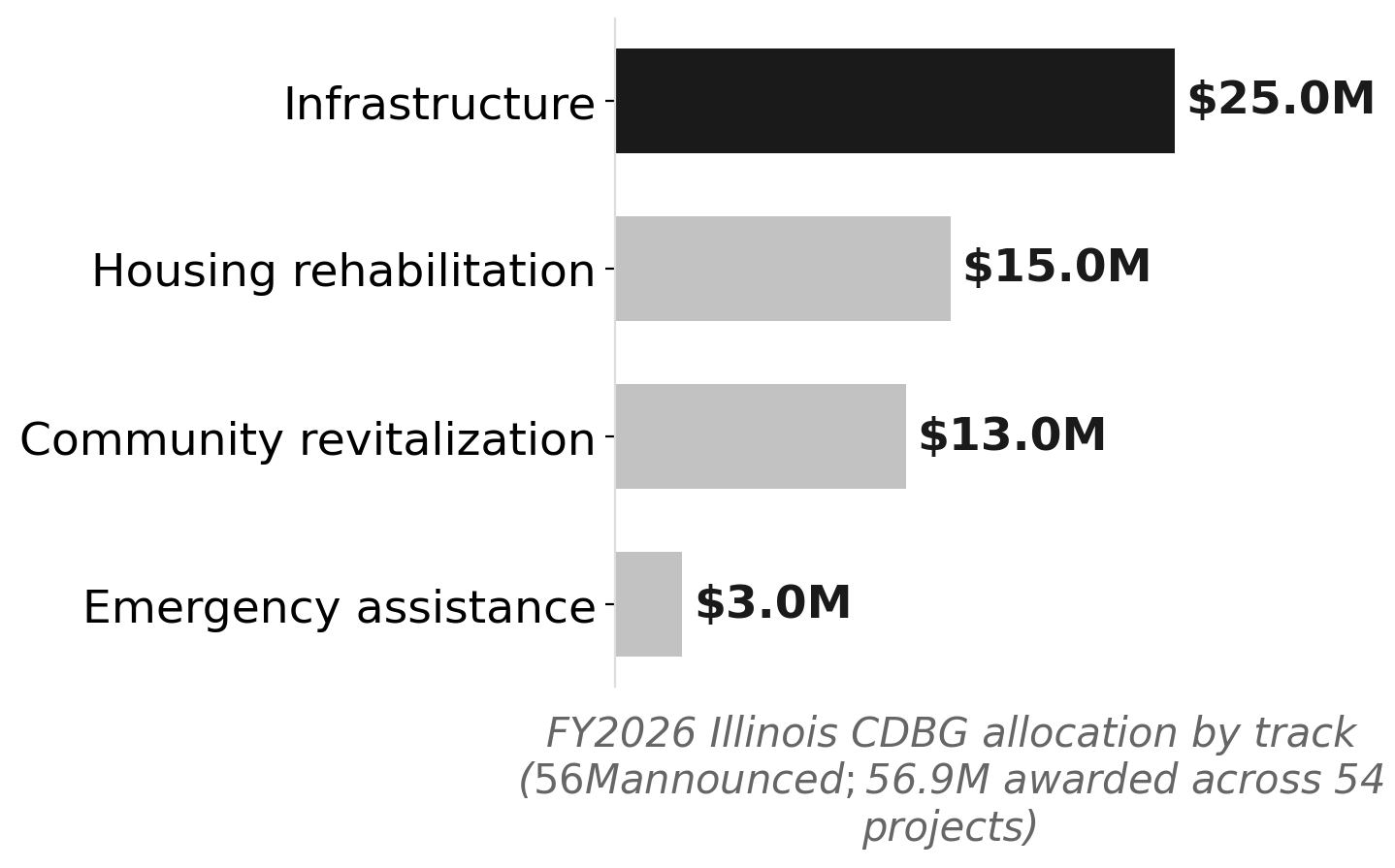
Eight Illinois housing authorities and small municipalities that had gone silent for more than a year all issued housing-related RFPs within the last 30 days. The cluster is not a coincidence. It is the mechanical downstream consequence of Illinois DCEO announcing $56.9 million in Community Development Block Grant awards to 54 non-metropolitan communities, with $15 million of that carved specifically for housing rehabilitation. The money arrived. Now the towns have to actually spend it.
Governor Pritzker and DCEO launched the FY2026 CDBG round in May 2026, making four funding tracks available to non-entitlement communities across Illinois, places too small to receive HUD funds directly. Applications were due August 27. Awards followed. And now, in October, the compliance machinery is clicking into motion in exactly the counties you would expect: Kankakee, Saline, Montgomery, Johnson, and Rock Island, all downstate, all jurisdictions that cannot fund capital housing projects from local budgets alone.
The profile of these RFPs tells the story plainly. Kankakee County Housing Authority, dormant on the procurement front for over a year, issued three simultaneous bids: IT services, an administrative and ACOP plan update, and a utility allowance study. Those are not the RFPs of an agency expanding its ambitions; they are the RFPs of an agency standing up the administrative scaffolding it needs to execute a grant. Saline County Housing Authority put out a roof replacement bid. Johnson County Housing Authority moved on HVAC upgrades. Montgomery County Housing Authority went looking for CFO consulting. Each of these represents a different funding stream, Kankakee, Saline, and Montgomery county housing authorities draw on HUD Operating Fund and Capital Fund grants for their ongoing public housing stock, distinct from the new CDBG rehab round, but the timing reflects the same pressure: money is in hand, federal deadlines are real, and the administrative capacity to spend it does not build itself.
Source: NationGraph.
The clearest window into CDBG compliance mechanics comes from Hampton, Illinois, a Rock Island County town of 1,726 people, which issued RFPs for both a housing market study and consolidated plan services. Those are not discretionary documents. They are required CDBG compliance submissions. A town the size of Hampton does not staff a housing planning department; it hires consultants to produce what the grant requires, and it does that when the grant arrives. The Jacksonville city council, to the south in Morgan County, illustrated a parallel dynamic in July when staff pursued both a CDBG infrastructure grant and a separate housing rehabilitation grant, illustrating how these communities stack applications across program cycles to cover capital needs their budgets cannot touch.
The CDBG Small Cities Housing Rehabilitation track funds owner-occupied home repair in communities under roughly 50,000 people, with individual awards ranging from $300,000 to $800,000 and up to $60,000 per household. Illinois received an estimated $28.86 million as its state portion of the $157.8 million national CDBG Small Cities allocation for FY2026. Against the state's broader HUD relationship, those numbers are real but modest: Illinois carries an active HUD housing grant portfolio of roughly $2.06 billion across 1,388 active grants, and receives an estimated $2.6 billion annually from HUD across all programs. For a city like Chicago, a $600,000 CDBG award is rounding error. For Hampton or Saline County, it is the entire housing capital budget for a grant cycle.
What is accelerating the scramble is not just the arrival of awards but the threat that this cycle may be among the last robust ones. The White House's proposed FY2027 HUD budget would cut $10.7 billion from the department nationally, a 13 percent reduction from FY2026 enacted levels. IHDA Board Chair King Harris warned publicly in June 2025 that proposed HUD cuts would push countless families closer to eviction, and the subsequent White House budget proposal made that concern concrete. For small downstate grantees, the calculus is straightforward: the FY2026 award is in hand, the FY2027 program may be smaller or restructured, and leaving money unspent because you could not hire an administrator in time is not an option any elected official wants to explain.
For residents of these communities, the practical effect is activity that may not have been visible for years. Housing rehabilitation funds in these grant ranges can repair dozens of owner-occupied homes in a single award cycle, addressing deferred maintenance in places where aging housing stock and limited local tax bases have made private repair unaffordable. What to watch next: whether these RFPs attract enough qualified respondents, program administrators, housing consultants, and contractors with CDBG compliance experience, to allow grantees to execute before award timelines close. Rural Illinois has a thin bench of CDBG-experienced contractors, and several of these communities are competing for the same small pool of qualified firms at the same moment.