Nine Florida institutions issued stormwater management RFPs for the first time in more than a year during the last 30 days alone, a procurement surge with no parallel in the prior 12-month window. Spread across Brevard, Gadsden, Lee, Miami-Dade, Osceola, Palm Beach, Pasco, Polk, and Seminole counties, these filings are the visible leading edge of something that has been building since fall 2024: hundreds of millions in committed federal grant dollars that have barely been touched, now entering the phase where local governments must actually hire someone.
The gap between what is committed and what has been spent tells the story. Florida's active federal stormwater grant portfolio across EPA, the Department of Transportation, and the Gulf Coast Ecosystem Restoration Council holds more than $192 million in obligated funding. Of that, just $134,000 has been outlayed in the last 24 months. That ratio is not a sign of slow-moving bureaucracy so much as the normal lifecycle of disaster-recovery infrastructure: first comes the declaration, then the grant awards, then the engineering assessments, then the design phases, and finally the construction contracts. Florida is now, unmistakably, at the construction-contract stage.
The federal money flowing into this moment arrived in waves. FEMA delivered approximately $480 million to Florida in January 2026, followed by $97 million in April, $89 million in June, $55 million in July, and a final $317 million tranche on August 31, the last of which split roughly $167 million through FEMA's Hazard Mitigation Grant Program and $150 million through its Public Assistance program. Those are two distinct mechanisms: HMGP funds forward-looking risk-reduction projects like drainage hardening and property elevations, while PA reimburses local governments for restoring damaged public infrastructure. Both flow through the Florida Division of Emergency Management, but they target different project types and cannot be treated as a single pool.
Source: NationGraph.
A third channel, HUD's Community Development Block Grant Disaster Recovery program, works differently still. It is a federal block grant disbursed through the state as a pass-through to counties and cities, with wider eligible uses than FEMA programs. Hillsborough County drew a $709 million CDBG-DR award and used a portion to fund a $95 million stormwater improvement plan that commissioners approved in April 2026. Design phases on that work were expected to begin by summer 2026, which is precisely when engineering firms would be finishing schematics and putting construction work out to bid.
Layered on top of the federal disaster programs is a fourth mechanism operating on an entirely separate track. The FDEP Resilient Florida program is a state-managed competitive grant funded by Florida legislative appropriations, not disaster declarations. Its FY2027-28 application window closed September 1, 2026, with more than $230 million available. Communities that submitted applications must now move quickly to procure construction services to remain viable grantees. That deadline is its own accelerant, independent of the federal pipeline.
The geographic spread of the nine first-timer institutions underscores that this is a systemic shift rather than a regional one. Gadsden County sits in the Florida Panhandle, far from the Gulf Coast counties that absorbed the worst of Milton's landfall. Miami-Dade operates a water management apparatus as large as some state agencies. Osceola County's municipality of Oviedo filed an RFP explicitly titled "Hurricane Milton Drainage Repairs at Panther Street / Carissa Lane", a direct causal fingerprint connecting a specific federal disaster declaration to a specific procurement action. These are not communities that happened to schedule routine maintenance at the same time. They are executing on grant obligations that arrived in the same federal funding cohort.
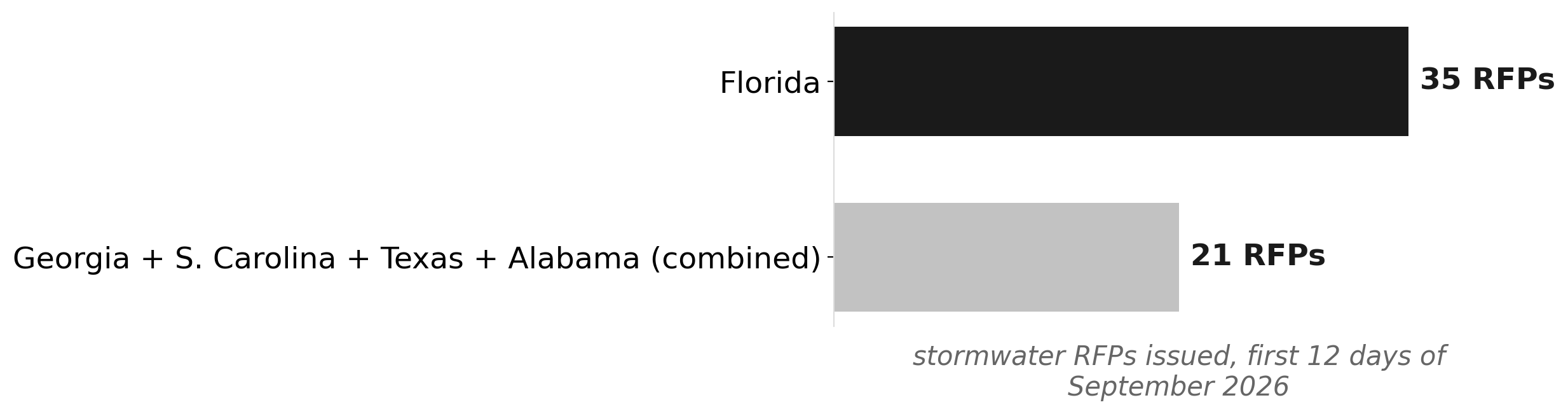
The scale of Florida's procurement activity in September 2026 has no peer in the region. The state issued 35 stormwater RFPs in the first 12 days of September. Georgia, South Carolina, Texas, and Alabama combined for 21 over the same period. As Sarasota Magazine noted in a September 11 piece on water infrastructure readiness, the 2024 storm season exposed systems that had not been designed for compounding storm surge followed immediately by inland flooding, Milton alone dropped up to 15 inches on neighborhoods that rarely see standing water.
For residents in the nine counties now issuing RFPs, the near-term signal to watch is contract awards, which typically follow RFP closings by 60 to 90 days. Those awards will indicate which engineering and construction firms are absorbing the bulk of the work and whether local governments are staying on the timeline their grant obligations require. Communities that miss disbursement milestones risk clawback of funds they have already banked on. The construction season that starts this fall is, in that sense, not optional.