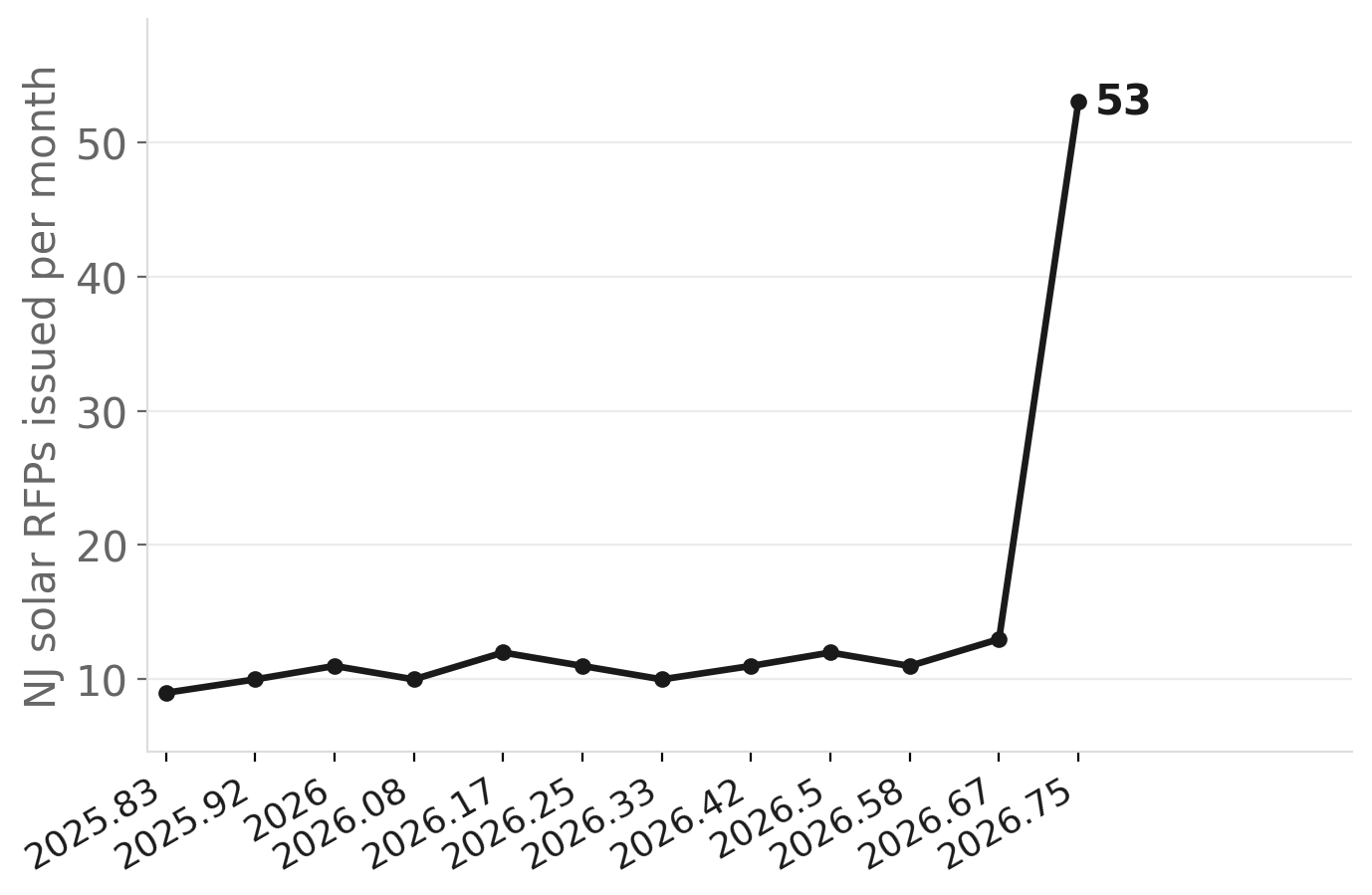
New Jersey issued 53 solar RFPs in October 2026, against a trailing monthly average of roughly 11, a 4.8x spike that amounts to the most concentrated public solar procurement push the state has ever produced. The buyers are not utilities. They are school boards, county agencies, housing authorities, and municipal governments, all moving simultaneously toward the same conclusion: the state has opened more solar incentive capacity than it has ever offered at once, and the window will not stay open indefinitely.
The procurement wave traces directly to three state policy actions layered across 2026, all administered by the New Jersey Board of Public Utilities using SREC-II certificates as the incentive currency, none of it federal money. On her inauguration day, January 20, 2026, Governor Mikie Sherrill signed EO-1, declaring a utility cost state of emergency, and EO-2, directing the NJBPU to accelerate solar and storage procurement within 45 days. The directive cited a $16 billion surge in PJM capacity costs and the fact that New Jersey imports more than 40% of its electricity, an exposure that made the state unusually vulnerable to wholesale price swings.
The BPU moved. On March 4, 2026, it opened a 3,000 MW Community Solar Energy Program solicitation, described by pv magazine as the largest community solar capacity allocation in state history, enough to serve 450,000 subscribers, while simultaneously launching a fourth Competitive Solar Incentive solicitation seeking 300 MW of grid-supply and large non-residential solar. Then in September 2026, Sherrill signed S3183/A3974, carving out a new 300 MW segment specifically for large solar facilities of 5 to 20 MW built on commercial rooftops, landfills, contaminated sites, and brownfields.
Source: NationGraph.
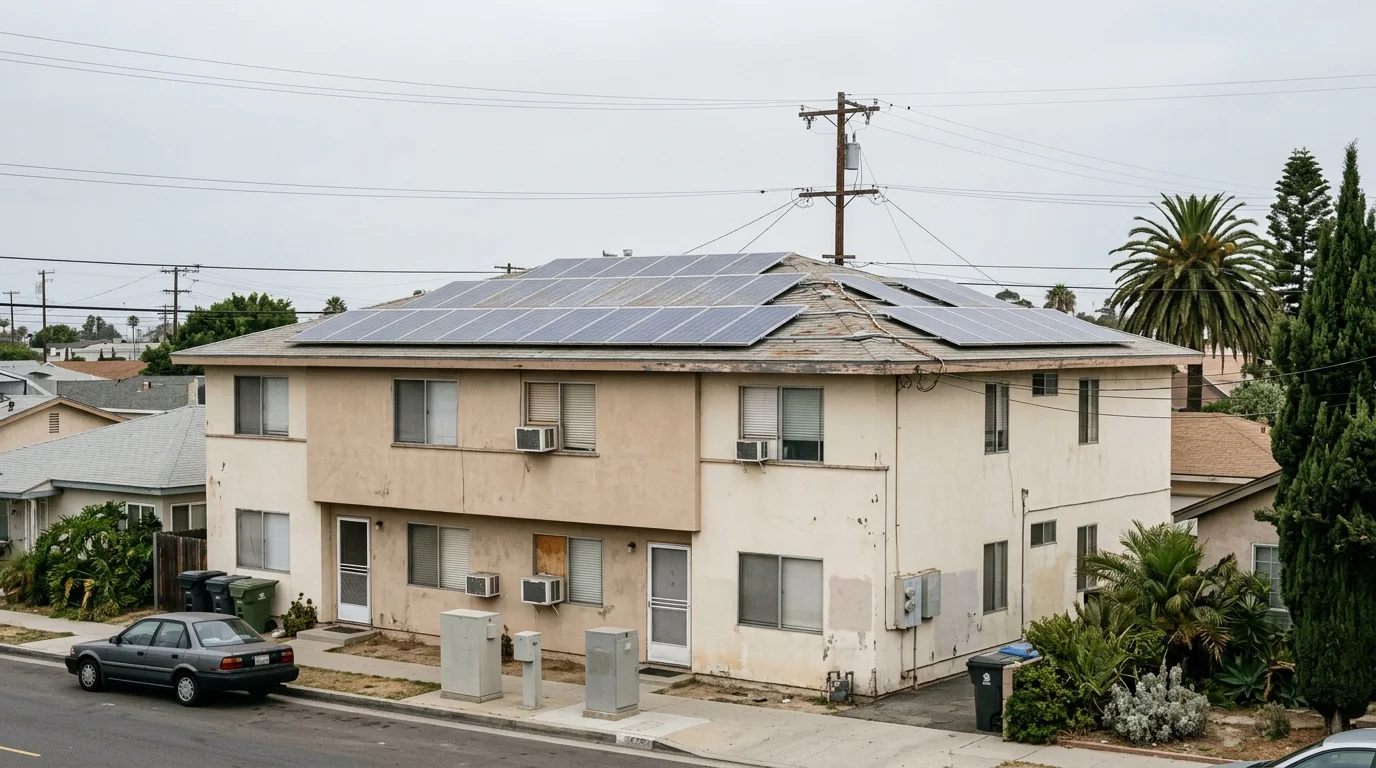
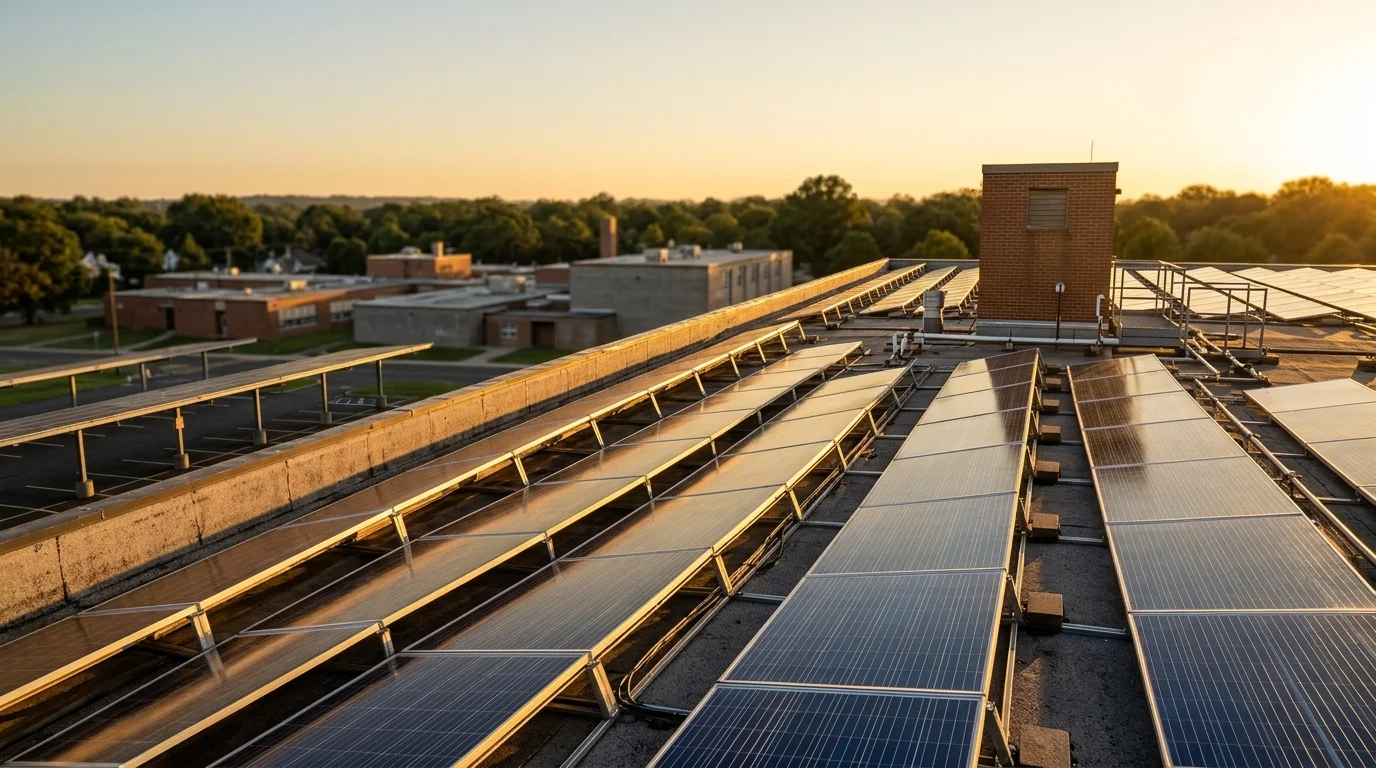
That last provision is the key to understanding who is filing the October RFPs. New Jersey is the most densely developed state in the country. Greenfield solar farms are effectively off the table. The geography forces a different kind of project: rooftop arrays on school gymnasiums, canopy installations over housing authority parking lots, ground-mounted systems on capped municipal landfills. The S3183 segment was written precisely to reach those assets, and the entities that hold them are responding. Of the 53 October RFPs, 18 came from municipal governments, 11 from school districts, 9 from county agencies, and 7 from housing authorities. Public utilities filed four.
The three programs are operationally linked but target distinct actors. The CSI Program runs competitive bid rounds aimed at large grid-supply developers. The Community Solar Program uses rolling registration open to any non-utility owner of an eligible site. S3183 unlocks the middle tier, the 5 to 20 MW rooftop and brownfield segment that local governments and school districts are best positioned to fill. All three windows are open simultaneously, which is why the RFP wave cuts across so many entity types at once.
The Community Solar program's structure adds another layer of urgency for housing authorities specifically. Under program rules, 51% of each project's subscriber base must be low-to-moderate income households, and subscribers must receive bill credits of at least 10 to 20% below retail rates. Housing authorities hold portfolios of LMI-eligible tenants by definition, making them natural anchors for community solar projects. The BPU also reduced the incentive rate from $80 per MWh to $60, a deliberate signal that the program prioritizes filling the 3,000 MW block quickly over maximizing per-unit returns. For local governments watching capacity fill, the message is clear: file now or wait for the next solicitation cycle.
Neighboring states also saw elevated solar RFP counts in October, New York logged 71, Pennsylvania 43, Connecticut 28, but none of them produced a proportional spike relative to their own baselines that matches New Jersey's. The combination of a statutory 50% renewable portfolio standard due in 2030, a governor who declared an energy emergency before finishing her inaugural address, and three distinct procurement mechanisms opening within a nine-month window has no clean regional parallel.
For residents and ratepayers, the October filing surge is a leading indicator, not a delivery date. RFPs are the start of a procurement process that typically runs six to eighteen months before a project reaches commercial operation. What the volume signals is that local governments have made a decision: participating in the NJBPU incentive programs is now a standard budget and facilities question, not an experimental one. The school district that files a PPA RFP today is locking in an energy cost structure before the CSI fourth-round awards close and before community solar capacity fills.
The next inflection point to watch is the BPU's review of applications under the March 4 community solar solicitation, which will reveal how much of the 3,000 MW block has been claimed and whether a fifth solicitation round becomes necessary before 2030.