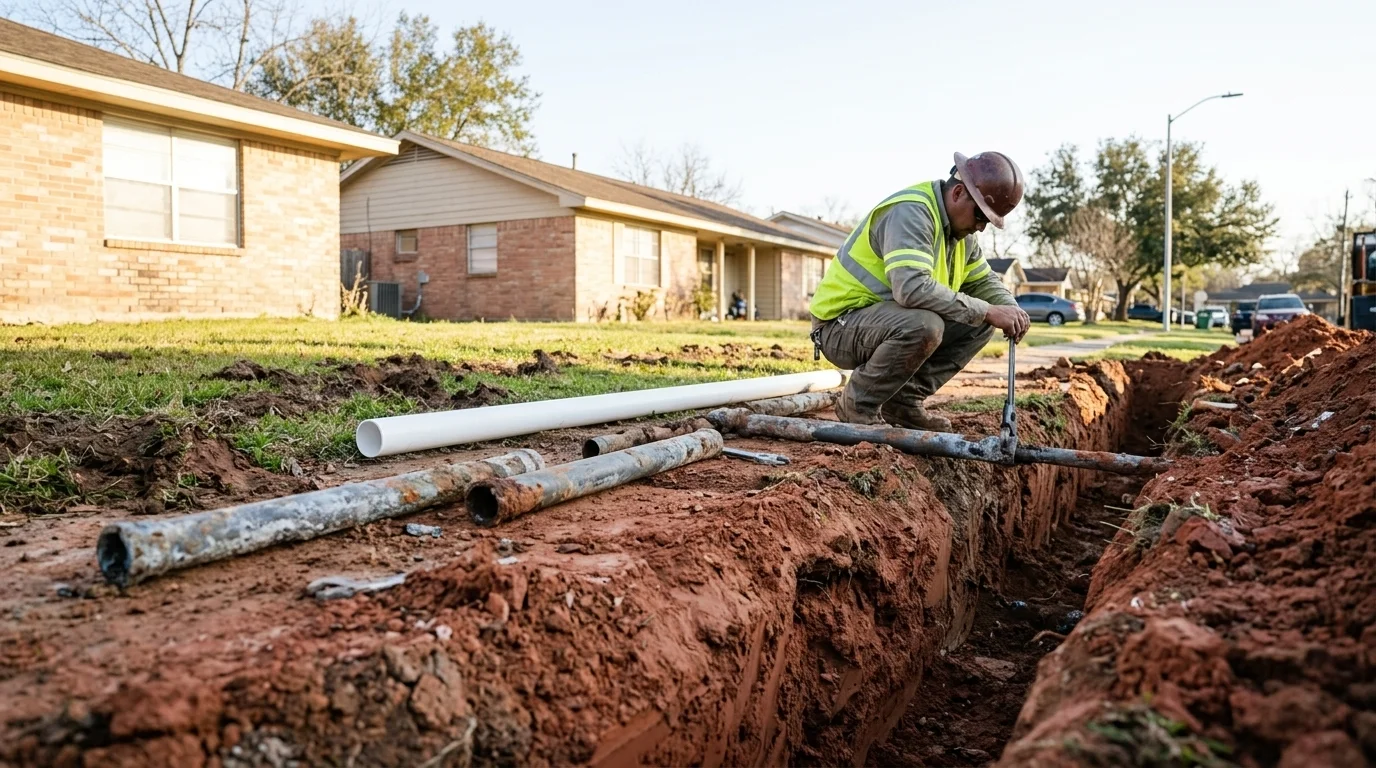
Texas water utilities issued 6 lead-pipe replacement solicitations in the last 30 days, against a 12-month monthly average of roughly 1.6, a 3.8x spike that lands almost exactly on the Texas Water Development Board's August 14 deadline for SFY 2027 lead service line replacement funding applications. The timing is not a coincidence.
The federal Infrastructure Investment and Jobs Act made FY 2026 the final year of dedicated supplemental lead-pipe appropriations, distributing $2.9 billion across all states in this last cycle. For Texas, that translated into a specific announcement: the EPA committed $76.6 million for Texas on May 20, 2026, routed through the Drinking Water State Revolving Fund. After this round closes, states revert to base DWSRF capitalization without the supplemental lead-specific top-up. Utilities that miss the current window will face whatever comes next largely on their own.
What makes the August surge striking is not just the volume of new solicitations, but how much federal money is still sitting on the table. The TWDB holds three active EPA capitalization grants totaling more than $374 million in DWSRF lead service line replacement funds. Of that, only about $452,700 has been outlayed to specific projects, meaning the vast majority of committed dollars remain unattached to any contractor or shovel. Utilities that get into the TWDB pipeline now will claim the lion's share of funds that have been sitting largely untouched.
The activity is concentrated in Harris County and Montgomery County municipal utility districts in the Houston metro. That geography matters. Houston-area MUDs are quasi-governmental entities serving unincorporated suburban Texas, and they often lack the in-house grant administrators and legal staff that larger city water departments maintain. Navigating a federal DWSRF application, assembling an Intended Use Plan submission, and running a compliant public procurement process simultaneously is a significant lift for a small district. The August spike in RFPs reflects those districts finally getting the outside procurement help they need to move, and cutting it extremely close.
Texas is also playing catch-up on two fronts at once. The state has an estimated 647,000 or more lead service lines, placing it fifth-highest nationally at roughly 7 percent of total lines. As the Texas Tribune reported in 2023, the EPA's revised survey found more than twice as many lines as the state had previously estimated. The EPA subsequently required Texas, along with Florida, to submit corrective inventory data as a condition of its FY 2023 BIL grants, after both states underreported in the 2021 national survey. That means the state was still completing basic inventory work at the same time it was supposed to be moving toward replacement contracts, compressing the practical timeline for utilities trying to act.
The regulatory pressure behind the funding deadline is real and hardening. The EPA's Lead and Copper Rule Improvements require community water systems serving schools and childcare facilities to comply with new testing and service line requirements by November 1, 2027. For any utility that serves a school and still has lead lines on its system, that date functions as a backstop: either replace the lines with federal assistance or replace them without it. The procurement activity this August suggests many utilities are, at last, choosing the former.
The broader arc of RFP activity confirms this is a structural shift, not a single-month blip. Lead and lead service line solicitations in Texas averaged 6 to 10 per month from January through May 2026, compared to near-zero in the second half of 2025. The onset tracks almost exactly with the TWDB publishing its SFY 2026 Intended Use Plan for public comment on January 30, 2026, the moment utilities learned which projects would be eligible and at what funding terms. The August spike is the late-cycle peak of a ramp that began when the money became real and the rules became clear.
What utilities and residents should watch now is disbursement. The gap between what the TWDB has committed on paper and what has actually moved to contractors is vast. Getting onto the priority list before August 14 was step one; converting that position into a signed contract and actual pipe removal is the work of the next 12 to 18 months. With the LCRI school compliance deadline arriving in November 2027, that timeline leaves little room for delays in design, permitting, or contractor capacity. The next signal worth tracking is how quickly TWDB outlays move from the current $452,000 baseline, and whether the Houston-area MUDs that filed this month can execute at the pace the deadline demands.