Twenty-three California housing agencies issued procurement notices in the last 30 days after going silent for more than a year, and the timing is not a coincidence. The burst of activity, which spans the full spectrum of California housing governance from the Los Angeles Homeless Services Authority to the Tax Credit Allocation Committee of California to small Central Valley cities, reflects two enforcement clocks running out at the same moment.
The immediate trigger was Governor Newsom's March 25, 2026 issuance of Notices of Violation to 15 cities and counties that had still failed to adopt compliant 6th cycle housing elements. According to a Governor's Office press release, the jurisdictions, including Half Moon Bay, Turlock, California City, and Merced County, were given 30 days to respond before facing referral to the state Attorney General. HCD Director Gustavo Velasquez noted that 92% of California communities had already achieved compliance, framing the action as a final accounting for the holdouts. For the 15 named jurisdictions and dozens of others watching nervously, the message was plain: the grace period is over.
At the same time, the state pulled the starting gun on the next eight-year planning race. SCAG launched the 7th cycle RHNA process in summer 2026, with HCD required to deliver its Regional Housing Needs Determination to SCAG by October 2026. For any jurisdiction that missed the early-mover advantage in the 6th cycle and paid the price in enforcement notices and legal exposure, the incentive to hire consultants immediately, before the field fills up, is substantial. Cities including Atascadero, Mammoth Lakes, Agoura Hills, Paso Robles, and Lakeport have already posted explicit "7th Cycle Housing Element Update" RFPs in the past 60 days.
Source: NationGraph.
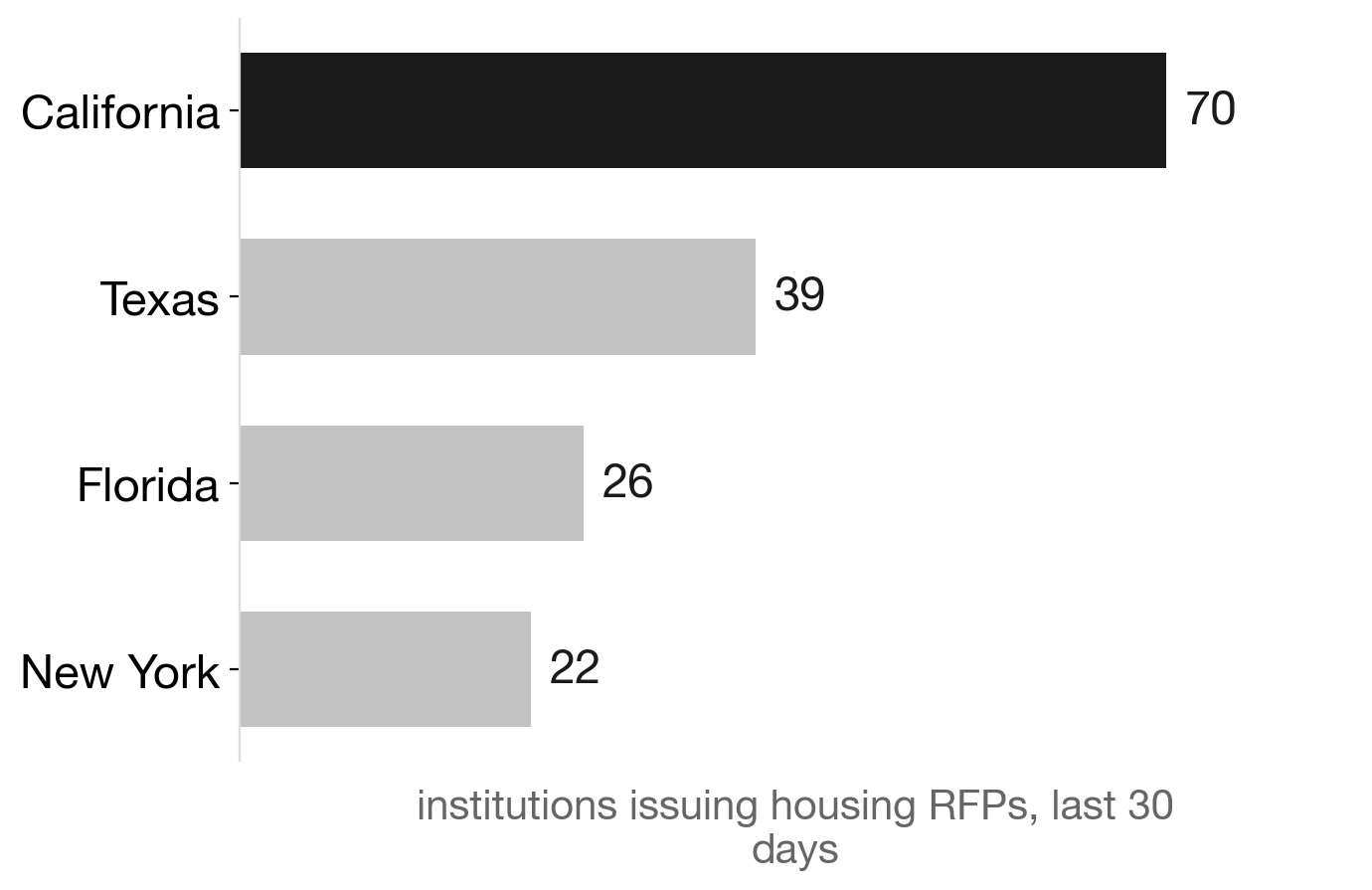
The result is a procurement surge with no recent precedent. California's 70 housing-related institutions active in the 30-day RFP window leads every large peer state by a wide margin: Texas posted 39, Florida 26, New York 22. The 23 first-time-in-a-year re-entrants are the sharpest signal. These are agencies that had gone dormant through the worst of the compliance backlog, and they are all moving at once.
The re-entrants span the full housing delivery chain. The Los Angeles Homeless Services Authority posted qualifications for affordable housing development. The Sacramento Housing and Redevelopment Agency sought banking and investment services for housing programs. Stanislaus County Housing Authority opened a project-based voucher solicitation. Yolo County, Calaveras County, and the Coachella Valley Water District all re-entered the market. This is not a cluster of similar agencies doing similar things; it is the machinery of housing production, at every level, restarting simultaneously.
The financial backdrop helps explain why procurement is viable right now. HUD holds $4.07 billion in active obligated grants to California, with $1.08 billion already disbursed. The Strategic Growth Council issued more than $73 million in new California housing grants between June and August 2026, including funding for Jordan Downs Phase S6 in Los Angeles. Agencies that spent 2024 and much of 2025 in compliance purgatory now have grant structures they can actually spend against.
The legal architecture is also tightening the window. AB 1398, enacted in 2022, compresses rezoning deadlines to one year for jurisdictions that certified their housing elements more than 120 days late. Cities that already missed early 6th cycle deadlines are now racing against that compressed clock, not the standard timeline. For a late-certifying city, every month of consultant procurement delay is a month off a rezoning deadline that was already shortened by statute.
For residents of the named jurisdictions, particularly in Southern California and the Central Valley, where enforcement concentration is highest, the procurement surge means planning activity they have not seen in years should now be visible: public hearings on housing element updates, zoning map revisions, and in some cases, new affordable development solicitations. The 6th cycle RHNA allocation for the SCAG region alone is 1.34 million units, most of which has not been built. The RFPs are a precondition for the plans that are a precondition for the zoning that is a precondition for the housing.
The next signal to watch is October 2026, when HCD delivers its Regional Housing Needs Determination to SCAG. That number will set the 7th cycle targets for every Southern California jurisdiction, and it will tell agencies currently drafting their consultant scopes whether the planning workload ahead is manageable or crushing. Any jurisdiction that has not locked in a planning consultant by then will be competing for a very thin market.