A single $5.28 million federal grant, booked to Nevada on July 8, 2026, has driven the state's trailing-90-day stormwater funding to $5,281,168, a 344% increase over the $1.19 million awarded in the same window a year ago. The recipient is the Tahoe Regional Planning Agency, and the reason the money is moving now has less to do with budget cycles than with a regulatory clock that started ticking the moment the calendar turned to 2026.
The grant is a USDA Partnership Agreement running through 2031, the direct product of the Lake Tahoe Restoration Act Reauthorization that President Biden signed in October 2024. That law, championed by Sen. Catherine Cortez Masto (D-NV) and Rep. Mark Amodei (R-NV) through a bipartisan, bi-state coalition, extended roughly $300 million in federal authorizations through 2034 and explicitly named stormwater and erosion control as one of six fundable project categories. The reauthorization unlocked a fresh pipeline of USDA Forest Service partnership dollars. TRPA moved quickly: it had already secured a $3.53 million USDA Watershed Restoration grant in August 2025. The July 2026 award stacks on top of that, making TRPA Nevada's dominant stormwater grantee by a margin that no other entity in the state comes close to matching.
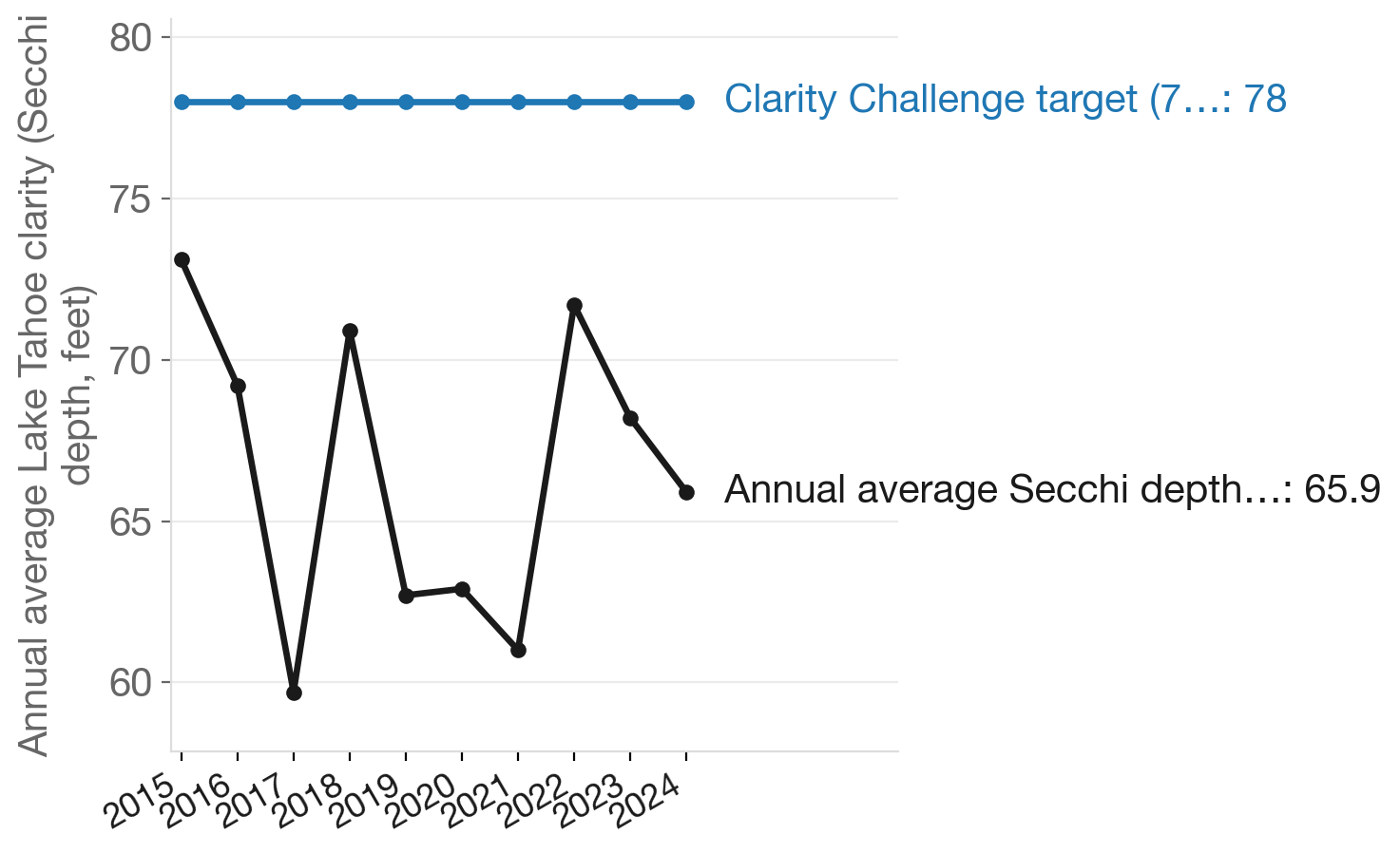
The urgency is not bureaucratic. The joint California-Nevada Total Maximum Daily Load program set a measurable target called the "Clarity Challenge": 78 feet of average water clarity, to be reached within the 2026 to 2031 window. That window is now open. A California State Water Resources Control Board report released in August 2026 found that the joint TMDL program kept a record 736,600 pounds of fine-grained sediment out of the lake in 2025. That is genuine progress. It is also a reminder of the scale of the problem: every pound of sediment that does reach the lake scatters light and locks in another year of clarity loss that takes decades to reverse.
Source: NationGraph.
TRPA has identified the source with unusual precision. Seventy-two percent of the pollutants degrading lake clarity wash in via stormwater from roads and parking lots. That specificity matters because it makes the intervention tractable: retrofit the drainage infrastructure around developed areas, and you address the dominant input. The Restoration Act's stormwater category exists precisely because the science on this has been settled for years. What has varied is the availability of federal dollars to act on it.
The geographic concentration of Nevada's surge is worth noting. This is entirely a Lake Tahoe Basin story. Las Vegas and Reno do not appear in the grant data. TRPA is a federally chartered bi-state compact agency headquartered in Stateline, Nevada, meaning grants booked to its Nevada office fund watershed work on both sides of the state line. Nevada has separately committed more than $112 million to Tahoe restoration through state bond programs since 1999, and the broader Environmental Improvement Program has now leveraged more than $2.8 billion in total public and private investment since 1997. The federal surge sits on top of a long-running state and regional commitment, not beside it.
One other piece of the Nevada stormwater portfolio is worth flagging. The Nevada System of Higher Education holds a $1.05 million EPA Centers of Excellence for Stormwater Control grant, awarded in June 2025 and running through 2027. It is small relative to the TRPA awards, but it adds a research dimension to the spending surge: the science informing where and how to deploy the larger dollars is being developed inside Nevada's university system at the same time the construction pipeline is opening up.
Among neighboring Western states in the same 90-day window, only California received comparable new stormwater funding, at $12.25 million across two grants. Nevada's $5.28 million from a single award to a bi-state basin agency is outsized relative to the state's population and its share of the lake's shoreline.
The next signal to watch is how quickly TRPA moves the new partnership dollars into on-the-ground contracts for drainage retrofits and road-edge erosion control. The 2026 to 2031 Clarity Challenge window gives the agency five construction seasons to demonstrate measurable clarity gains. The Nevada Independent has reported on the congressional effort to keep the full $300 million pipeline flowing; the question now is whether project delivery can keep pace with the authorization. Stormwater infrastructure takes time to permit, design, and build. The money has arrived. The deadline has not moved.