Federal school safety grants newly committed to New York entities have reached $10.6 million in the past 90 days, a 377% jump from the $2.2 million obligated in the same window a year ago. The surge is not a policy shift. It is a countdown.
The money flows from the Bipartisan Safer Communities Act (P.L. 117-159), signed by President Biden in June 2022 in the weeks after the Buffalo supermarket shooting and the Uvalde elementary school massacre. Congress authorized school safety funding through fiscal year 2026 only. The Department of Education's School Safely National Activities program issued its final round of competitive awards beginning January 1, 2026. After September 30, the spigot closes.
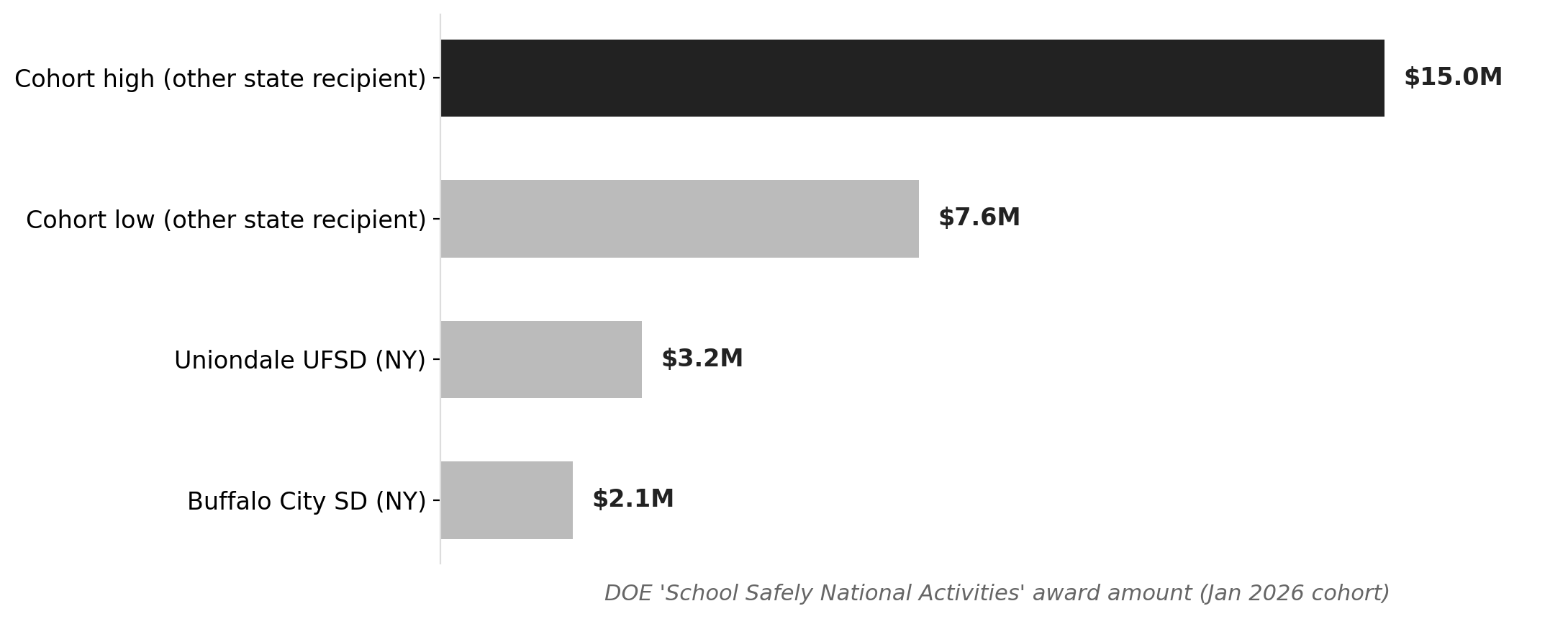
The two largest school-safety-specific awards in the current window tell the story plainly. Uniondale Union Free School District, a Nassau County district serving a predominantly low-income student population on Long Island, received a $3.2 million DOE School Safely National Activities grant effective January 1. Buffalo City School District received $2.1 million under the same program on the same start date. Together, those two awards account for roughly half the state's 90-day total. That Buffalo, the city where the 2022 mass shooting helped force the BSCA into law, is now drawing from the law's final-year school safety dollars carries its own weight.
Source: NationGraph.
The rest of New York's active school safety portfolio runs through the DOJ STOP School Violence and School Violence Prevention programs, with awards reaching the New York City Board of Education, Clyde-Savannah Central School District, New Dawn Charter High School, and two BOCES entities. These grants layer onto the $69.3 million in BSCA Stronger Connections Grants that the New York State Education Department distributed to 44 local education agencies statewide, money that also expires September 30, 2026.
The late-arriving quality of the current wave is not accidental. When the BSCA passed, competitive grant programs like School Safely National Activities required districts to write applications, document need, and wait through federal review cycles that stretched into years. Education Week reported in early 2023 that only 38 districts nationally had received School Safely National Activities money nearly a year after the law's passage. Many New York districts, particularly smaller rural ones without dedicated grant-writing staff, sat out the early rounds entirely. The January 2026 cohort of awards represents, for those districts, the last available on-ramp.
Nationally, the Bipartisan Safer Communities Act directed roughly $1 billion toward school safety, mental health services, and gun violence prevention across its five-year authorization. New York's current-window totals, while large relative to its own recent history, sit at the lower end of the national distribution: the January 2026 DOE cohort awarded between $7.6 million and $15 million per recipient in other states, meaning New York's combined $5.3 million from Uniondale and Buffalo came in below the national midpoint. One partial explanation is the state's fragmented district structure. New York has more than 700 local education agencies. Large competitive grants reward consolidated capacity; districts that share resources through BOCES have had better odds, but hundreds of small districts filed nothing.
For the districts that did secure funding, September 2026 creates a hard planning problem. Programs built on federal school safety grants, whether mental health counselors, threat assessment teams, or physical security upgrades, do not automatically transfer to local budgets when the authorization lapses. A district that hired three counselors on BSCA money this January will need to decide by summer whether to absorb that payroll or eliminate the positions. There is no successor federal authorization currently moving through Congress, and the Trump administration's broader scrutiny of education grants has made district administrators reluctant to treat any federal promise as permanent.
The next concrete signal to watch is September 30. That is the date by which all BSCA Stronger Connections Grant funds must be obligated by the 44 New York LEAs that received them, and the effective end of School Safely National Activities disbursements under the current authorization. Districts that have not yet fully committed their allocations will face the choice of rushing expenditures or returning unspent funds to the federal government. For districts like Buffalo and Uniondale, which received their largest-ever school safety grants just five months before expiration, the clock is already running.