New York received $51.6 million in newly started federal mental health grants over the past 90 days, a 154% jump from the $20.3 million recorded in the same window a year ago. Read that number in isolation and it sounds like a state pouring resources into a crisis. Read the underlying month-by-month data and a different story emerges: $49.5 million of that total arrived in January 2026 alone, a single-month figure with no precedent in the prior two years of grant records.
The spike is not a policy expansion. It is, in effect, a fire sale.
On January 15, 2026, the Trump administration abruptly terminated approximately $2 billion in SAMHSA mental health and addiction grants nationwide, then reversed the decision within 24 hours after immediate backlash. NPR reported the episode as causing "24 hours of chaos", an upstate New York care provider was among those receiving rescission letters before the reversal. Former SAMHSA director Dr. Yngvild Olsen said the terminations were made "without the input of experts." For the university-based research institutions that dominate New York's NIH grant portfolio, the message was clear: obligate now, before the next disruption freezes the pipeline.
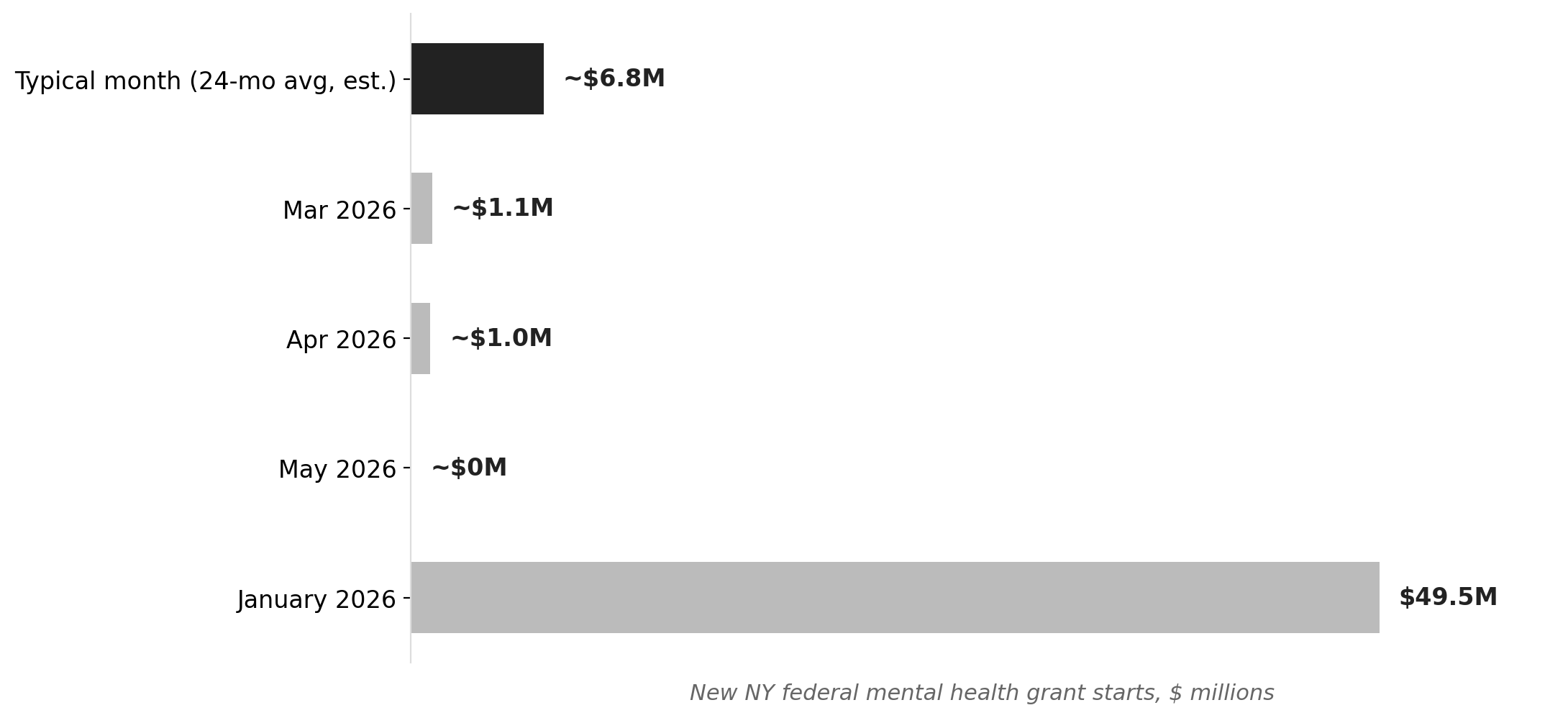
Source: NationGraph.
The institutions that moved fastest were the ones already best positioned to do so. Rockefeller University locked in $13 million in new grant starts in January. Columbia University added $9.9 million across 18 grants. Icahn School of Medicine at Mount Sinai secured $8.4 million, and NYU pulled in $7.9 million. These are not new entrants to federal science funding, they are entrenched recipients with hundreds of active NIH awards and the administrative infrastructure to accelerate paperwork when the window appears to be closing. New York's broader active mental health grant portfolio spans 831 grants worth $3.7 billion in total obligated funds.
The awards themselves tend to run four to five years, which means the institutions are not just capturing this year's money. They are, to the extent they succeed, insulating their research programs from whatever restructuring follows. NIMH's own website now carries a disclaimer that due to "current HHS and NIH restructuring," content is not being updated regularly, a signal that the agencies themselves are operating in an unsettled state.
New York ranks second nationally in trailing-90-day mental health grant dollars, behind only California at $56.9 million. Texas, with a far larger population, sits at a distant third with $22.2 million. That gap reflects something real about institutional capacity: New York and California house the kinds of research universities that can absorb and deploy federal obligations at scale. States without that infrastructure, including many with acute mental health needs, are not positioned to benefit from a compensatory grant flush even when one occurs.
The harder question is what this money does for the people waiting for care. New York City currently has 1,300 people on wait lists for its Intensive Mobile Treatment programs alone. The city's FY2026 budget allocates $47.3 million in municipal funds to replace expiring federal American Rescue Plan dollars that had been supporting community mental health services, a sign that city officials are already pricing in federal withdrawal from the service side of the ledger, even as the research side of the ledger looks flush.
The distinction matters. NIH mental health grants fund university researchers studying depression, psychosis, and addiction. SAMHSA grants fund the clinics, mobile treatment teams, and crisis centers that those 1,300 people on wait lists are trying to reach. The January chaos hit SAMHSA, the service-funding agency. The January grant surge flowed through NIH, the research-funding agency. The two streams rarely converge at the point of care.
What to watch: SAMHSA's budget trajectory for the remainder of fiscal year 2026 will be a more direct indicator of what happens to community mental health services in New York than any NIH grant announcement. If the administration moves again on SAMHSA appropriations, Stat News has reported ongoing uncertainty around the agency's budget, the city's $47.3 million municipal backstop will be tested. The research grants locked in this January will keep Rockefeller and Columbia labs running. Whether they keep the lights on at the clinics is a different question entirely.