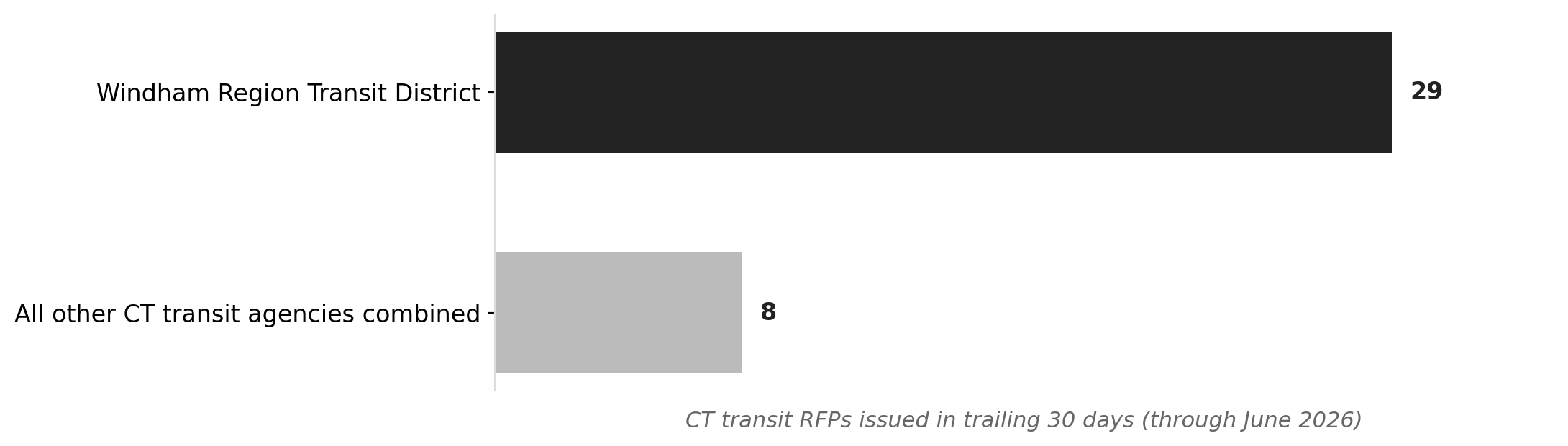
Connecticut transit agencies have issued 37 procurement requests in the past 30 days, four times the monthly average of 9.2 over the prior year. Twenty-nine of those 37 RFPs, or 78 percent, came from a single entity: Windham Region Transit District, a small rural operator headquartered in Mansfield Center serving the economically distressed communities of northeastern Connecticut. The sprint from one of the state's least prominent transit agencies is the most visible signal yet of a deeper scramble: Connecticut is sitting on approximately $1.04 billion in committed-but-unspent federal transit money, and the law that created most of it expires in fewer than five months.
The forcing mechanism is the Infrastructure Investment and Jobs Act, whose $156 billion in advance transit appropriations expire September 30, 2026. As the Bipartisan Policy Center has explained, those advance appropriations do not automatically carry over. Congress would need to pass new surface transportation legislation, and no reauthorization is imminent. CTDOT's own 2026-2030 Capital Plan, published in February, acknowledges this directly: "since the IIJA ends in FFY2026, the Capital Plan assumes funding will continue at the same level" after reauthorization. That is an optimistic assumption, and agencies up and down Connecticut's transit network appear to be treating it as such.
The scale of what Connecticut has already committed makes the urgency legible. The state carries 350 active federal transit grants totaling $1.57 billion in obligations, with only $531 million disbursed so far. A fresh $283.4 million Federal Transit Formula Grant landed on March 30, 2026, running to 2031, adding to an already large pipeline. CTDOT Commissioner Garrett Eucalitto has laid out a FY2026 capital program of $3.78 billion, with $2.16 billion earmarked for bus and rail, including the MOVE New Haven Bus Rapid Transit corridor and Waterbury Branch Line upgrades. The institutional pressure to turn obligations into contracts, fast, is not incidental to this moment. It is the whole story.
Source: NationGraph.
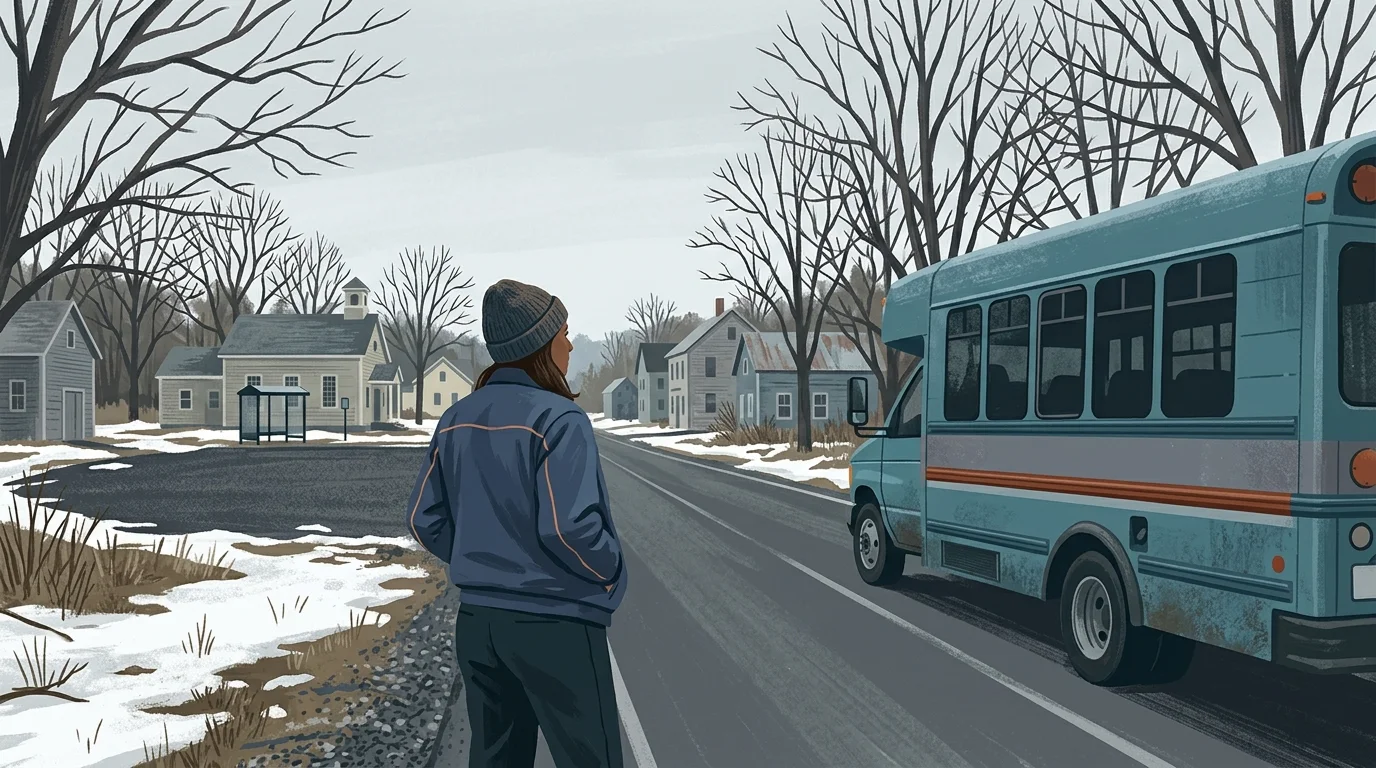
What makes Windham Region Transit District's role surprising is its size. This is not CTtransit Hartford or Metro-North. WRTD serves a region where Windham County's poverty rate runs well above the state average, operating routes through communities with limited transit alternatives. Yet WRTD appears to have positioned itself to move faster than larger agencies, issuing nearly three-dozen RFPs in a single month. One likely accelerant is a streamlined federal review agreement between USDOT and Connecticut that Mass Transit Magazine reported can cut six or more weeks off the review schedules of at least 90 state projects per year. For a small agency managing a compressed procurement window, six weeks is a meaningful margin.
The contrast with Connecticut's neighbors sharpens the picture. New York's transit agencies are running at 0.32 times their own prior baseline over the same window. Massachusetts is at 0.03 times. The surge is not a regional phenomenon driven by shared deadlines or a shared federal program. It is Connecticut-specific, and within Connecticut it is concentrated in ways that a headline RFP count alone would obscure. A second wave of activity has been building since February 2026, coinciding with the capital plan release and the March formula grant, suggesting this is an orchestrated push rather than a coincidence of independent agency decisions.
For Connecticut residents, particularly in communities served by regional operators, the practical consequence of this sprint could be durable. Procurement contracts signed before September 30 lock in federal dollars at current IIJA rates. Rolling stock, maintenance facilities, and service expansions funded now will operate for years after the legislative authorization that paid for them has expired. The risk is on the other side: projects that miss the window may face a recalibrated federal funding environment where the next reauthorization sets different formulas, different match requirements, or simply less money.
The next signal to watch is whether the pace of contract awards follows the pace of RFPs. Issuing a solicitation is not the same as obligating money. CTDOT's Draft 2027 State Transportation Improvement Program closed its public comment window on June 12, meaning the department is simultaneously closing out current-cycle procurement and locking in the next four-year program. If WRTD and other sub-grantees move from solicitation to award before September 30, Connecticut will have converted a significant share of its unspent pipeline into enforceable commitments. If the sprint stalls in the award phase, the RFP count will turn out to have been noise. Either way, Windham County just became an unexpectedly useful place to watch the end of the IIJA play out.