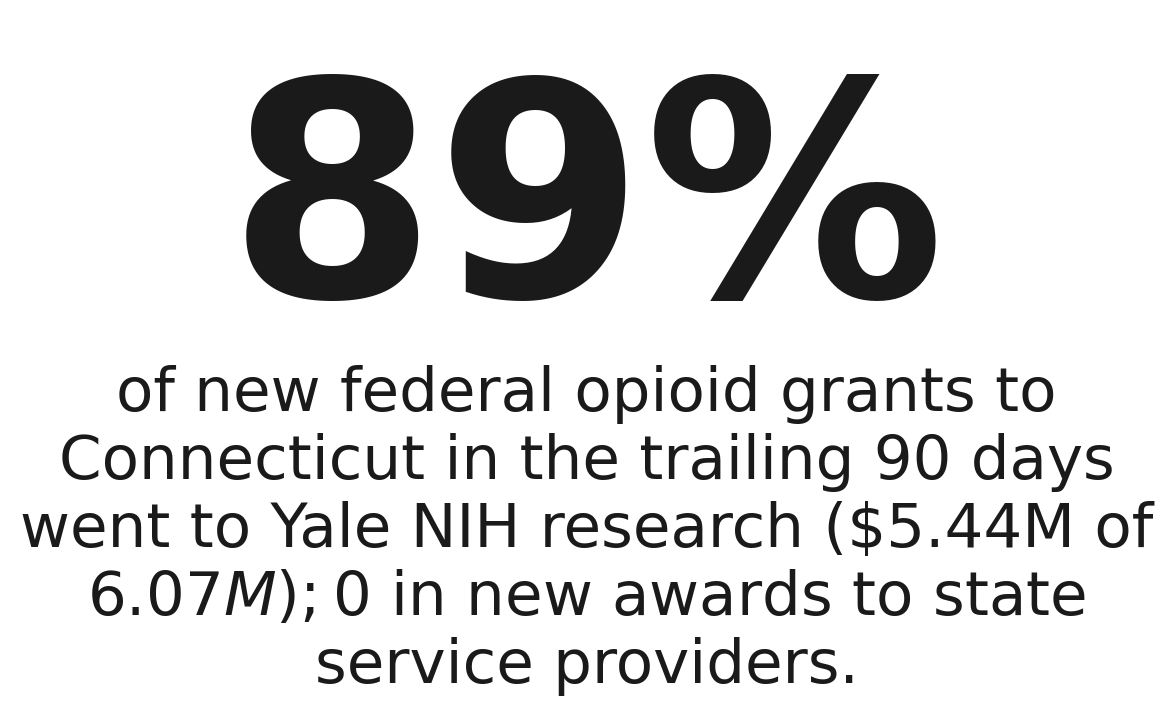
Federal opioid grants flowing into Connecticut have doubled in a year, hitting $6.07 million in the trailing 90 days compared with $3.01 million in the same window last year, a 102% jump driven almost entirely by NIH research awards to Yale University, not by new money for the clinics and treatment programs that serve patients.
Yale accounts for $5.44 million, or 89%, of those new commitments, all of them NIDA grants under the Drug Use and Addiction Research Programs line. The largest single award, $4.17 million issued in August 2026, runs through November 2030. The University of Connecticut received the remaining $48,000. These are multi-year scientific research grants funding investigators studying addiction mechanisms and treatment modalities, a categorically different thing from the federal dollars that keep treatment beds open and naloxone in the hands of first responders.
That distinction matters more right now than it usually would. The same federal government writing new five-year research checks to Yale investigators briefly terminated roughly $100 million in Connecticut SAMHSA behavioral health grants in January 2026. The termination lasted less than 48 hours before the grants were reinstated, but the episode, documented by CT Data Haven's mapping of nearly $100 million in suspended grants, exposed how quickly the service-delivery side of Connecticut's opioid infrastructure can be destabilized.
Source: NationGraph.
Connecticut's treatment apparatus runs on two distinct federal streams that are under separate and active political pressure. CT DMHAS holds a $30.5 million SAMHSA State Opioid Response grant covering 2024 through 2027, which funds medication for opioid use disorder, overdose reversal, and recovery support services delivered through sub-grantees across the state. A separate $7 million DOJ Comprehensive Opioid, Stimulant, and Substance Use Program grant funds justice-system-linked response including diversion and reentry programs. Neither of these is the same program as the NIH research grants; they flow through different agencies, under different political vulnerabilities, to different recipients for different purposes.
The SAMHSA SOR program survived intact at the national level: SAMHSA's September 2025 announcement committed more than $1.5 billion in FY2025 continuation awards nationally, with HHS Secretary Robert F. Kennedy Jr. framing the grants as returning power to states. But the Trump administration's FY2026 proposed budget includes deep SAMHSA cuts, and the FY2027 framework anticipates restructuring much of SAMHSA's grant portfolio into a consolidated block grant, a change that would give states more flexibility but fewer guaranteed dollars and less federal oversight of how funds reach patients.
The NIH side of Connecticut's opioid funding picture looks more stable on paper, but it has its own fault lines. NIH terminated 19 grants at Yale and UConn earlier in 2026, worth more than $42 million combined, with $11 million unspent at termination; those grants targeted mental health and LGBTQ+ health rather than opioid-specific programs, according to Hartford Business Journal reporting. The NIDA opioid research grants have so far survived, in part because they sit within a program area the administration has not targeted in the same way. Yale's active addiction grant portfolio now exceeds $126 million in cumulative NIH obligations across multi-year awards, a concentration of research infrastructure that has few peers nationally.
For Connecticut residents, the divergence in where the money is going has concrete implications. Research grants fund investigators, graduate students, clinical trial infrastructure, and eventual findings that may shape treatment guidelines years from now. They do not fund the counselor at a New Haven clinic, the mobile unit distributing buprenorphine prescriptions, or the recovery coach working with someone leaving prison. Those services depend on SAMHSA and DOJ dollars, the streams that faced termination notices in January and that the administration's budget proposals continue to put at risk.
In the New England context, Connecticut's position is notable. The state ranks second in the region for new opioid grant value in the trailing 90 days, behind only New York at $6.6 million and well ahead of Massachusetts at $664,000 and Rhode Island at $1 million. But that ranking reflects Yale's dominance in NIH competition, not an expansion of treatment capacity.
The next concrete signals to watch: whether Congress passes a final FY2027 budget that consolidates SAMHSA grants into a block grant structure, and whether the CT DMHAS SOR grant, currently running through September 2027, draws on its full allocation before any policy shift interrupts the flow. For Yale's newest awards, the research clocks run as far out as November 2030. The gap between those two timelines is where Connecticut's opioid response lives.