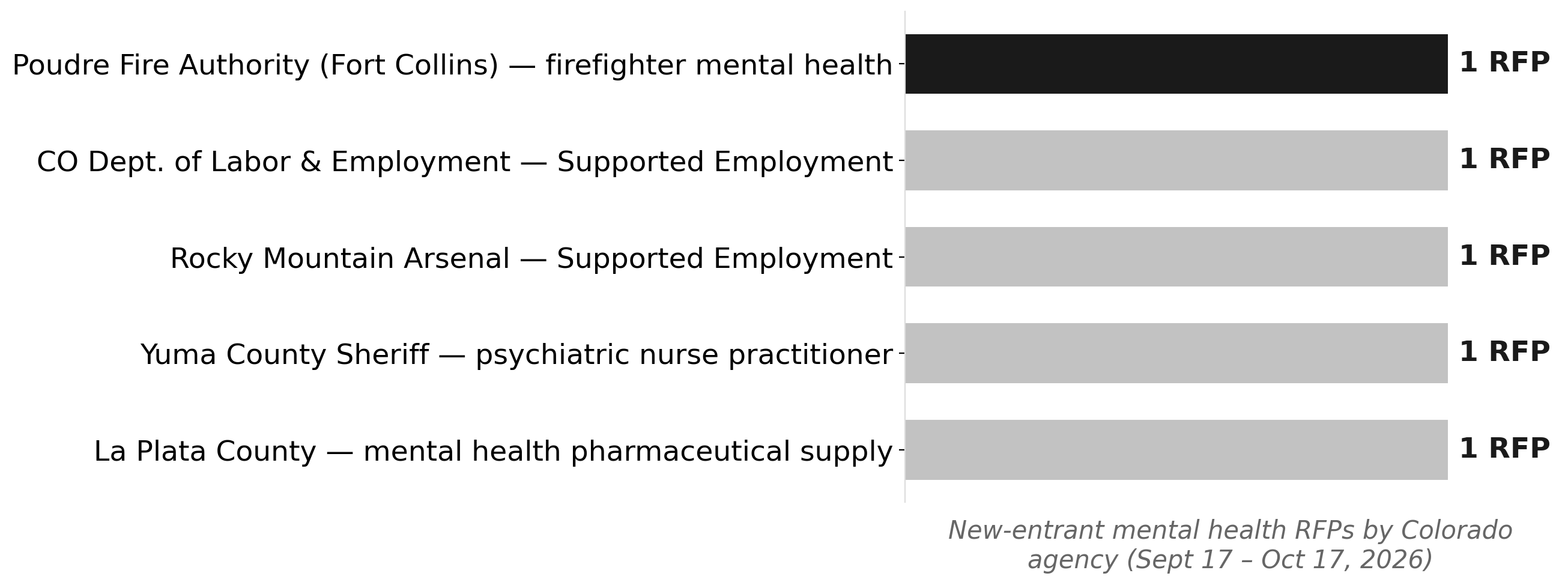
Five Colorado institutions issued mental health RFPs in the last 30 days after going more than a year without one, and the list includes a fire authority and a labor department, not just the county health agencies that typically drive this procurement. That institutional spread is the signal worth watching.
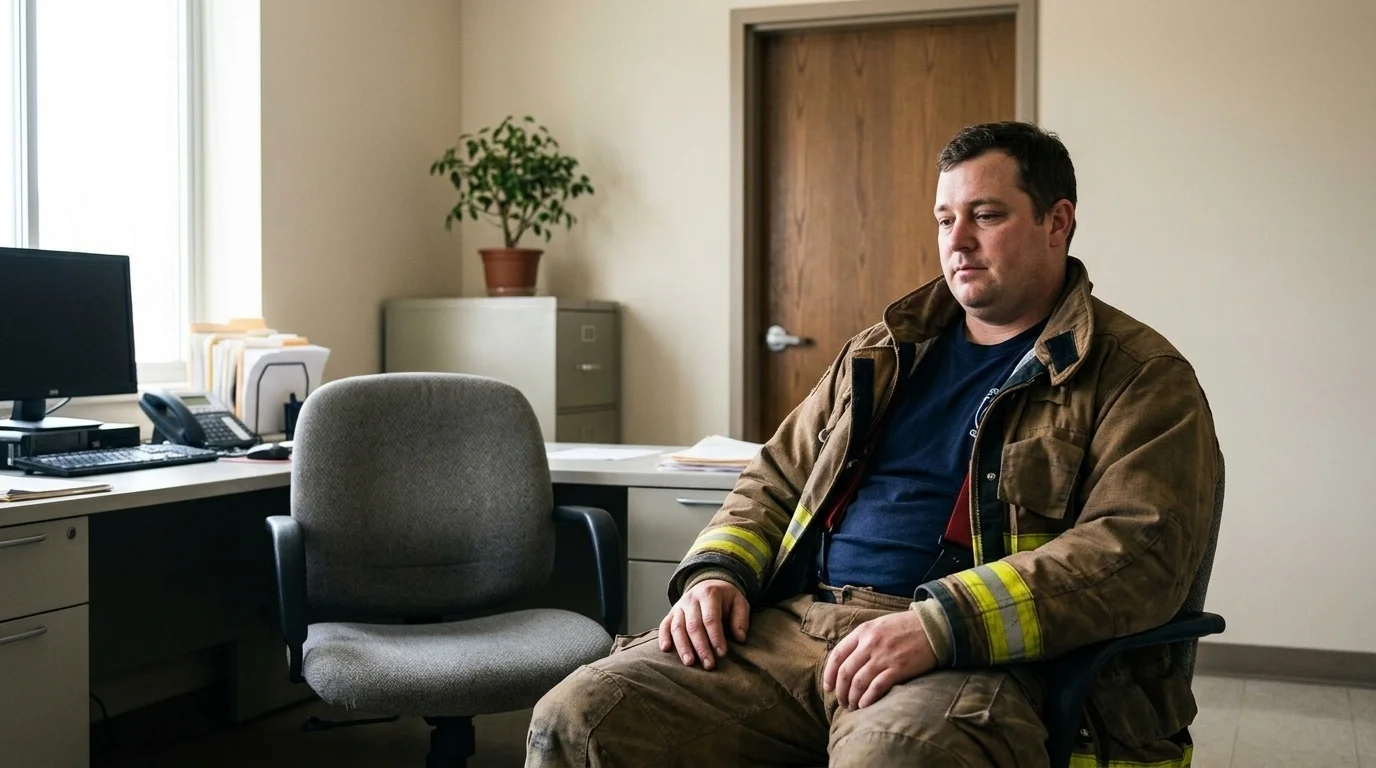
The most striking entry is the City of Fort Collins and Poudre Fire Authority, which posted an RFP for mental health support services for firefighters on October 17, 2026. According to NationGraph's procurement database, it is the first standalone mental health services RFP ever issued by a Colorado fire agency. Alongside it, the Colorado Department of Labor and Employment and Rocky Mountain Arsenal both issued Mental Health Supported Employment RFPs, Yuma County Sheriff's Office sought a psychiatric nurse practitioner, and a La Plata County entity posted a pharmaceutical supply solicitation for an existing mental health program. Fort Collins sits in Larimer County; Yuma County anchors the eastern plains; La Plata County reaches into the Western Slope. This is not a Front Range phenomenon.
Three distinct policy mechanisms explain the surge, and collapsing them into a single "Colorado mental health push" would obscure what's actually moving.
Source: NationGraph.
The first mechanism is the 988 crisis grant. On September 8, 2026, designated "988 Day", HHS announced $383.4 million in behavioral health grants nationally, including $252 million targeted at the 988 Lifeline and crisis response infrastructure. Colorado's Department of Human Services received a $4.8 million slice, awarded September 30 and running through 2029, specifically to strengthen 988 call capacity, mobile crisis teams, and community-based crisis response. County and municipal agencies that receive subgrants from CDHS under that award would have procurement timelines consistent with RFPs appearing in October.
The second mechanism is the SAMHSA Community Mental Health Services Block Grant, a separate federal stream. SAMHSA distributed nearly $800 million in block grants in February 2026, including $319 million for community mental health services. Colorado's $17.5 million share began flowing October 1, 2025, and runs through September 2027. That block grant funds direct services for adults with serious mental illness and children with serious emotional disturbance, a different purpose and a different population than the 988 grant, distributed by formula rather than competition. Both streams flow through Colorado's Behavioral Health Administration, which has operated as a standalone agency since a 2022 reorganization, giving county-level agencies a clear subcontracting pathway that many states lack.
The third mechanism is unrelated to SAMHSA entirely. Colorado's Department of Health Care Policy and Financing redesigned its Medicaid Supported Employment reimbursement model under an "Employment First" framework, with a targeted implementation date of July 1, 2026. That redesign, shifting Individual Supported Employment services to outcome-based reimbursement for people with serious mental illness, coordinated with the Division of Vocational Rehabilitation, is the direct policy trigger for the MHSE RFPs from CDLE and Rocky Mountain Arsenal. Colorado's HCPF has been developing the supported employment model through an extended stakeholder process; when the July 1 implementation date arrived, agencies with employment-support mandates needed contractors.
Fort Collins' Poudre Fire Authority fits a different lineage. Colorado already leads the nation in co-responder programs pairing behavioral health clinicians with law enforcement, according to the International Co-Responder Alliance. Those programs are partly funded through the state's Marijuana Tax Cash Fund, which allocates $3.67 million per year under SB17-207. The Poudre Fire Authority RFP extends that co-responder logic into fire services, a category that has not previously appeared in standalone mental health procurement. Whether other fire departments follow depends partly on whether the Poudre contract produces an evaluable model.
The aggregate numbers frame the context: in the 90 days ending October 17, 2026, 61 new federal grants touching mental health topics were obligated to Colorado, totaling $42.3 million. Colorado's active federal mental health grant portfolio from HHS alone now stands at $276.6 million across 198 currently active grants. Monthly RFP volume across Colorado mental health procurement has been elevated since early 2026, running between two and seven new institutional entrants per month after a quiet fourth quarter in 2025.
For residents, the practical effect is that mental health services are now being procured by agencies whose primary missions are emergency response, workforce development, and law enforcement, which means people interacting with those systems may encounter behavioral health resources embedded in services they already use. Whether contracted capacity keeps pace with demand is a question the next round of awards will begin to answer.
The next indicator to watch is the CDHS subgrant cycle under the $4.8 million 988 award. Those subgrant decisions will determine which counties gain mobile crisis capacity before the grant's first program year closes in September 2027, and which agencies show up as first-time RFP issuers in the months that follow.