Five EV charging RFPs hit Rhode Island's procurement systems in the past 30 days, against a baseline of roughly one every two months. The number is striking on its own, but what it signals is more important than the count: the state's federal EV charging program has completed its pivot from highway corridors to neighborhood parking lots, and the procurement activity is the visible edge of that shift.
The driving event was the April 2026 completion of Rhode Island's NEVI Phase 2A award cycle. The Office of Energy Resources and the Rhode Island Department of Transportation, administering federal dollars from the 2021 Bipartisan Infrastructure Law's National Electric Vehicle Infrastructure Formula Program, announced grants to 20 locations across 18 municipalities, targeting more than 100 new charging stations and 200 ports statewide. The state's FY26 deployment plan commits $13.2M in unobligated NEVI funds, drawn across FY24, FY25, and FY26 tranches, with roughly $8M allocated to Phase 2A competitive grants. With awards in hand, municipalities are now executing the installation-phase procurements that flow from those grants, which is exactly what the procurement spike reflects.
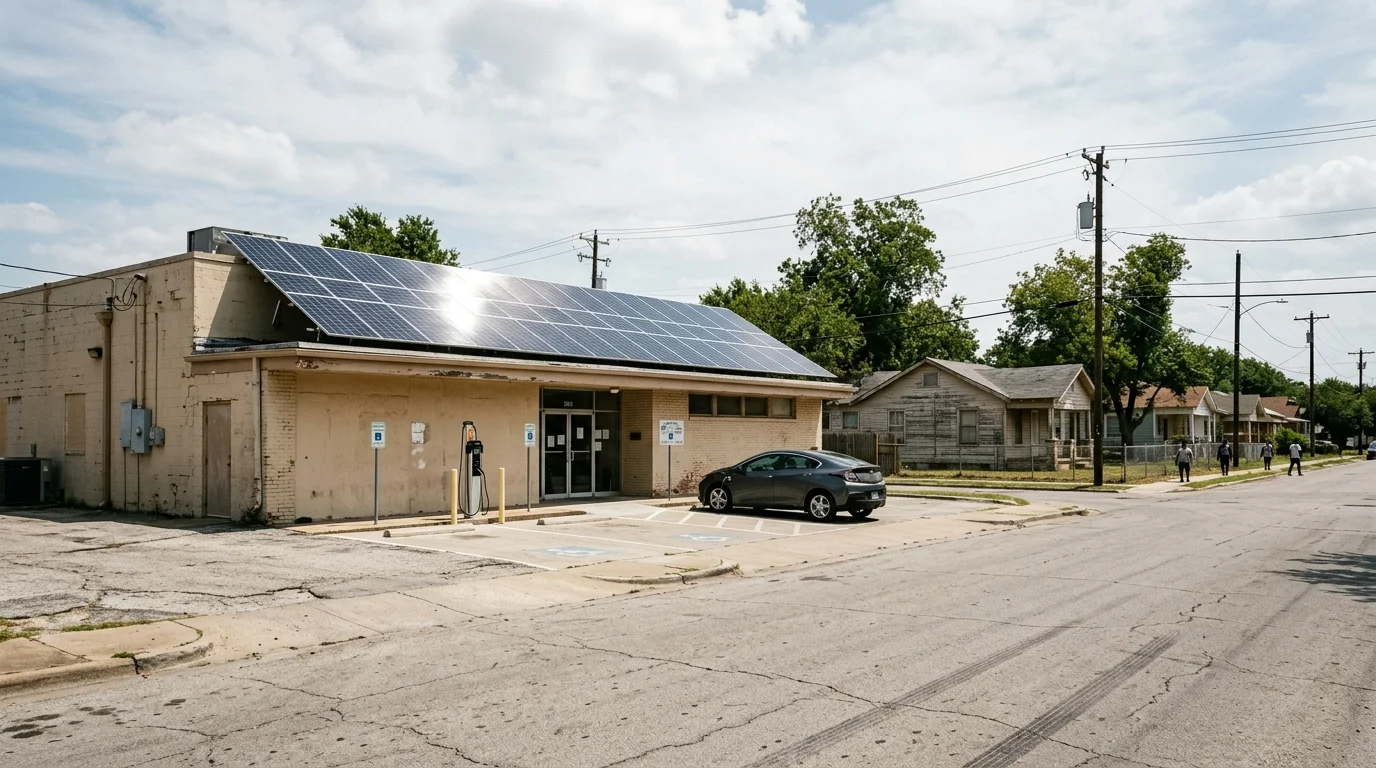
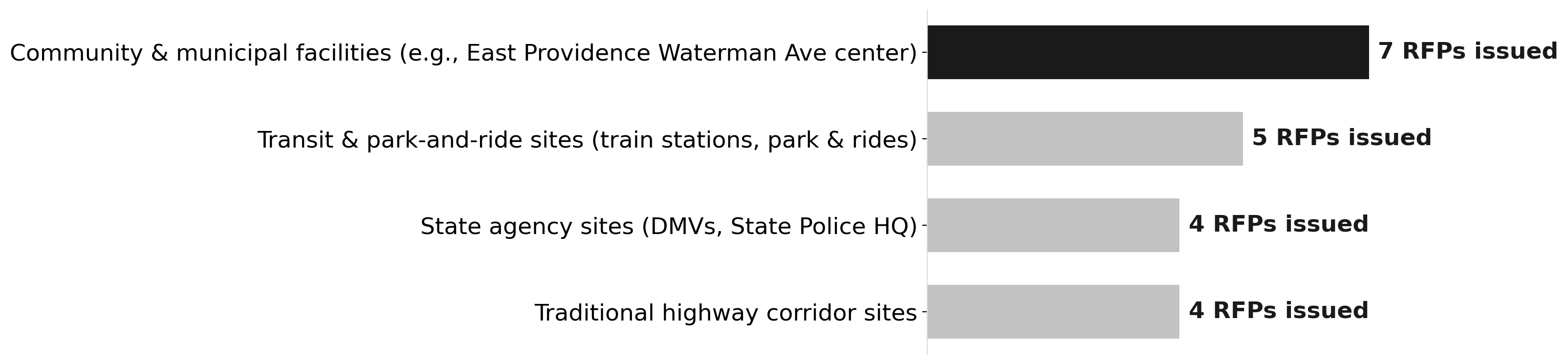
The clearest illustration of the geographic shift is a current East Providence solicitation, RFP EP26/27-01, seeking vendors to install six dual-port Level 2 charging stations at a new community center at 610 Waterman Ave. The site is not a highway rest stop or a transit hub. It is a neighborhood recreation facility. That siting choice is not incidental: Phase 2A was specifically designed to flex NEVI dollars off the interstate corridor and into publicly accessible community locations, opening eligibility to municipalities, nonprofits, and private entities that had no role in Phase 1.
Source: NationGraph.
Phase 1 was itself a milestone. Rhode Island became the first state in the country to complete NEVI Phase 1 in summer 2024, installing fast chargers along I-95 at Ashaway and the Warwick Park & Ride. The state's structural advantage was straightforward: its single Alternative Fuel Corridor is short. A single I-95 corridor that takes minutes to traverse end-to-end is easier to build out than a multi-corridor network spanning hundreds of miles. That same smallness is now compressing the Phase 2A rollout, making the shift visible faster than it would be in a larger state.
The path to this moment was not smooth. Federal executive orders in January and February 2025 froze NEVI funding nationwide, pausing Rhode Island's Phase 2A application process before it opened. A federal court issued a preliminary injunction in July 2025 restoring the program, and OER reopened the statewide application portal that same month before closing it in August. FHWA approved Rhode Island's FY26 NEVI plan in September 2025. The April 2026 awards were the culmination of that stop-and-restart arc.
The state-agency procurement pipeline reflects the same timeline. The Rhode Island Division of Purchases issued solicitations between April and August 2026 for DC fast chargers at the Cranston and Wakefield DMVs, State Police headquarters in Scituate, the Pawtucket/Central Falls Train Station, and the Warwick Park & Ride. Taken together with the East Providence community center solicitation, the procurement record shows two parallel tracks: state agencies hardening their own facilities and municipalities bringing chargers to the places residents actually go.
For context, no neighboring New England state registered any EV charging RFP activity in the same 30-day window. Massachusetts, Connecticut, Maine, New Hampshire, Vermont, and Delaware each showed zero. That absence does not mean those states are behind on EV policy, but it does confirm that Rhode Island's current procurement spike reflects its own unusually advanced implementation timeline, not a regional surge.
As of mid-2024, Rhode Island had 284 Level 2 charging locations and 41 DC fast charging locations statewide. Phase 2A's 200-plus ports represent a meaningful percentage increase against that existing base, concentrated in communities that previously had little or no public charging access. OER Commissioner Chris Kearns has framed the program in terms of Rhode Island's Act on Climate obligations, though that law sets emissions targets rather than administering or funding EV infrastructure directly; the NEVI program is the funding and administrative engine.
Federal NEVI grants to Rhode Island DOT total roughly $9.7M committed through November 2028, with no outlays recorded yet, consistent with a state still in the installation phase following April awards. The open question now is sequencing: several municipalities could not complete Phase 2A proposals within the original 30-day solicitation window and remain in a pipeline for a potential second award round. Whether OER opens that round, and how quickly additional municipalities move from award to procurement, will determine whether the current spike in RFP activity is a one-time flush or the beginning of a sustained installation period.