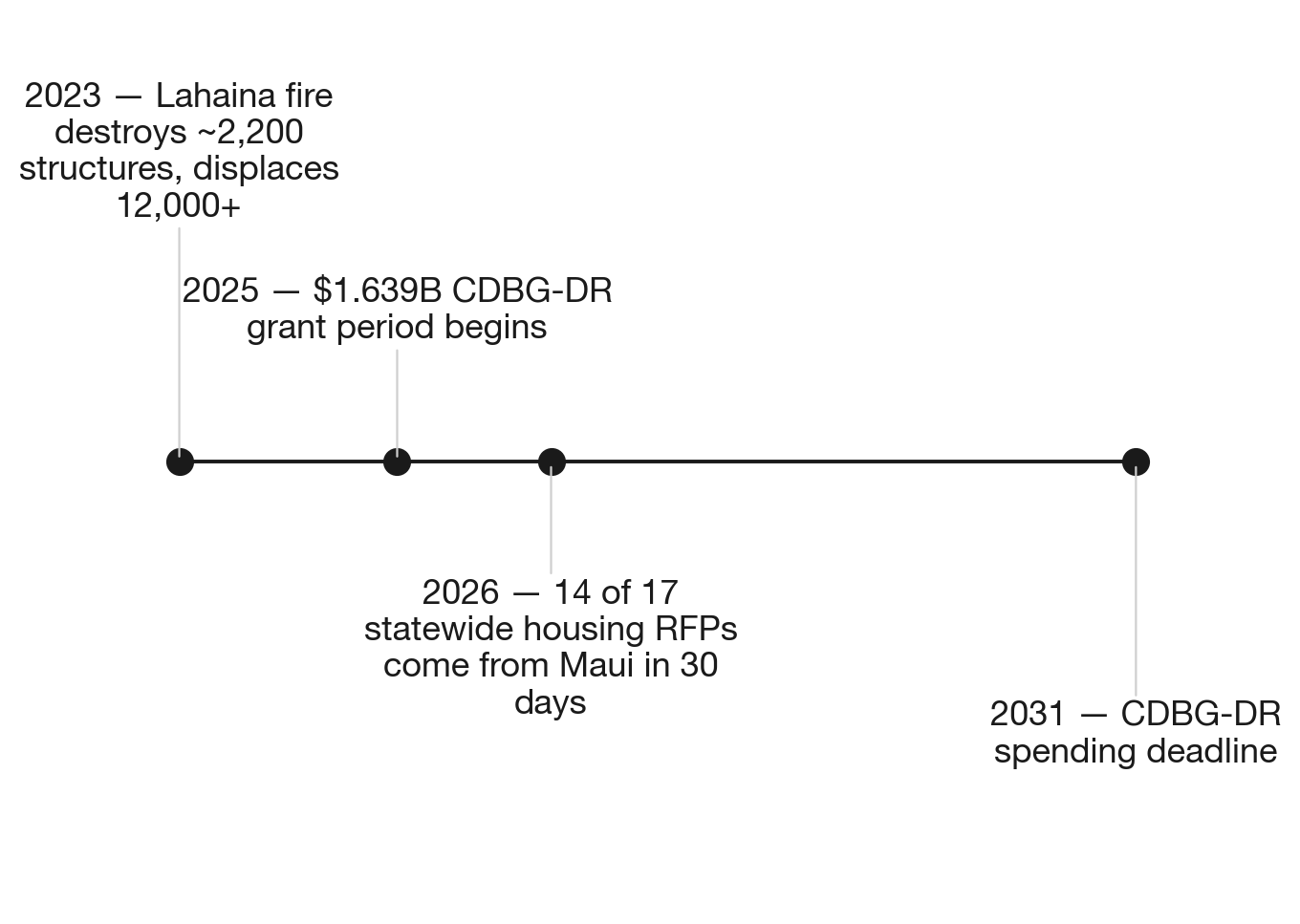
Hawaii's housing procurement volume has jumped to 17 RFPs in the last 30 days, against a 12-month average of roughly 6.8 per month, a 2.5x spike that is almost entirely the story of one county. Fourteen of those 17 solicitations originated from Maui County, whose procurement activity is now registering in state data for the first time as its disaster recovery machinery shifts into gear.
The trigger is a single document signed on June 20, 2025: a $1.639 billion CDBG-DR grant agreement between Maui County and HUD, the largest such allocation to any single local municipality in the program's history. Congress appropriated the money in December 2024. HUD approved the County's Action Plan on June 4, 2025. Housing program intake was targeted for mid-August 2025. What's showing up in the procurement data now is the downstream activation of that pipeline.
The dollars are real, the clock is running, and the question is whether a small county government built for routine administration can execute at a scale it has never attempted.
Source: NationGraph.
Maui County is simultaneously managing three overlapping crises: the largest disaster housing recovery in state history, a structural affordable housing shortage (median household income sits around $110,800, but housing costs rank among the highest in the nation), and the displacement of more than 12,000 wildfire survivors who lost homes in the August 2023 Lahaina fire. FEMA Temporary Housing Assistance, covering nearly 950 households, was extended through February 2027 after Governor Josh Green lobbied Homeland Security Secretary Kristi Noem directly. That extension bought time, but it also set a hard backstop: if permanent housing isn't delivered before that deadline, the displacement will harden into something more permanent.
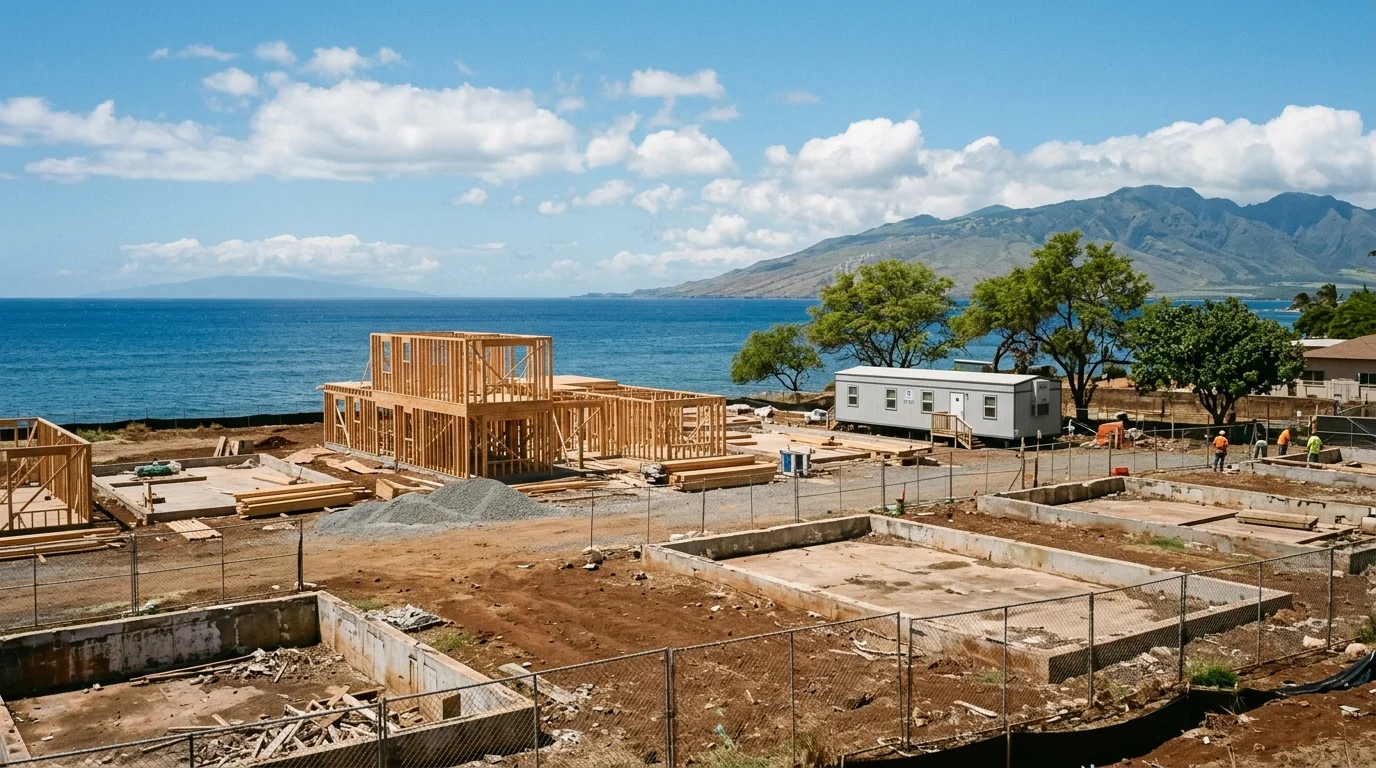
The county's Hoʻokumu Hou program offered the first concrete signal of scale in March 2026, conditionally selecting seven multifamily housing projects and 22 infrastructure projects targeting 519 affordable rental units in West Maui. Mayor Richard Bissen told the Hawaii State Legislature in January 2026 that over 500 affordable and workforce homes were completed in 2025, with more than 600 projected for 2026 and roughly 3,000 total by 2030. Of those, 427 units have been fully constructed in Lahaina itself since the fire. The numbers are moving, but the gap between what's been built and what's been promised is wide.
Running parallel to the CDBG-DR effort, the Department of Hawaiian Home Lands is administering two concurrent Native Hawaiian Housing Block Grant awards totaling $22.3 million across the 2025 and 2026 vintages. The county also carries an active Section 8 Housing Choice Voucher portfolio worth more than $10.5 million in the current window. Those programs don't solve the Lahaina problem, but they represent a separate track of statewide housing investment that will compete for some of the same contractors, permitting staff, and construction capacity.
That capacity constraint is the central tension in the recovery. The CDBG-DR spending window runs through May 2031, six years that sounds generous until you account for permitting timelines, environmental reviews, contractor availability on an island, and the administrative overhead of federal compliance at billion-dollar scale. Senator Brian Schatz, who chairs the relevant Appropriations subcommittee and has called CDBG-DR funds "a lifeline", has pushed publicly for speed. Speed, in federal grant administration, is not the default setting.
The RFP surge is an early indicator, not a delivery confirmation. Solicitations precede contracts. Contracts precede construction. Construction precedes occupancy. The families still in temporary housing need the last step, and the procurement data only reflects the first. What the spike does confirm is that the county's CDBG-DR programs have moved from planning to active market engagement, a transition that was not guaranteed and that, as recently as early 2025, was still being negotiated with HUD.
The next signal to watch is contract awards. If the volume of RFPs now entering the market converts into executed agreements by late 2025, the county will have demonstrated it can absorb federal dollars fast enough to meet the February 2027 FEMA deadline. If solicitations stall in evaluation or awards fragment across undercapitalized vendors, the gap between money available and housing delivered will widen, and more than 950 households will face a cliff with nowhere soft to land.