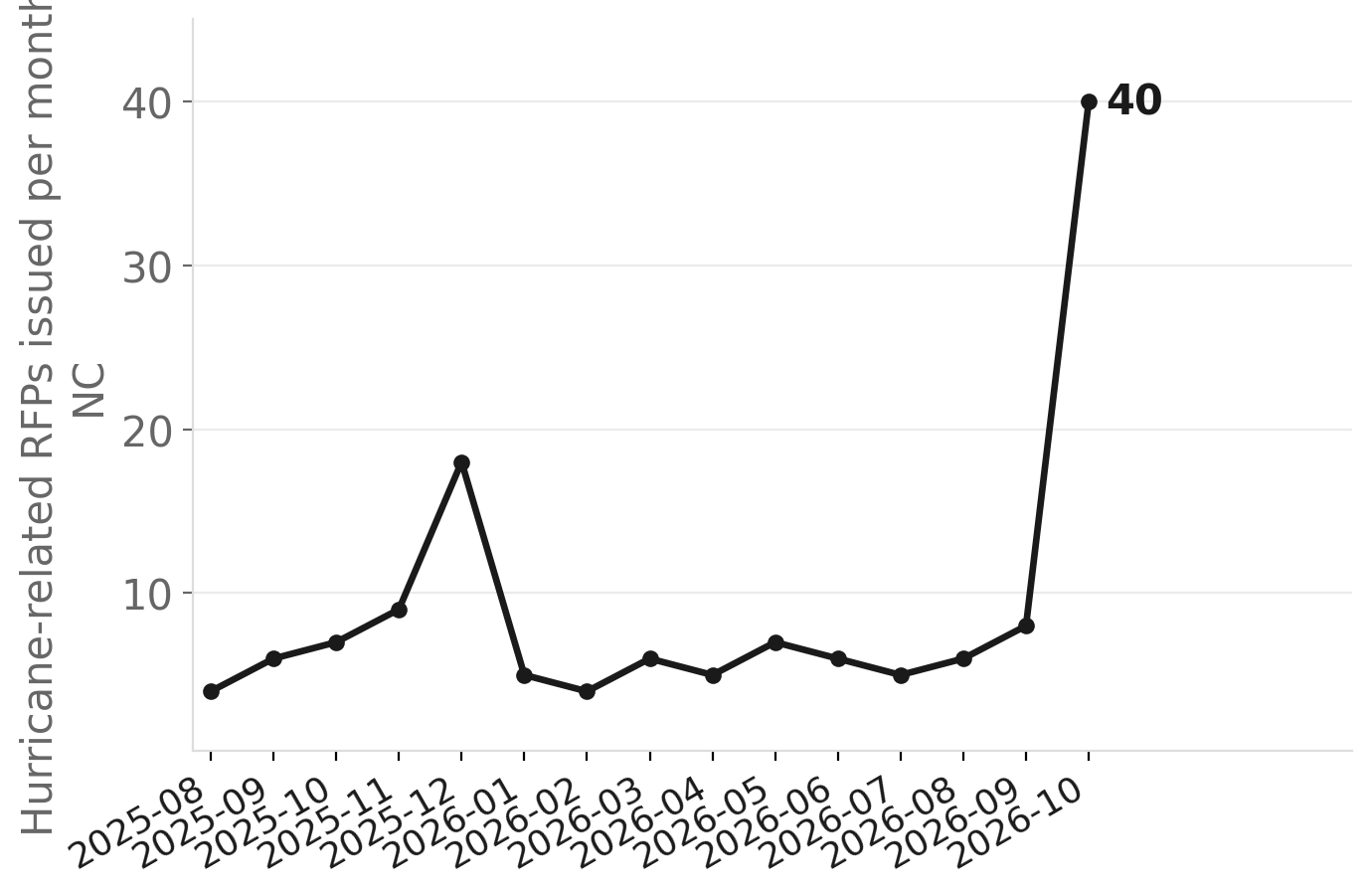
North Carolina issued 40 hurricane recovery RFPs in October 2026, against a 12-month monthly average of roughly 6.2. That 6.5x spike is not what a disaster recovery looks like when it is winding down. It is what one looks like when the federal reimbursement machinery finally shifts into gear.
Hurricane Helene made landfall on September 27, 2024. The storm killed 107 people in North Carolina, carved out bridges, contaminated water systems, and left mountain communities in Buncombe, McDowell, Avery, Watauga, and Rutherford counties without basic infrastructure. FEMA's estimated commitment to the state has since surpassed $7.5 billion across more than 3,000 approved projects. But as of October 2026, only $434 million of $3.21 billion in obligated federal grants has actually been outlayed. The gap between obligation and expenditure is the procurement pipeline, and right now it is wider than it has ever been.
The timing of this month's burst is not coincidental. On October 22, FEMA announced more than $101 million for 52 North Carolina projects, including $49.4 million to NC Emergency Management for debris removal. That announcement came days before October's RFP count surpassed every prior month in a 15-month series. The previous peak was 18 RFPs in December 2025. October 2026 more than doubled it.
Source: NationGraph.
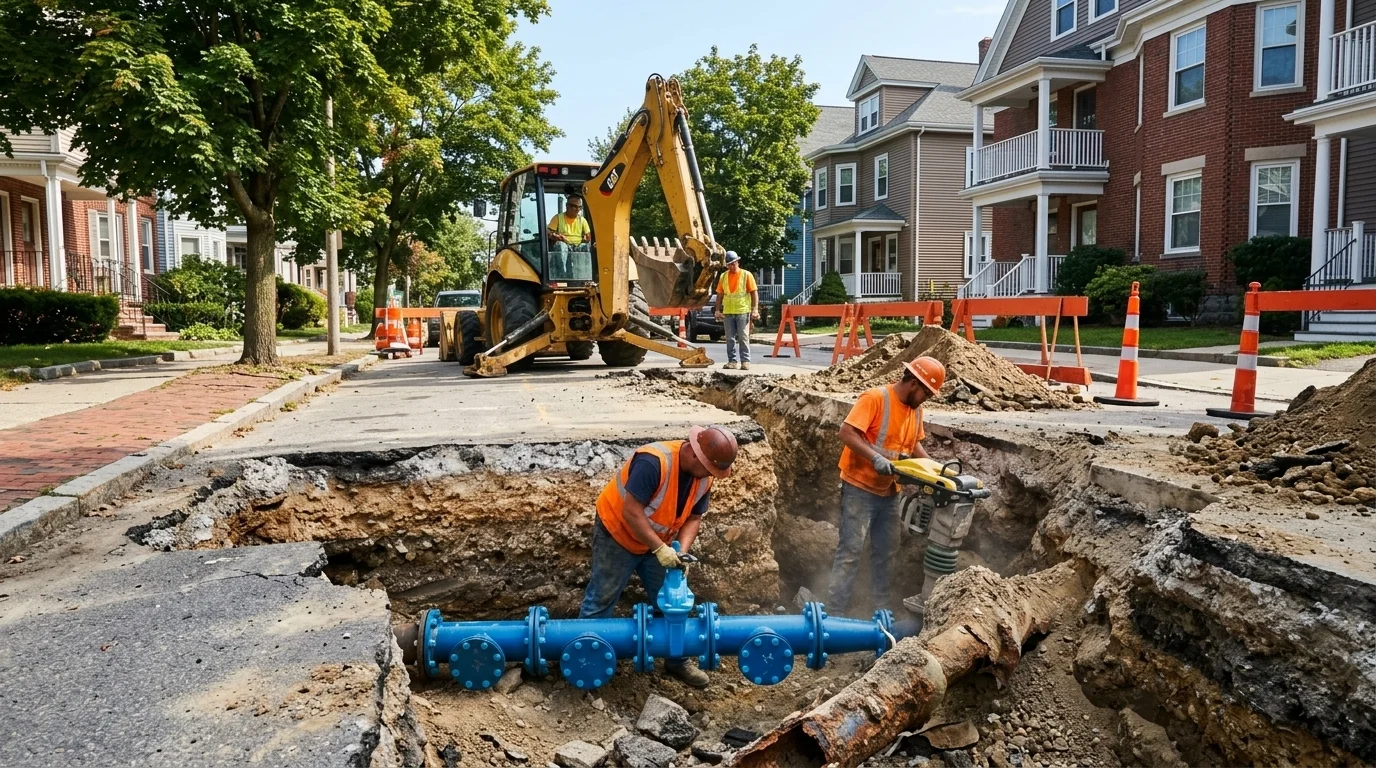
Five distinct federal programs are driving the procurement wave, and they work differently enough that collapsing them into a single story obscures what is actually happening on the ground. FEMA's Public Assistance program, which has obligated $2.48 billion for more than 3,100 Helene projects in NC at a 90% federal cost share, reimburses local governments after they complete approved work. That reimbursement structure means every bridge replacement, water line repair, or public building reconstruction has to go through a local competitive procurement before a dollar moves. FHWA's Emergency Relief program is funding road and bridge reconstruction through NCDOT, which appears among the top RFP issuers this month. EPA's supplemental State Revolving Funds, totaling $409 million for drinking water systems and $253 million for clean water infrastructure, are flowing through NC DEQ into local water and wastewater projects. A separate $61 million EPA hazardous waste grant, received by NC DEQ in 2025 and running through 2030, is funding brownfields cleanup, solid waste debris management, and underground storage tank repair across the affected region. FEMA's Hazard Mitigation Grant Program, operating at a 75% cost share, approved $48 million in September 2026 for roughly 135 property acquisitions in flood-prone areas.
The 90% cost-share designation on FEMA Public Assistance deserves particular attention as a behavioral driver. When Washington covers 90 cents of every dollar, local governments with limited fiscal capacity have strong incentive to submit every eligible project category, not just the most urgent ones. Western NC mountain counties are not flush with municipal budgets. The near-full federal backstop is what makes it financially rational to go to bid on parks restoration in Chimney Rock at the same time NCDOT is procuring bridge replacements and Asheville is tendering residential demolition and reconstruction contracts.
What this means for residents in the affected counties is a construction and remediation period that will extend well past 2026. At the two-year mark, NC DPS reported that FEMA Public Assistance alone had obligated $2.48 billion for more than 3,100 projects. With only 13.5% of obligated funds outlayed, the bulk of the physical work has not started. For communities that have been living with damaged roads, compromised water systems, and flood-scarred parks for two years, that means contractors and construction activity are coming, but so is a multi-year disruption of a different kind.
The broader scale of unfinished business keeps this pipeline open for years ahead. North Carolina has requested federal support covering roughly half of an estimated $60 billion in total Helene damage. Federal approvals, while large in absolute terms, remain a fraction of assessed need, which means additional approval tranches and corresponding procurement cycles are probable. Each new FEMA or EPA obligation triggers its own round of local RFPs, environmental review, and contract award.
The signal to watch next is whether the November and December 2026 RFP counts sustain October's pace or pull back as local procurement offices absorb the current load. Western NC counties have limited administrative capacity. If October's 40 RFPs reflect genuine execution velocity, the physical recovery will accelerate visibly in 2027. If procurement offices hit capacity constraints, the approval-to-outlay gap will widen further, extending a pipeline that is already two years deep.