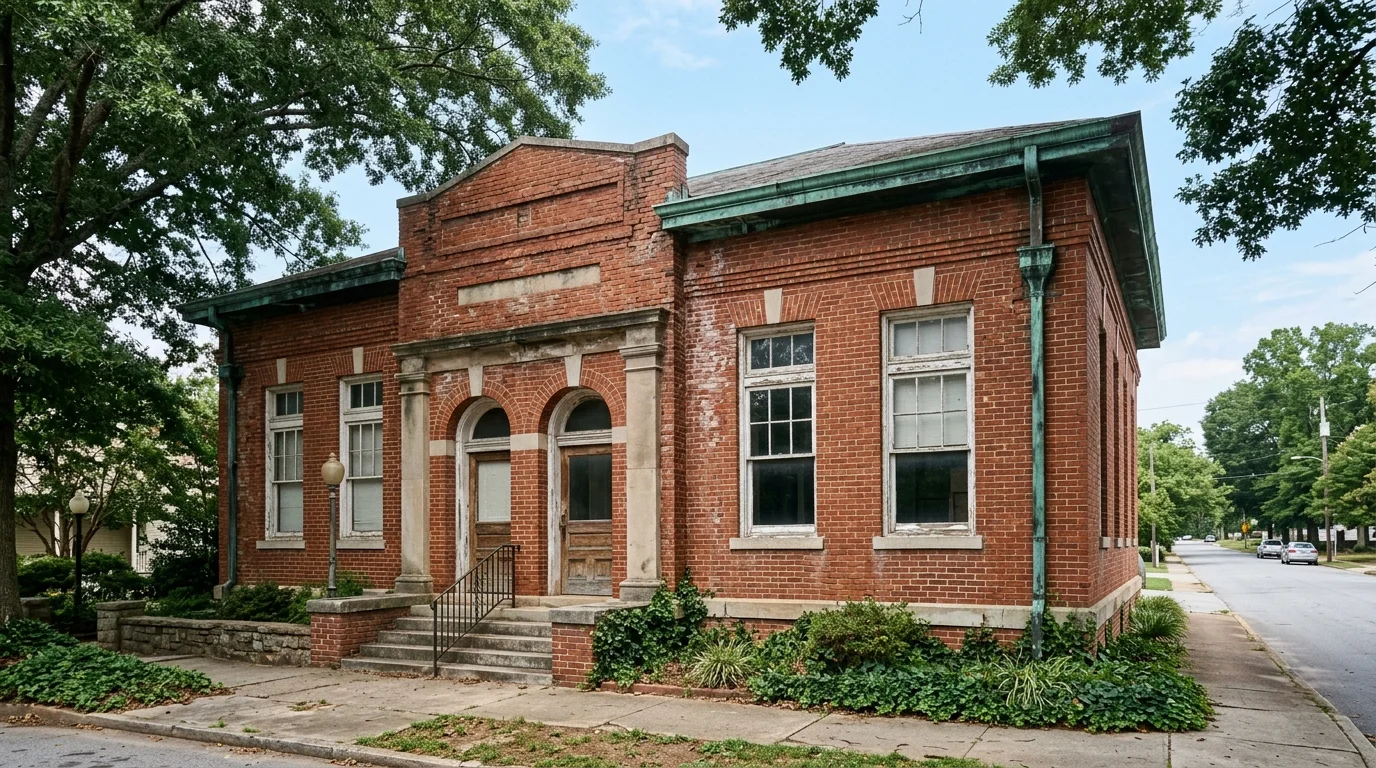
Pelham, Ga., is moving to restore a piece of American civic history at 200 Hand Avenue West: a two-story brick library built in 1908 with money from Andrew Carnegie, now 117 years old and badly in need of repair.
The project is one of the most significant capital investments the small Mitchell County city has undertaken in years. Pelham has roughly 3,500 residents and sits in one of Georgia's poorest regions, where poverty rates have persistently exceeded 20 percent. Mayor James Eubanks is personally serving as the city's representative on the project.
A century of use has taken a toll. Water intrusion over decades damaged the historic plaster walls and wood structure. A mid-20th-century renovation left behind approximately 2,000 square feet of 9-inch asbestos floor tile and mastic adhesive that must be professionally removed before restoration work can begin. The building's mechanical systems are due for a full replacement.
The rehabilitation plan aims to bring the library back without erasing what makes it worth saving. Workers will restore the original wood windows, main entrance doors, plaster walls, wood trim, flooring, tongue-and-groove wood ceilings and staircases. Outside, crews will repoint and clean the brick, repair the roof, and restore the original copper gutters, fascia and soffits. All work must meet the Secretary of the Interior's Standards for Historic Preservation, the federal framework that governs projects receiving preservation funding.
Carnegie funded 1,689 public libraries across the United States between 1883 and 1929, including 24 in Georgia. Of those 24, only about half still stand, and fewer still operate as libraries. Small towns across the country are now confronting a similar reckoning: these buildings are hitting the 100-to-120-year mark where deferred maintenance becomes existential, and local budgets rarely cover the cost of doing the work right.
The Southwest Georgia Regional Development Authority, a multi-county economic development body, is administering the construction bid, a structure that typically indicates state or federal pass-through funding is involved. The project is listed in public notices on the authority's website, where qualified contractors can access bid documents. The Thomasville, Ga.-based architecture firm Jinright, Ryan & Lynn designed the restoration.
No construction cost estimate or project timeline was included in the public bid notice.