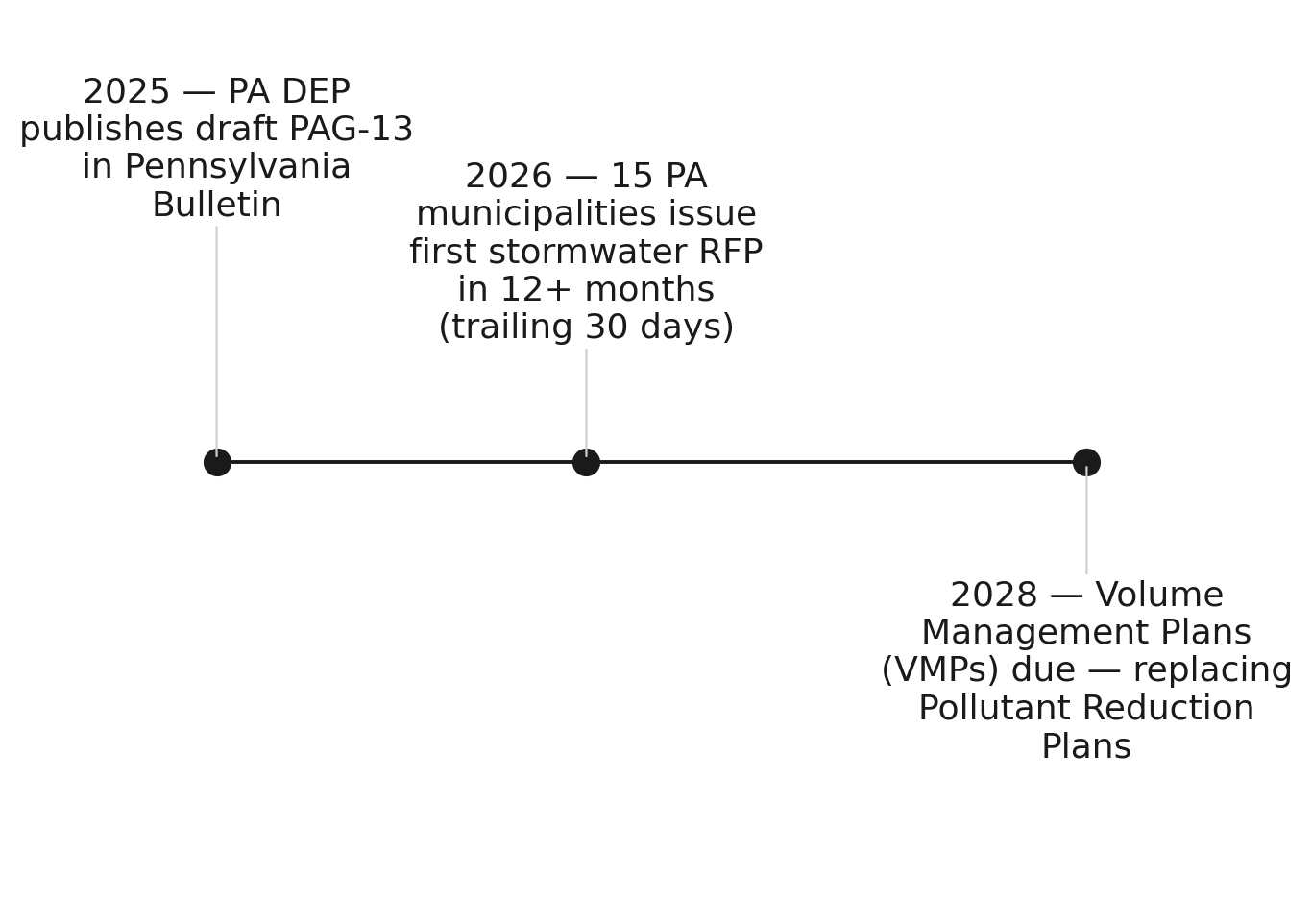
Shickshinny Borough, population 625, sitting in Luzerne County along the Susquehanna River, has just entered the stormwater contracting market for the first time in more than a year. So has Scalp Level, a Cambria County borough of 722 people. And a school district in Westmoreland County. And another in Delaware County. In the last 30 days, 15 Pennsylvania institutions issued stormwater RFPs after going dark for 12 or more months, a cohort of first-timers layered on top of the state's ordinary monthly procurement activity, which itself runs between 23 and 62 institutions in any given month.
This is not routine purchasing. When governments this small start writing contracts after a year of silence, a regulatory clock has run out.
The clock is PA DEP's reissuance of the PAG-13 NPDES General Permit for small Municipal Separate Storm Sewer Systems, announced in the January 18, 2025 Pennsylvania Bulletin. PAG-13 covers 493 small MS4s across the commonwealth, boroughs, townships, and municipalities whose stormwater systems drain to regulated waterways, and the reissuance is the first major overhaul since the 2018 permit took effect. The draft permit set a September 30, 2026 NOI deadline, with the new permit anticipated to become effective October 1, 2026. DEP has since signaled it will not finalize the permit on that schedule, but municipalities are not waiting for the revised date. The draft deadline created a de facto compliance sprint.
Source: NationGraph.
What makes this reissuance structurally different from previous renewals is what it replaces. Under the outgoing permit, municipalities managed compliance through Pollutant Reduction Plans, essentially pollution-accounting documents. The new permit scraps that framework and substitutes Volume Management Plans, due September 30, 2028, which require each MS4 to demonstrate physical reductions in stormwater runoff volume through best management practices (BMPs) already in the ground. The shift matters because you cannot earn BMP credits for infrastructure that doesn't exist yet. As Entech Engineering explains in its PAG-13 guidance, municipalities also have to run a new DEP-issued MEP Calculator before they can even file their Notice of Intent, a technical hurdle that requires knowing what BMPs they have, where, and at what capacity. Getting that baseline established means building things now.
The RFPs coming to market reflect exactly that logic. Named projects in the last 30 days include Ashwood Drive Stormwater Improvements, Crary Street Stormwater Improvements, Spring and Nice Streets Stormwater Project, Veil Road and Spring Street Stormwater Project, and a 2026 Stormwater Improvements package. Lancaster, at the larger end of the cohort with a population of nearly 57,000, issued an RFP for a Small Stormwater Project Permitting Guide Development, a compliance infrastructure document designed to accelerate the city's own project pipeline. The geographic spread covers at least 10 counties: Westmoreland, Luzerne, Schuylkill, Cambria, Allegheny, Bucks, Lancaster, York, Northampton, Montgomery, and Delaware. This is a statewide phenomenon, not a regional one.
The permit pressure compounds in at least one more direction. PennDOT's individual MS4 permit, which governs stormwater from state-owned road infrastructure, expires October 31, 2026, virtually simultaneous with the PAG-13 effective date. That parallel renewal creates additional procurement demand at the state level for road-related stormwater systems, tightening the engineering and contracting capacity available to small municipalities competing for the same consultants.
For boroughs with fewer than 1,000 residents and no dedicated environmental staff, the practical burden is significant. RETTEW, one of the engineering firms marketing PAG-13 compliance support statewide, notes that the new permit's volume-management framework requires municipalities to inventory existing BMPs, model future conditions, and identify capital projects, all before the 2028 VMP deadline, and ideally before the 2026 NOI. For Shickshinny or Bradfordwoods (Allegheny County, population 1,130), that sequence means hiring outside engineering help, identifying fundable projects, and getting construction contracts awarded within a window measured in months.
Financing is available. PENNVEST, Pennsylvania's state infrastructure bank, currently holds active EPA Clean Water State Revolving Fund awards exceeding $160 million, plus a $3.18 million EPA Sewer Overflow and Stormwater Reuse Municipal Grant active through September 2028, federal funds that municipalities can draw on as low-interest loans or direct grants for exactly this category of capital work. But it is critical to be precise here: PENNVEST financing is not what is driving the RFP wave. The PAG-13 regulatory mandate is the driver. The federal funds are a financing option for municipalities trying to meet a compliance deadline they cannot ignore.
Adding a further federal layer, Pennsylvania MS4s discharging to Chesapeake Bay tributaries carry wasteload allocations under the Bay TMDL that the new permit will embed more explicitly. For municipalities in the Susquehanna and Potomac drainage basins, which includes much of central and south-central Pennsylvania, the volume-management requirements carry Bay restoration obligations on top of local compliance ones.
The September 30, 2026 NOI deadline may shift, but the VMP deadline of September 30, 2028 will not move with it. The gap between filing an NOI and demonstrating a functioning BMP inventory is where municipalities have to spend money. The next signal to watch: whether procurement volume accelerates further as DEP publishes its revised final permit date, potentially drawing in the remaining MS4s that have not yet re-entered the market.