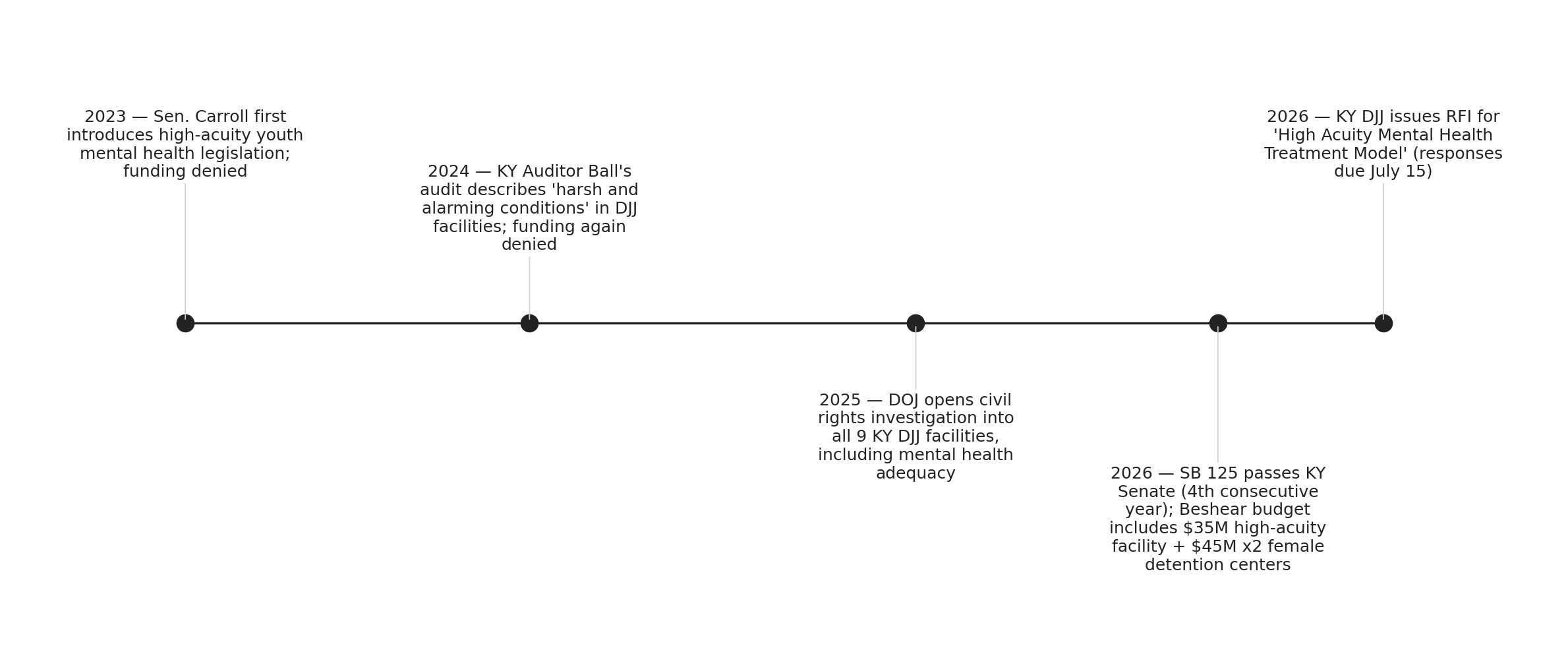
Kentucky's Department of Juvenile Justice issued a formal request for information on a "High Acuity Mental Health Treatment Model" on June 24, 2026, with responses due July 15, a procurement signal that would have been unremarkable except for what preceded it: three consecutive legislative sessions in which the General Assembly refused to fund exactly this kind of facility, and a federal civil rights investigation that changed the political math almost overnight.
The investigation is the load-bearing fact here. The U.S. Department of Justice opened a civil rights inquiry into all nine Kentucky DJJ facilities in February 2025, examining conditions under the Civil Rights of Institutionalized Persons Act. The scope covered excessive force, the use of isolation, and, critically, whether the state provides adequate mental health services to incarcerated youth. A statewide finding of systemic violations carries the possibility of a federal consent decree, which would transfer meaningful operational control of the DJJ to a court-appointed monitor for years.
That prospect clarified things. Governor Andy Beshear's FY2026-27 budget proposal included $35 million for a dedicated high-acuity mental health facility and $45 million each for two female-only detention centers, requests that predecessors had made and the legislature had denied for three straight cycles. Sen. Danny Carroll, a Republican from Paducah who has carried juvenile justice reform legislation for four consecutive sessions, was direct with colleagues in February 2026. "I really don't think it'll be another year," he told a Senate committee, referring to the DOJ's expected timeline. Senate Bill 125, his 2026 measure, passed the Kentucky Senate and creates a formal legal structure for "high acuity youth" evaluation and treatment, authorizes a new residential mental health facility, and sets enhanced hospital reimbursement rates for facilities that accept DJJ youth.
Source: NationGraph.
That last provision matters because private psychiatric hospitals have essentially opted out of this population. DJJ documented one case in which staff attempted to place a single youth in nine different private facilities, all nine refused admission, citing the youth's violent and high-acuity behavior. The DJJ is legally obligated to accept any court-ordered youth regardless of severity. Private hospitals are not. The result is a system that absorbs the most complex juvenile psychiatric cases in the state with almost no dedicated clinical infrastructure, relying instead on correctional staff and contracted mental health coordinators.
Kentucky's geography compounds the problem. The state ranks among the most rural in the country, with more than 41 percent of residents in rural areas and documented gaps in behavioral health access across much of Eastern and Appalachian Kentucky. The federal grant portfolio the state has assembled reflects that reality: the Kentucky Cabinet for Health Services holds a $75.4 million Opioid State Targeted Response grant active through September 2027, a $13 million Community Mental Health Block Grant, a $9 million HHS grant for children with serious emotional disturbances, and a $212.9 million Rural Health Transformation Program grant awarded in December 2025 that explicitly addresses mental health care gaps in rural communities.
Those grants represent the broader behavioral health infrastructure the state is building. The DJJ's June RFI sits at the acute end of that spectrum, the youth who have fallen through every other system and landed in a secure facility that was not designed to treat them.
The conditions inside those facilities had already drawn scrutiny before the DOJ arrived. Republican State Auditor Allison Ball released a 2024 audit describing "harsh and alarming conditions" in DJJ facilities, a finding that cut across party lines and gave Carroll's legislation bipartisan credibility. The DJJ has since increased frontline correctional officers by 63 percent and, for the first time, placed a mental health treatment director in every facility, changes that represent meaningful operational shifts but fall short of the clinical infrastructure the RFI is now seeking to procure.
The July 15 deadline for RFI responses is a procurement step, not a construction groundbreaking. What comes next is a formal RFP, a contract award, a siting process, and a capital build that could take years. The DOJ investigation, by contrast, operates on its own timeline, and Carroll's warning suggests the state has little room to treat this as routine procurement. If the legislature funds the facility in the final budget and the DOJ sees credible forward motion, a negotiated resolution is more likely than a consent decree. If the capital appropriation stalls or the RFP process drags, that calculus shifts.
The next signal to watch is whether SB 125's facility authorization survives conference and reaches the governor's desk with its funding intact, and whether the DOJ signals, publicly or through negotiation, that Kentucky's pace of action is sufficient.