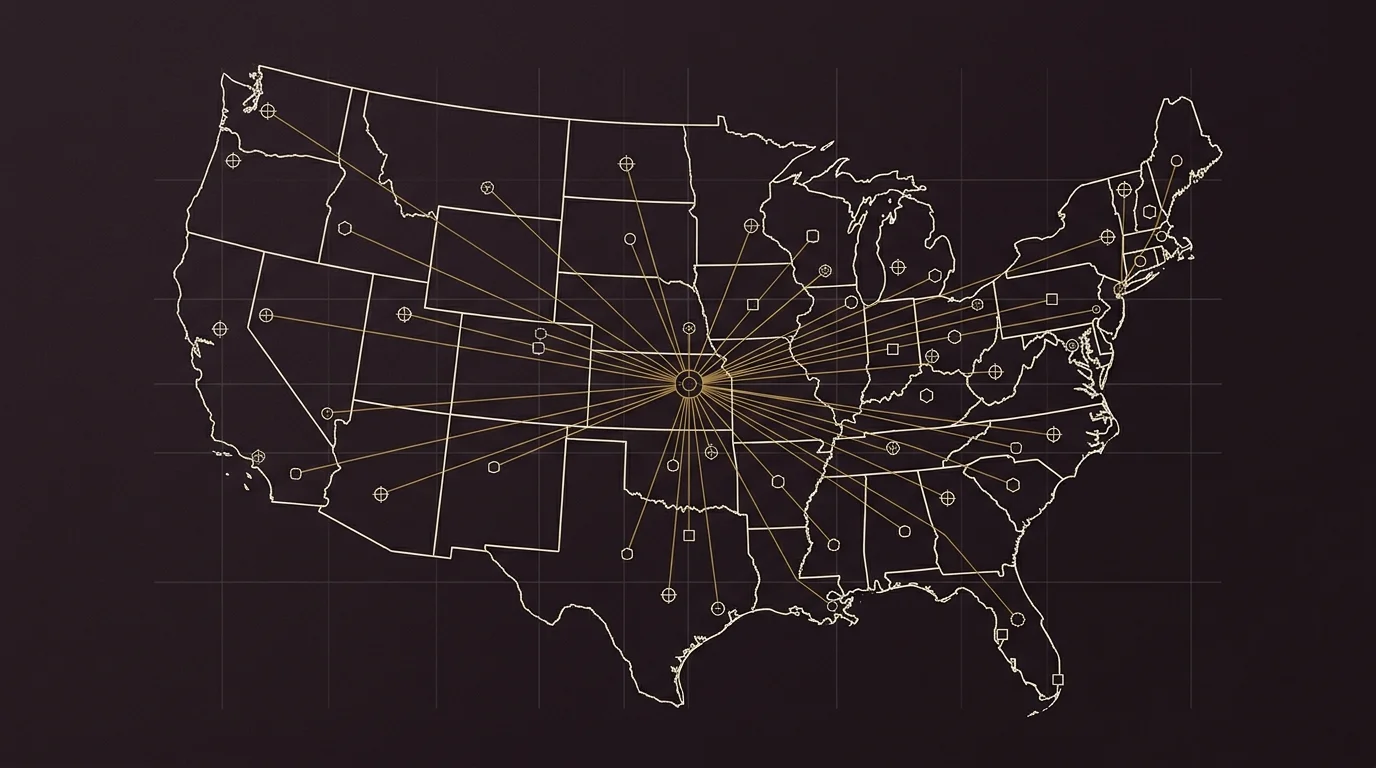
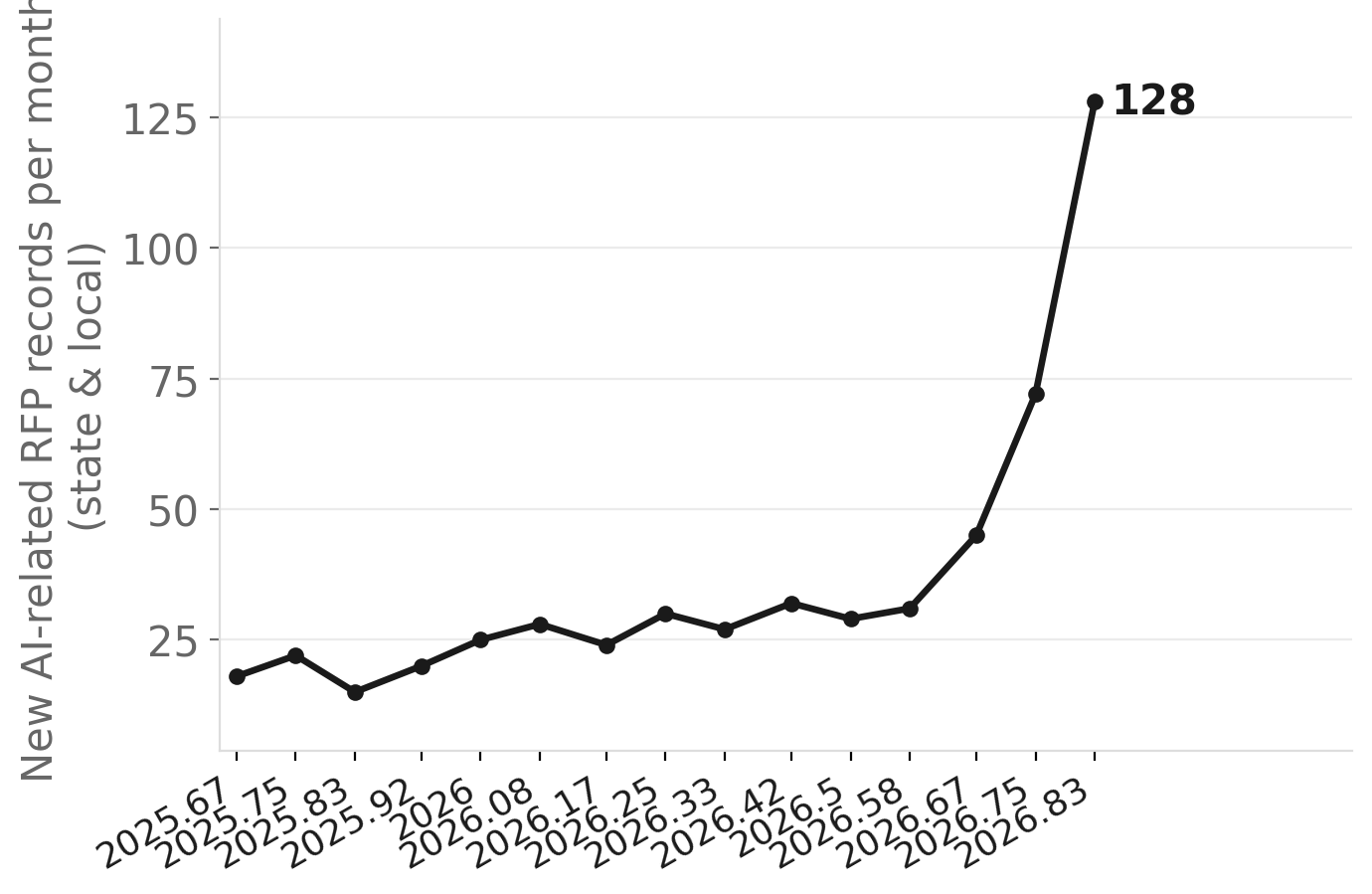
State and local governments issued AI-related RFPs through 85 unique institutions across 15 states in just the last 60 days, roughly 3.2 times the prior 12-month bimonthly average of 27. The single sharpest week on record: October 19, 2026, when 118 institutions across 39 states posted 132 distinct AI procurement titles in seven days. This is not a story about a federal spending program. No single grant is underwriting it. It is a story about a permission slip.
The structural shift traces to two federal instruments that most procurement officers would not typically read. Trump's Executive Order 14365, signed December 11, 2025, directed the Justice Department to challenge state AI laws on preemption and interstate commerce grounds, and signaled that federal discretionary grants could be conditioned on states avoiding "onerous" AI regulations. But the same order carved out one explicit exception: "state government procurement and use of AI." The White House's National AI Policy Framework, released March 20, 2026, extended that signal to Congress, recommending that any preemption legislation "not preempt requirements governing a state's own use of AI, whether through procurement or services." The message reached state procurement offices without a press release: this is the one AI lane the federal government will not contest.
The two largest state responses illustrate how differently that opening can be operationalized. California Governor Newsom signed EO N-5-26 on March 30, 2026, directing state agencies to build AI vendor certification and procurement standards expressly designed to operate within the federal carve-out. California now leads the national count with 15 institutions in the data window. South Carolina's surge, by contrast, is driven almost entirely by education. The SC Department of Education created a dedicated AI office on October 14, 2026, and SC Competes' Palmetto AI Corridor launched AI-Ready CTE Pathways implementation across 10 school districts in the same fall window. South Carolina, a mid-sized Southern state with no particular reputation as a technology procurement leader, ranks second nationally with 12 institutions. That anomaly is the clearest evidence that the carve-out's effect is structural, not a product of tech-sector proximity or budget size.
Source: NationGraph.
The sector diversity reinforces that point. AI procurements in the data span county sheriffs seeking weapons-detection and 911-dispatch tools, community college districts buying AI-integrated learning management systems, municipal water utilities piloting AI leak detection, and state judicial offices contracting AI probation-reporting platforms. Florida (8 institutions), Texas (8), New York (6), Maryland (5), and Colorado and Missouri (4 each) round out the top states. No single agency type or policy mandate is pulling this. The common denominator is the carve-out itself.
Federal AI grant activity is rising in parallel, but it is a distinct phenomenon and should not be confused with the procurement surge. August and September 2026 each saw 346 to 513 new federal AI grants per month, totaling more than $600 million obligated across 54 states and territories, up from 25 to 80 grants per month through most of the year. That surge reflects federal agencies pushing AI deployments through their own grant channels. The RFP wave is state and local governments buying AI with their own appropriations and local levies, not federal pass-through dollars.
Colorado adds a wrinkle. The state repealed and replaced its landmark AI Act through SB 26-189, signed May 14, 2026, pushing the compliance deadline to January 1, 2027 under a narrower transparency framework. Local procurement officers in Colorado are not waiting for that clock. Four Colorado institutions appear in the current data window, suggesting agencies are moving on AI contracts regardless of whether the state's regulatory framework has fully settled.
That dynamic, agencies procuring while the regulatory environment remains in flux, is the condition the carve-out created everywhere. State AI governance laws are being challenged, repealed, delayed, or revised in nearly every jurisdiction. But the federal signal on procurement is unambiguous: governments buying AI for their own operations are in protected territory. The result is that a school district in South Carolina, a water authority in Florida, and a transit agency in Colorado are all making multi-year AI vendor commitments in the same 60-day window, each acting on the same federal signal, each spending their own money, each outside any coordinated national program.
The next signal to watch is whether October's spike is a compressed release of demand that had been building since early 2026, or whether it marks the opening of a sustained procurement cycle. Agencies that posted RFPs in October will award contracts through early 2027. Those awards will arrive just as Colorado's new AI framework takes effect and as Congress continues weighing preemption legislation that could, in a future iteration, narrow the very carve-out that started all of this.