CALIFORNIA - Eight distinct requests for proposals for benefits third-party administrators have landed from California public entities in the last 30 days, against a monthly average of 5.0 over the prior year, a 60% step-up that is not explained by any new law or appropriation. The driver is more structural: a cohort of multi-year TPA contracts signed between 2021 and 2023 is hitting its expiration window at the same fiscal-year boundary, and the public sector is scrambling to replace them all at once.
The clearest single example is Los Angeles County. The county's Chief Executive Office issued a competitive solicitation for Workers' Compensation Claims Third-Party Administration Services with an October 7, 2026 deadline, covering a program that protects roughly 100,000 county workers and carried more than $427 million in annual program costs as of recent reporting. The contracts it is replacing expired June 30, 2026. The LA County Board of Supervisors authorized a sole-source bridge extension for the incumbent TPAs specifically to allow time to run a competitive process, secure board approval for new contracts, and complete any transition to a successor, the kind of administrative sequencing that only becomes necessary when a large, long-term contract reaches its hard stop without a ready replacement.
LA County is not an outlier. Marin County is running a parallel General Liability TPA search with a September 4, 2026 deadline. Alameda County has an active FSA and commuter benefits TPA solicitation open. San Leandro and Huntington Beach have separate workers' compensation administration RFPs in market. These are not connected programs or coordinated procurements, they share only the vintage of the contracts they are replacing.
Source: NationGraph
That vintage matters. California's self-insured public sector operates on a distinct procurement rhythm. The state's Office of Self-Insurance Plans requires TPA firms serving self-insured employers to hold active certificates renewed on an annual May cycle, which creates a predictable audit point for both administrators and the agencies that hire them. Public entities layer their own fiscal-year-end conventions on top of that: California local governments close their books on June 30, and multi-year service contracts, typically three to five years, are indexed to that date. A contract signed in fiscal year 2021–22 expires in fiscal year 2024–25 or 2025–26. Enough agencies signed enough contracts during the COVID-era administrative buildup that the expirations are now converging.
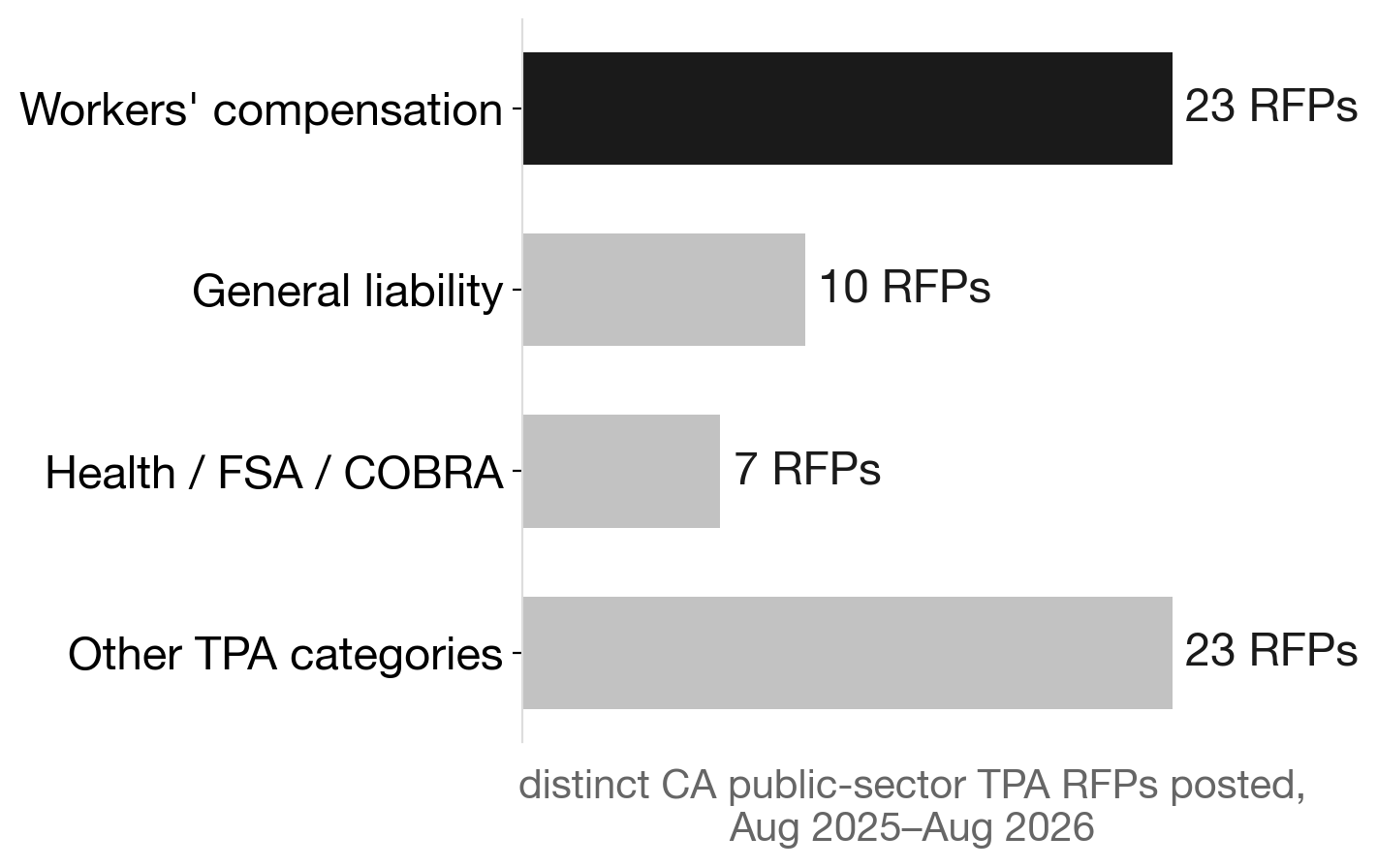
The current surge is actually the second wave. February and March 2026 produced the single heaviest raw posting volume in the trailing 13-month window, with 11 to 17 cross-posted RFPs in a single month. The August activity looks like a second crest from the same tide, agencies that did not complete renewals in the spring are closing out before the next fiscal year begins. Workers' compensation TPA solicitations are the dominant category across both waves, accounting for 23 of roughly 63 total California TPA postings over the period, with general liability and health and FSA administration as secondary categories.
The scale of what is being contested is worth stating plainly. California operates the largest workers' compensation self-insurance program in the nation. As of January 1, 2026, 7,049 active self-insured employers held certificates through the state's OSIP program, covering approximately one in eight California workers. Public entities, counties, transit agencies, water districts, community college districts, make up a disproportionate share of that population, and virtually all of them rely on contracted TPAs rather than in-house claims staff. When contracts turn over, the stakes for continuity of claims management are real: injured workers can be mid-treatment, open liabilities can span years, and institutional knowledge of complex cases does not transfer automatically.
CalPERS, operating at a different scale entirely, moved at the same time. The pension fund awarded a new five-year Long-Term Care TPA contract to Illumifin effective July 1, 2026, running through June 30, 2031. The CalPERS program is funded through its own revenues and shares no mechanism with county workers' comp or municipal general liability self-insurance. The programs are unrelated. What they share is a mid-2026 rollover date, further evidence that the current procurement wave reflects a broad contract-vintage effect rather than any single policy trigger.
For TPA firms, the practical consequence is a narrow window in which to respond to multiple large, complex solicitations simultaneously. LA County's October 7 deadline and Marin County's September 4 deadline are six weeks apart. Smaller firms without dedicated public-sector business development capacity may find it difficult to compete on both. For the agencies themselves, the risk is transition: the bridge extension LA County authorized is a symptom of what happens when a competitive process cannot be completed before the incumbent contract expires.
The next signals to watch are the award decisions. LA County's October deadline puts a new TPA contract on track for Board of Supervisors approval by early 2027 at the earliest. If the competitive process extends further, or if a sole-source bridge needs a second renewal, it would suggest the procurement wave is running longer than the fiscal calendar can absorb.