New Jersey municipalities issued seven water infrastructure RFPs in the past 30 days, 2.3 times the prior 12-month monthly average of roughly 3.1, and that seed count understates the surge. Across water infrastructure, lead service lines, drinking water, and wastewater keywords combined, the state posted 27 RFPs in October 2026 alone, with nearly two weeks left in the month, up from 2 to 15 per month through most of spring and summer. The burst spans six counties: Camden, Salem, Burlington, Somerset, Monmouth, and Morris. This is a statewide mobilization, not a regional project cluster.
Two deadlines are pressing at once, and they are independent of each other. The first is fiscal. The Infrastructure Investment and Jobs Act's water infrastructure authorization expired September 30, 2026. That expiration makes the current State Fiscal Year 2027 the last cycle at peak capitalization levels: the NJ Water Bank's SFY27 Drinking Water SRF Intended Use Plan projects a combined $276 million in federal grants, $110 million for the Clean Water State Revolving Fund and $166 million for the Drinking Water SRF, including a substantial lead service line replacement set-aside. The IIJA had quadrupled annual SRF capitalization nationally, from roughly $2.7 billion to $11.4 billion per year. Once SFY27 closes, that federal amplification ends and base-level capitalization resumes. Municipalities that miss the SFY27 project list will face the same replacement mandate on a thinner federal subsidy.
The second deadline is legal. New Jersey's Lead Service Line Replacement Law (P.L.2021, c.183), signed by Governor Phil Murphy in July 2021, requires every community water system in the state to identify and replace all lead and galvanized service lines by July 2031. As of December 2025, NJ DEP's lead service line notices show 115,121 known lead or galvanized lines still in the ground statewide, plus 688,378 lines of unknown material out of 2.4 million total reported. The majority of the replacement work remains ahead, and the clock is running. A municipality that has not yet engaged an engineering firm, completed its inventory, and queued a project for Water Bank financing is measurably behind schedule, regardless of what happens with federal funding.
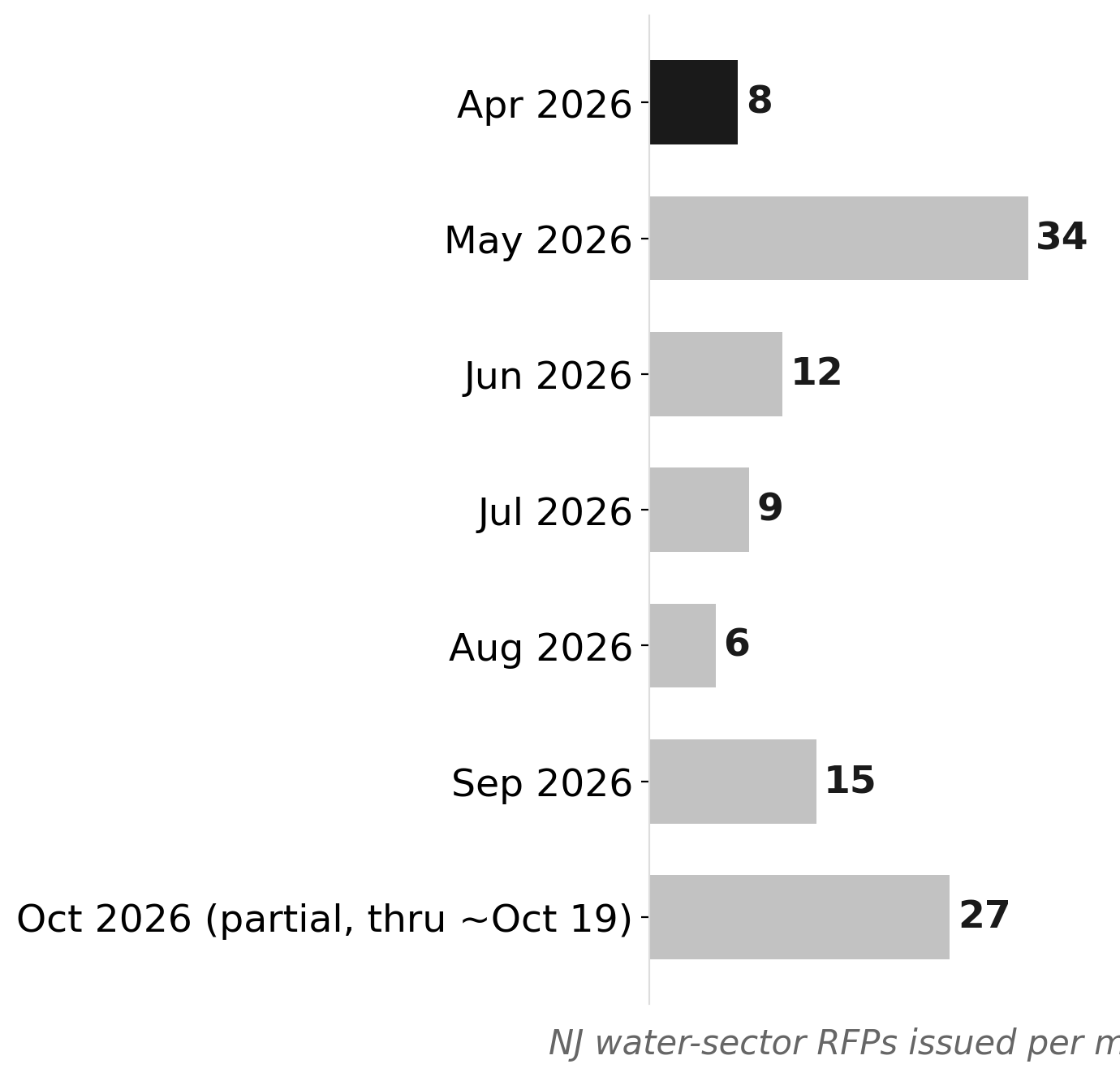
Source: NationGraph.
The NJ Water Bank, a partnership between the NJ Infrastructure Bank and NJDEP and the nation's oldest environmental revolving fund program, has been the primary financing vehicle for LSLR work. Two of the largest recent closings came in June 2026: Elizabeth City secured a $19.9 million loan with roughly 80 percent principal forgiveness for lead service line replacement, and East Orange closed a $19 million loan for the same purpose. Both deals illustrate what peak-capitalization SRF financing looks like in practice, soft loans that smaller utilities could not replicate through the municipal bond market. The pressure to get on the SFY27 list before that window closes explains a significant portion of October's procurement activity.
A parallel, and distinct, dynamic is generating its own cluster of RFPs from smaller municipalities. New Jersey's Water Infrastructure Protection Act (WIPA, N.J.S.A. 58:30-1, enacted 2015) allows municipalities to sell or long-term-lease water and wastewater assets to a private or regional operator without a voter referendum, provided NJDEP certifies that emergent conditions exist: infrastructure in serious disrepair, or a utility that lacks the financial capacity to fix it. Two of the seven seed RFPs in the trailing 30 days reflect WIPA activity directly: Quinton Township in Salem County is seeking a consulting engineer to evaluate its water system under WIPA, and Mendham Township in Morris County has reissued an RFQ to sell its wastewater utility. WIPA procurement is not connected to the LSLR mandate or IIJA financing; it is a separate legal pathway driven by fiscal stress and aging systems in communities too small to capitalize major repairs on their own.
For residents across these six counties, the immediate consequence is a wave of engineering procurement that will determine which projects get built at the most favorable financing terms the state has ever offered. Communities that complete inventory, engage consultants, and submit Water Bank applications in time for the SFY27 cycle can access low-interest loans with substantial principal forgiveness. Those that miss the window will still face the 2031 deadline, they will just face it with a smaller federal subsidy behind them.
The next signals to watch: NJDEP's finalization of the SFY27 DWSRF Intended Use Plan, which will set the project priority list; any federal action on post-IIJA SRF reauthorization, a question that remains open in Congress; and whether the October RFP surge translates into Water Bank applications by the submission deadline early in calendar year 2027. The 2031 mandate does not move. The financing window just got smaller.