Colorado water utilities have issued six PFAS-related procurement solicitations in the past 30 days, four times the state's monthly average of roughly 1.5, the highest volume of any Rocky Mountain or Plains state in the same window. The spike is not a coincidence. It is the sound of a procurement window closing.
The deadline driving it is April 1, 2027, when Colorado's Water Quality Control Commission requires all community water systems to complete initial PFAS monitoring under Regulation 11, the state rule adopted in August 2025 that incorporates the EPA's national 4-parts-per-trillion maximum contaminant level for PFOA and PFOS. Designing a treatment facility, issuing an early-procurement RFP, awarding a construction contract, and getting a plant operational all take time that utilities no longer have in abundance. For a utility that hasn't started the engineering phase, late 2026 is close to the last viable entry point.
The money to move is already in the state. The federal government has delivered two parallel grant streams to Colorado through distinct programs. The IIJA's Small and Underserved Communities Emerging Contaminants Grant Program put $41.8 million with the Colorado Department of Public Health and Environment beginning in April 2025, targeted at communities most in need of safe water infrastructure. In May 2026, the EPA announced an additional $44.3 million for Colorado's small and disadvantaged community water systems, part of a national investment exceeding $1 billion, according to KKTV's reporting on the announcement. The Colorado Water Resources and Power Development Authority carries roughly $57 million more in active EPA Drinking Water State Revolving Fund grants. The capital is not the constraint. Engineering capacity is.
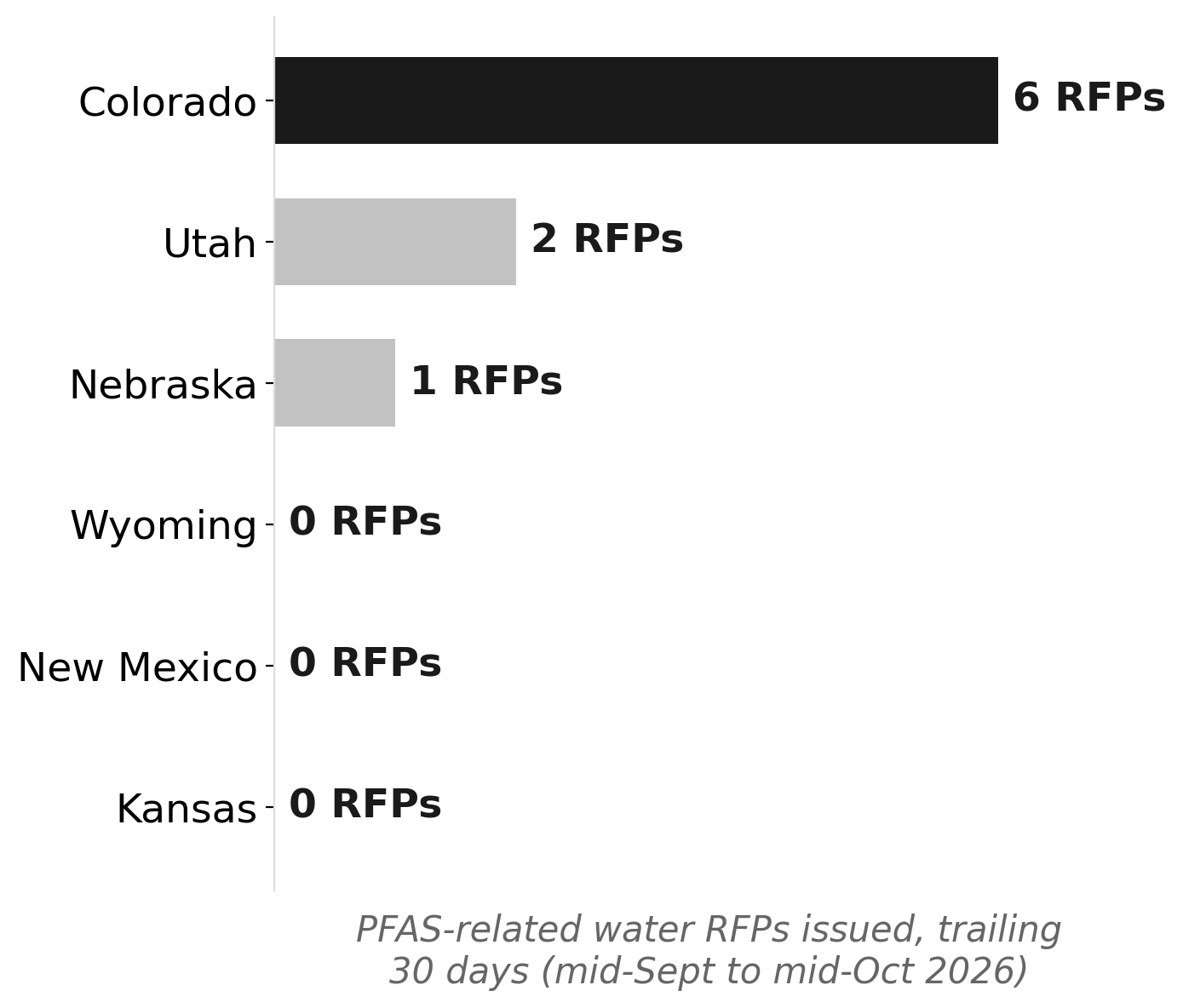
Source: NationGraph.
The clearest illustration of what moving fast looks like is Cherokee Metropolitan District in El Paso County, which serves about 29,600 people from groundwater sources near Colorado Springs. The district's tests detected PFOA at 8.7 parts per trillion, more than double the 4-ppt MCL. Cherokee issued an "Early Procurement" RFP for a full PFAS Water Treatment Facility and reached a Notice of Award with PCL Construction in June 2026, a timeline that CPR News documented as the district pushed aggressively toward its compliance obligations. General Manager Kevin Brown stated publicly that the district is "committed to maintaining that timeline" regardless of what happens at the federal level.
That federal-level caveat matters because the Trump EPA has simultaneously rolled back some Biden-era PFAS regulations and extended the full federal compliance deadline to 2031. For utilities in states that simply mirror federal rules, that extension offered breathing room. Colorado's utilities have no such option. CDPHE has stated that Regulation 11 will remain at least as stringent as the federal rule even if Washington weakens its own standard. The state clock does not reset.
In Weld County, the Town of Frederick has issued and updated its PFAS Remediation RFP at least four times in October 2026 alone, an unusual frequency that signals both the complexity of the project and the urgency behind it. Weld County's contamination profile is distinct from the military-base firefighting foam sources that drove early PFAS headlines in Colorado Springs. The county hosts roughly 22,000 oil and gas wells, and PFAS compounds used in fracking operations have entered groundwater across the Front Range. Colorado has approximately 21,000 industrial sites flagged as potentially handling PFAS, with Weld County representing a major concentration point. That diffuse, multi-source contamination geography means the remediation wave is not confined to a handful of base-adjacent utilities.
For residents of affected communities, the practical consequence of this procurement rush is that treatment infrastructure is being contracted now, not in 2029. That is the actual implementation timeline, regardless of any federal rollback. For smaller systems watching from the sidelines, the risk is different: if they wait for certainty before engaging engineering firms, those firms may be fully committed to larger projects before the end of 2026.
The next signal to watch is how CDPHE disburses the remaining IIJA grant funds to smaller and rural Front Range systems that lack Cherokee's institutional capacity to run a competitive construction procurement. The grant runs through March 2030, but the April 2027 monitoring deadline means that any utility hoping to have treatment in place at compliance, rather than scrambling to catch up after its first monitoring results, needs to be in contract by early 2027. Whether the state's grant disbursement pace matches that engineering calendar is the open question the next round of RFPs will answer.