Illinois municipalities issued 6 lead-pipe replacement RFPs in the last 30 days, nearly three times the 12-month monthly average of roughly 2.2 per month. The surge is not a coincidence. FY2026 is the final year of the Infrastructure Investment and Jobs Act's $3 billion annual supplemental for lead service line replacement through the federal Drinking Water State Revolving Fund, and municipalities that miss the window lose access to grants and principal-forgiveness loans, yet still face a hard regulatory deadline on the other side.
Three distinct legal instruments are compressing simultaneously. The IIJA DWSRF supplemental is a federal funding mechanism, channeled through the Illinois EPA to local water systems, that expires after FY2026 with no successor appropriation yet signaled. Illinois's own Lead Service Line Replacement and Notification Act (Public Act 102-0613, enacted 2021) is a separate state law mandating inventory and replacement timelines that predates the federal rule. And the EPA's Lead and Copper Rule Improvements, finalized in October 2024 and published in the Illinois Register on February 17, 2026, sets a compliance date of November 27, 2027, roughly 13 months from now. The IIJA funds the work; the LCRI and the state law mandate it on overlapping but distinct timelines. All three are bearing down on the same pipes at once.
The procurement activity is concentrated in mid-sized cities, not Chicago. Rockford, with a population of about 149,000 in Winnebago County, has issued five Phase 11 lead service line RFPs since September 20, including two updated bids posted on October 18 alone. Aurora, Kane County's 178,000-resident city, posted a new on-call replacement contract on October 18 covering 2027 and 2028, a forward contract that extends deliberately beyond the IIJA window. Skokie posted a 2026 water main improvement project in the same period. Active issuers now span at least seven counties: Cook, Kane, Winnebago, Sangamon, Du Page, Rock Island, and Peoria. This is a statewide procurement sprint, not a cluster around a single urban center.
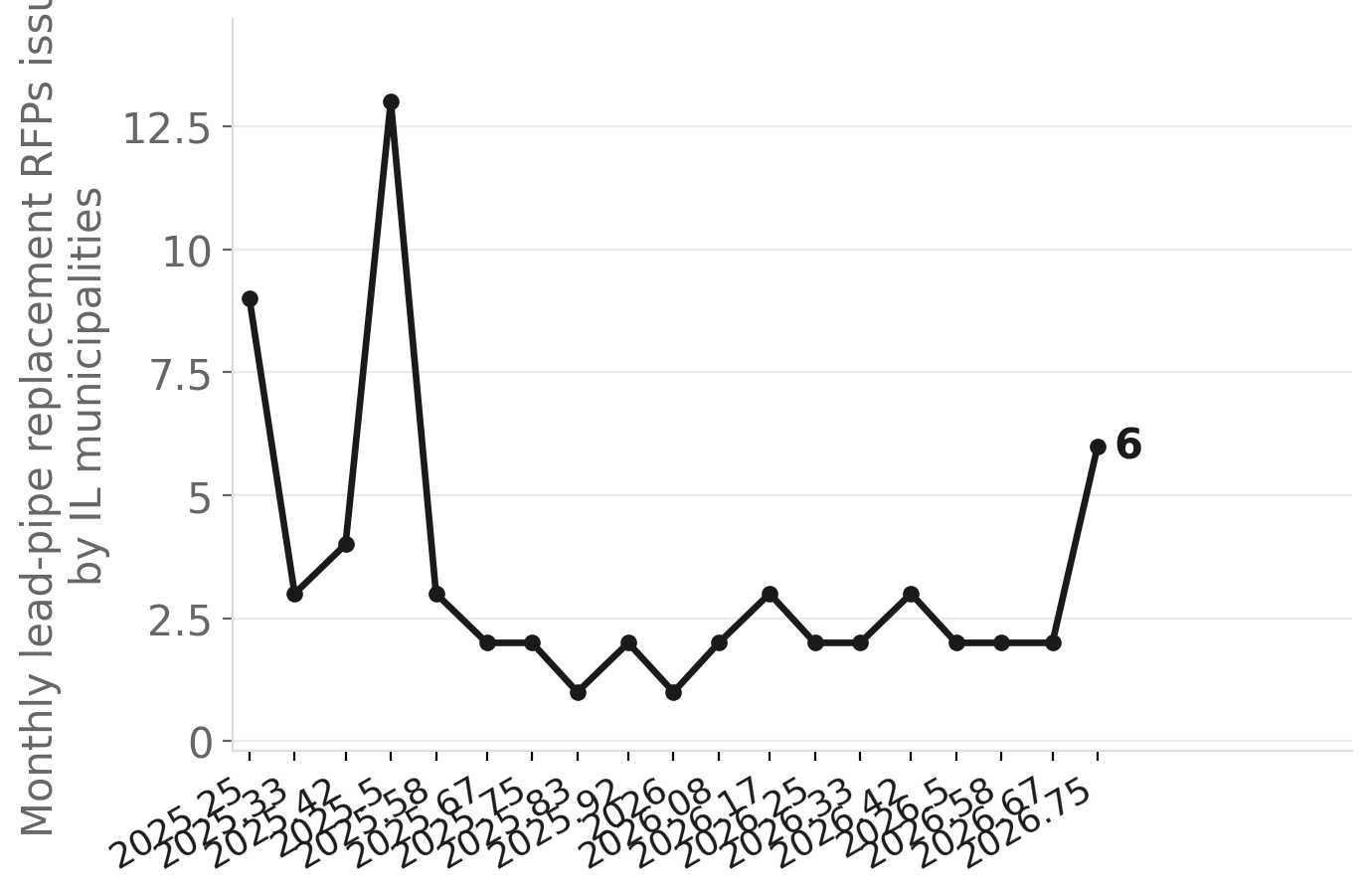
Source: NationGraph.
The Illinois EPA is intermediating more than $388 million in active DWSRF capitalization grants to local water systems, a combined $245.9 million, $75.6 million, and $33.5 million in tranches starting July 2025, with performance periods running through June 2029. As EPA announced, that capital underwrites the loans and grants flowing down to cities like Rockford and Aurora. Municipalities that lock in contracts now, while IEPA still has IIJA-sourced capital to deploy, can access financing terms, including principal forgiveness for disadvantaged communities, that will not be available once the federal supplemental closes.
The stakes are particularly high in Illinois. The state has an estimated one million lead service lines, more than any other state in the country. The Environmental Policy Innovation Center flagged in August 2026 that expiring IIJA funding, with no clear signal for future federal LSL appropriations, is forcing communities across the country to confront a funding cliff, and Illinois sits at the edge of that cliff with more exposure than anyone else.
Chicago represents the most acute version of the problem, but its trajectory is separate from the current RFP surge. The city submitted a replacement plan in April 2026 that targets completion by 2076, approximately 30 years behind the federal LCRI pace that requires roughly 20,000 replacements per year beginning in 2027. Chicago, with an estimated 412,000 lead service lines of its own, is effectively operating on a different timeline. The procurement activity visible in the RFP data is happening in the cities that are still trying to get ahead of the deadline, and trying to do it on federal dollars while federal dollars remain available.
A state bill, HB4763, that would have reformed SRF priority scoring to direct more funding toward high-lead-burden communities stalled in committee in 2026, leaving the existing formula intact. The Illinois Municipal League had separately asked Congress in October 2024 to exempt Illinois from the LCRI's 10-year replacement timeline, given the state's pre-existing 2021 law. That request was not granted.
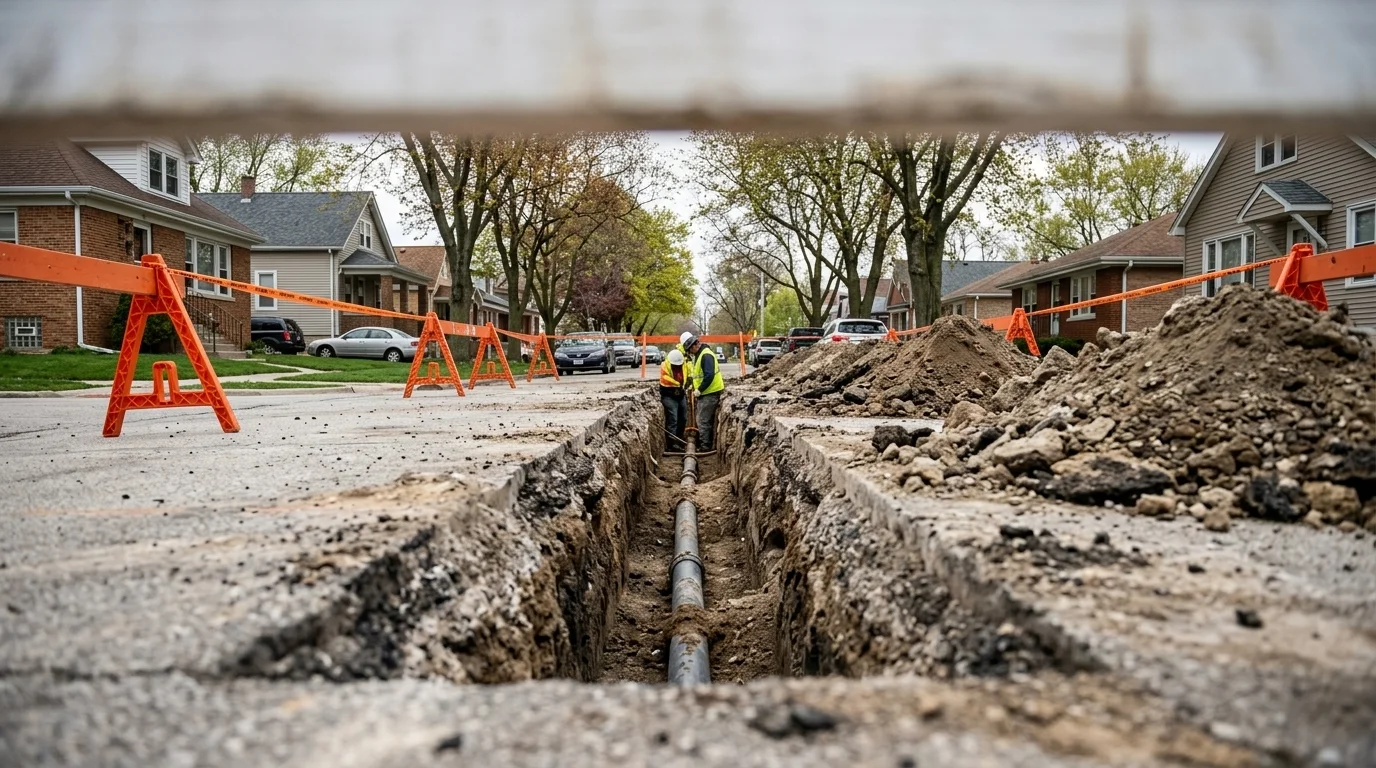
For residents in Rockford, Aurora, and the dozens of other Illinois communities actively procuring replacement contracts right now, the practical meaning is straightforward: crews will be in the street. For municipalities that have not yet moved, the calculus is narrowing. The next signal to watch is whether the Illinois EPA's DWSRF project priority list for FY2026, the final IIJA-funded cycle, closes with unallocated capital or a queue of applicants waiting on money that is no longer there.