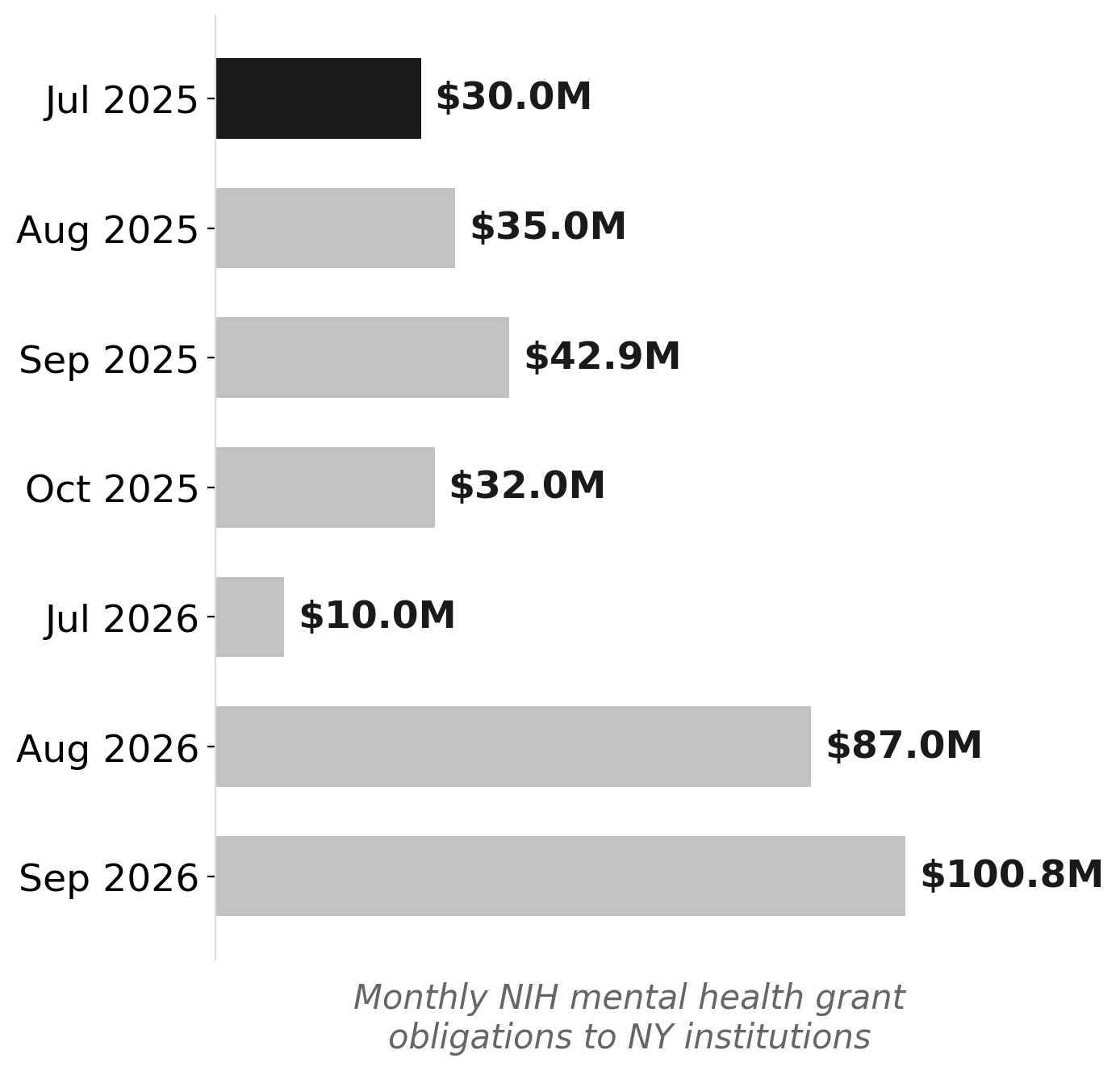
New York's research universities and medical schools collected $197.8 million in federal mental health-related grants in the past 90 days, up 83% from $107.9 million in the same window a year ago. The numbers look like a windfall. They are not. They are the fiscal residue of a broken year.
The surge is almost entirely concentrated in August ($87 million) and September ($100.8 million, through September 24), the final two months of the federal fiscal year. Both are the highest monthly totals in a two-year time series. The reason is mechanical: NIH faces a use-it-or-lose-it deadline of September 30, and it entered the home stretch of FY2026 with an extraordinary backlog. By late March, the agency had obligated only about 15% of its extramural research budget, awarding 63% fewer new grants than the historical average at that point in the fiscal year, according to the AAMC. NIMH alone was staring at a potential $500 million in unspent funds. By late July, NIH had still left $10.6 billion unobligated with two months remaining. NIH Director Jay Bhattacharya pledged the full $47.2 billion budget would be spent by September 30.
The backlog did not build itself. Trump administration directives froze grants touching DEI, LGBTQ+ health, and vaccine hesitancy topics early in FY2026. Mass terminations of previously approved awards followed. HHS restructuring left NIMH short-staffed and unable to process applications at normal volume. The result was a year-long compression: hundreds of scored, fundable grant applications sat in queues while the clock ran. The September surge is that queue releasing all at once.
Source: NationGraph.
New York is particularly well-positioned to absorb the rush. NYU led all state recipients with $48 million across 45 grants, followed by Icahn School of Medicine at Mount Sinai ($42.8 million, 48 grants), Weill Cornell ($35.6 million, 36 grants), and Columbia ($31 million, 47 grants). The University of Rochester added another $12 million. These institutions share a critical trait: they had large inventories of pre-scored applications ready to go, and administrative infrastructure capable of accepting large, multi-year lump-sum obligations quickly. NIH has leaned heavily on that lump-sum mechanism this year to move dollars fast, NYU alone received a single $128 million drug use and addiction grant in March structured as a multiyear upfront payment, a format that inflates dollar totals while reducing grant counts.
The state's legal posture also matters. New York Attorney General Letitia James led a 16-state coalition lawsuit against NIH's grant cancellations, explicitly naming disrupted research at New York institutions. That litigation created a judicial backstop that likely preserved some of the application pipeline that is now being funded. States without that legal cover may have seen more permanent attrition in their grant queues.
Nationally, New York ranks second in 90-day mental health grant volume, behind California ($273 million) and ahead of Texas ($125 million) and Ohio ($119 million). The concentration at the top of that list reflects the same dynamic: large research university systems with deep grant pipelines in dense metro areas absorb end-of-year obligations faster than distributed state systems.
The new money also lands on top of an already enormous base. New York currently carries 1,012 active mental health grants with $3.94 billion in total obligated value, of which $2.5 billion has already been outlayed. The 90-day surge adds to that portfolio, but it does so in a compressed, irregular way that the institutions themselves have to manage, multi-year lump sums require staffing, compliance, and project infrastructure that normal annual funding allows time to build.
For researchers at these institutions, the practical consequence is real but double-edged. Labs that survived the freeze period with stalled applications may now receive funding, but compressed timelines and lump-sum structures create their own administrative strain. For the federal mental health research enterprise more broadly, as Science reported, NIH is likely to award fewer total grants this year even as it spends the full budget, because lump-sum multiyear awards move more money per transaction.
The number to watch after September 30 is the FY2027 baseline. If NIH enters the next fiscal year with normalized staffing, cleared backlogs, and no new administrative freezes, the October-through-December grant flow to New York institutions should look unremarkable, and the absence of a surge will confirm that this one was a correction, not a trend. If the backlog rebuilds, the September 2027 cliff will arrive again.