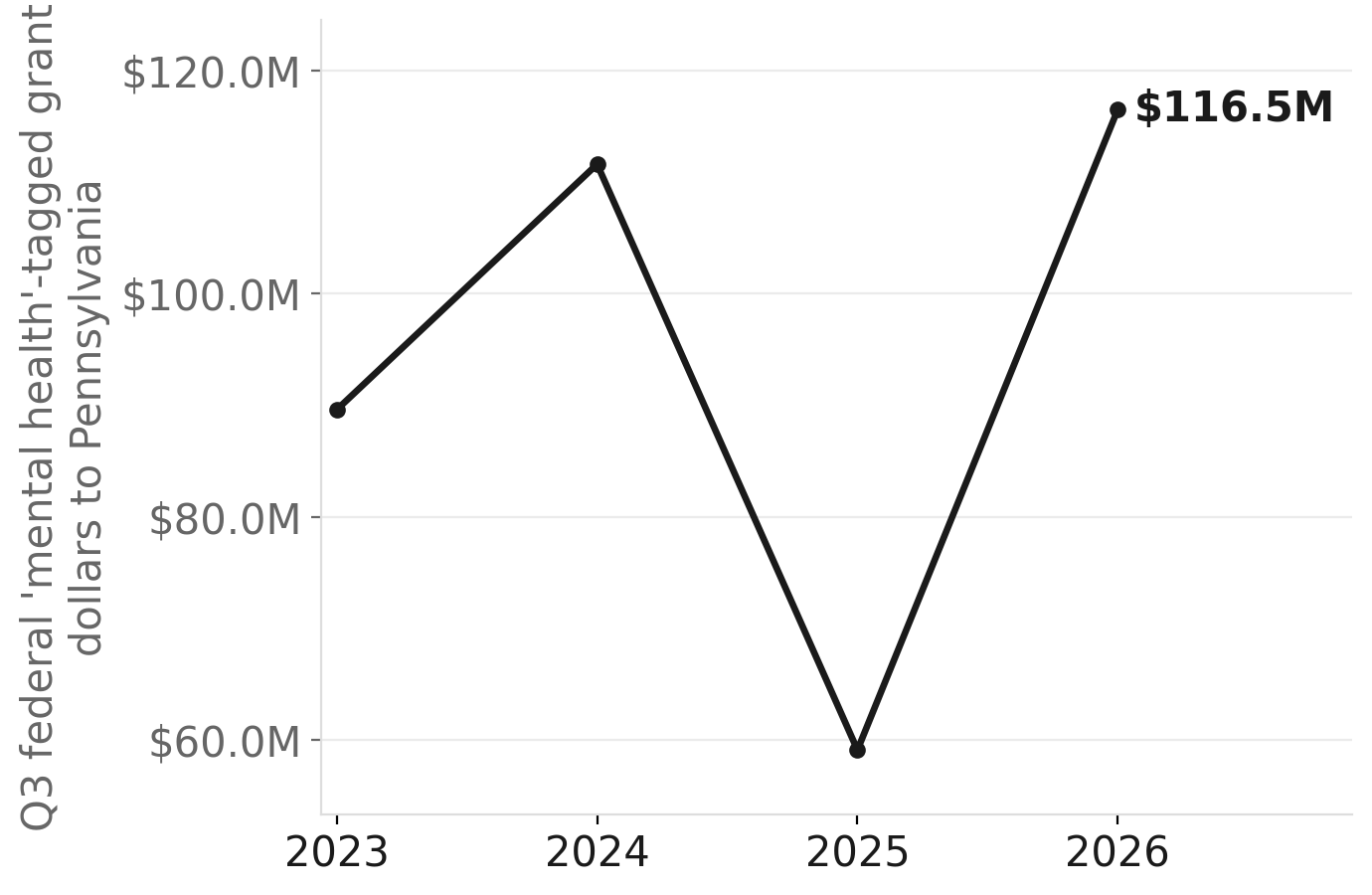
Pennsylvania pulled in $116.5 million in federal grants tagged to mental health in the trailing 90 days, nearly double the $59.1 million the state received in the same window last year. Behind that 97% jump are two entirely separate federal mechanisms arriving at the same moment: a record NIH grant wave clearing at fiscal year-end, and a large HUD homelessness-services renewal to Allegheny County. Understanding the surge means holding both in view without conflating them.
The larger force is the NIH calendar. The Consolidated Appropriations Act, 2026 (P.L. 119-75, signed February 3, 2026) rejected the Trump administration's proposed 40% cut to NIH's budget and preserved the agency's institutional structure, including indirect cost rate protections that had been frozen under a federal court injunction since April 2025. That resolution cleared roughly 18 months of institutional uncertainty that had slowed grant issuance across the country. The result: a compressed award calendar flushing through in a single fiscal-year-end rush. Q3 is already structurally the peak NIH quarter, and 2026's is the largest on record in this dataset: 118 awards this window, up from 81 in Q3 2024 and 56 in Q3 2023.
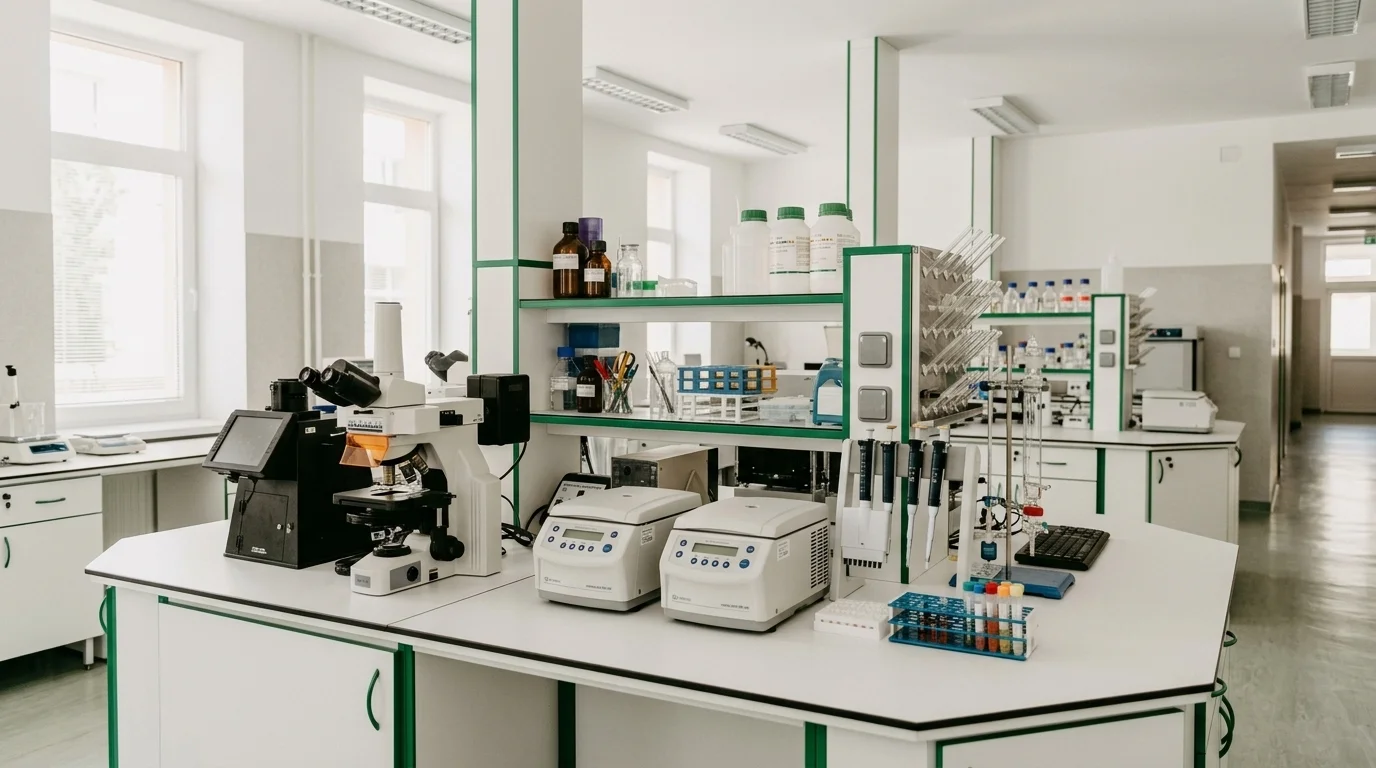
Pennsylvania is positioned to capture an outsize share of any NIH surge because it hosts two of the nation's top-five NIH-funded research universities. The University of Pennsylvania, ranked fifth nationally with $722.7 million in NIH funding in FY2025, collected $61.4 million across 77 mental-health-tagged grants in this 90-day window alone. Thomas Jefferson University added $10 million across 12 grants; Drexel University, $9.8 million across 14. Carnegie Mellon accounted for another $2.3 million. The University of Pittsburgh, ranked seventh nationally at $669.7 million in FY2025 NIH funding, carries $523 million in total active NIMH research obligations in Pennsylvania, a reserve that keeps producing new awards each quarter.
Source: NationGraph.
These are peer-reviewed, multi-year competitive research awards: R01s, R21s, R03s and similar mechanisms that fund basic, translational, and clinical mental health science at the bench and in clinical trials. They are not service dollars. A grant to Penn's neuroscience department for depression biomarker research and a grant to Jefferson for addiction pharmacology reach the state's balance sheet the same way, but they fund scientists, not patients.
The second mechanism is structurally unrelated. HUD's Continuum of Care program delivered $28.5 million to Allegheny County and Erie County in this window as FY2025 renewal awards, announced as part of $349 million in first-round CoC renewals HUD issued in March 2026. That $28.5 million, roughly 24% of the headline total, funds housing and wraparound services for people experiencing homelessness in the Pittsburgh region, a significant share of whom live with serious mental illness. It shares no statutory authority, no application mechanism, and no federal agency with the NIH cluster. Allegheny County's Department of Human Services operates as a HUD-designated Unified Funding Agency, a rare designation giving it unusual discretion over how CoC dollars flow to sub-grantees. The county is currently operating under a new five-year Strategic Improvement Plan (2026-2030) aimed at reducing chronic homelessness.
The NIH awards do not fund that work. The CoC renewal does not support that research. Both show up in a keyword search for "mental health" because both touch the population and the field, but a reader or policymaker tracking either program should treat them as distinct signals.
At the state level, SAMHSA block grants for community mental health services add roughly $72 million in total active obligations to Pennsylvania's Department of Human Services, funding state-administered outpatient and crisis services. Those dollars move on a different schedule and were not a primary driver of the 90-day jump.
What the combined figure does show is Pennsylvania's structural position in any federal mental health funding environment. The state ranks third nationally in this 90-day window, behind only New York ($197.8 million) and Ohio ($119.1 million), two states that similarly host dense clusters of major research universities and large urban CoC systems. When Congress acts to preserve NIH and HUD's grant calendars catch up, these states collect disproportionately.
The open question is whether Q3 2026 represents a new baseline or a one-time correction. HUD's FY2026 CoC competition, with its NOFO issued June 1, 2026, reduces protected renewal funds from roughly 90% to 60% of the pool, making more dollars competitive. Allegheny County's next renewal will face a tighter field. On the NIH side, Congress held NIMH's FY2026 budget near $2.3 billion, but the administration's appetite for restructuring has not disappeared. The research corridor between Philadelphia and Pittsburgh won the immediate fight. Whether the next appropriations cycle holds is the signal worth watching.