Federal mental health grants flowing into Utah have reached $10.18 million in the trailing 90 days, nearly double the $5.35 million committed in the same window a year ago. Every dollar of that increase came from one source: HHS and its Substance Abuse and Mental Health Services Administration, which went from $1.6 million to $10.9 million year-over-year. At the same time, HUD's $3.5 million mental health housing contribution from the prior cycle has fallen to zero, consolidating the entire federal funding relationship into a single pipeline.
The timing is not coincidental. SAMHSA's FY2026–2027 Combined Community Mental Health Services Block Grant and Substance Use Prevention, Treatment, and Recovery Services Block Grant cycle, applied for by Utah's Department of Health and Human Services in mid-2025, triggered new federal commitments that began landing in late 2025 and accelerated into 2026. According to SAMHSA's block grant application portal, states that filed coordinated behavioral health assessments with their applications were better positioned to draw from expanded allocation pools. Utah, which consolidated its fragmented health and human services agencies into a single DHHS in 2022, gave federal partners a more capable counterparty than it had in previous cycles.
The new awards sit on top of an already substantial active portfolio. Utah DHHS holds a $21.4 million Opioid State Targeted Response grant running through September 2027, a $6 million Children's Serious Emotional Disturbance grant through 2028, and multiple SAMHSA PRNS awards totaling more than $18 million. The total active federal mental health footprint in Utah now exceeds $80 million. The two dominant awardees in the current cycle are the University of Utah and Utah DHHS's Office of Substance Use and Mental Health, the same institutions anchoring the state's long-term research and service infrastructure.
Source: NationGraph.
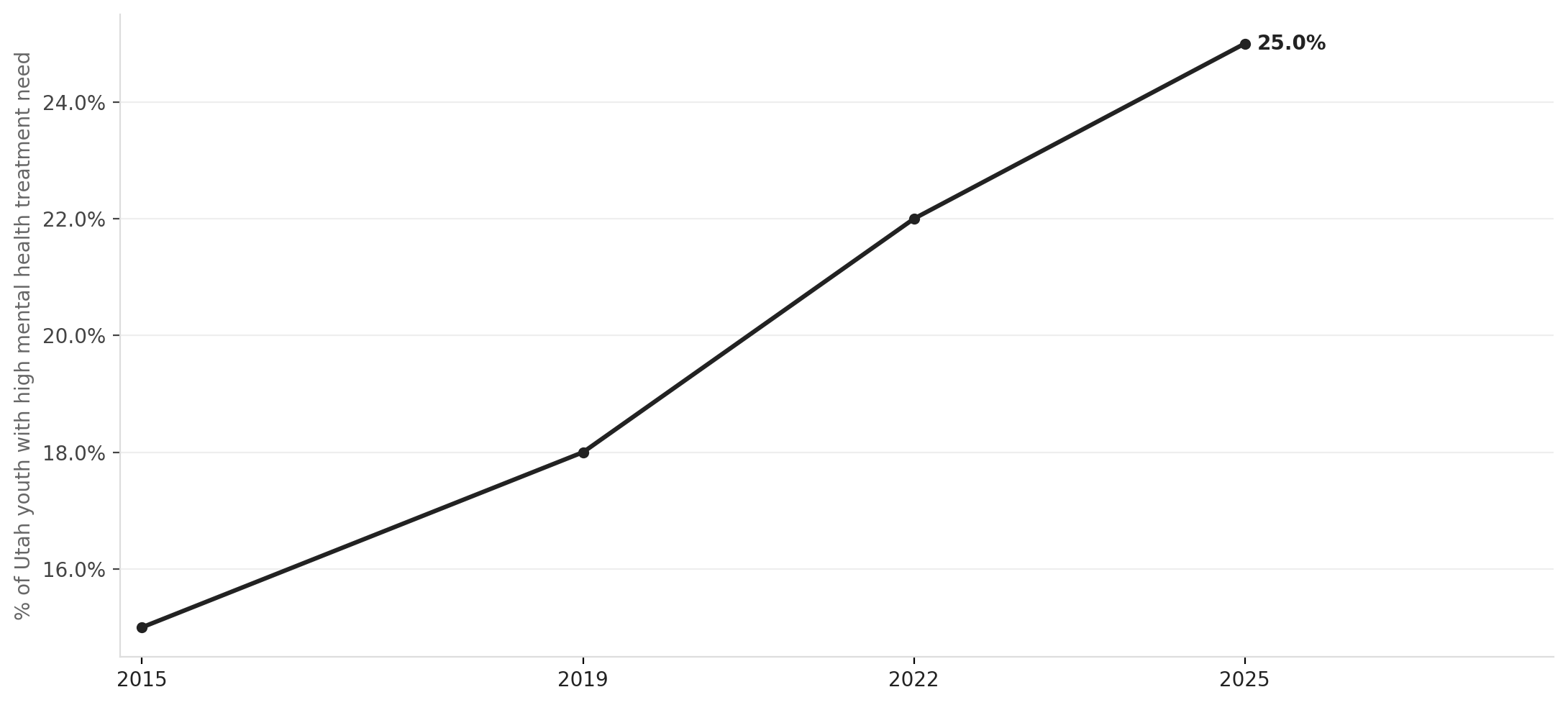
The scale of investment is meeting a documented crisis. Utah holds the highest rate of mental illness in the United States at 30 percent of adults, compared to a national average of 23 percent, according to the Utah Behavioral Health Commission's November 2025 report to the Legislature. A quarter of Utah youth now have high mental health treatment needs, up from 15 percent a decade ago. In 2025, 33 Utah teenagers died by suicide. The state's annual adult suicide toll has run between 640 and 717 deaths per year in recent years, figures that have made Utah a recurring reference point in national public health research, including landmark longitudinal work from the Huntsman Mental Health Institute at the University of Utah on century-long cycles in American suicide rates.
Utah's persistent outlier status on these metrics reflects structural forces that federal grants alone cannot fix: high-altitude geography associated with elevated suicide risk, a religiously homogeneous culture that can suppress help-seeking, and a rapidly growing population outpacing provider supply. What has changed is the state's institutional capacity to absorb federal resources. The Utah Behavioral Health Commission's five-year strategic plan and its 2025–2026 legislative recommendations gave both the Legislature and federal partners a coordinated target list, including a recommended $10 million in ongoing state funding for crisis stabilization infrastructure. That alignment matters in federal grant competitions.
The current surge is unfolding against a clock. The FY2027 federal budget proposes consolidating behavioral health grants into a single $4.5 billion mega-block-grant, a restructuring that would reduce the categorical flexibility states currently have to direct MHBG funds toward specific populations and services. If that consolidation moves forward, the conditions that allowed Utah to draw $10.9 million in a single 90-day window under the current program structure may not repeat. States are effectively racing to deploy commitments made under the existing, more flexible framework before any reorganization takes effect.
For Utah residents, the near-term signal is in how the new money moves. Active RFPs in 2026 include peer support services, PATH homelessness-to-care transition programs, law enforcement mental health co-responder support, and school safety and suicide prevention training, a mix that touches schools, jails, homeless shelters, and primary care offices simultaneously. The University of Utah's Huntsman Mental Health Institute is positioned to absorb research and training components, while DHHS's OSUMH manages the service delivery grants.
The next marker to watch is whether the Legislature acts on the Behavioral Health Commission's recommendation for $10 million in ongoing state crisis stabilization funding in the 2026 general session. Federal block grants require state match commitments and long-term planning documents; if the Legislature's contribution falls short, it could limit Utah's ability to draw at the same rate in the next SAMHSA cycle, precisely when Washington may be rewriting the rules.