Federal AI grants committed to Oregon in the last 90 days total $9.51 million, a 758% increase over the $1.1 million recorded in the same window a year ago. The state has no major AI company. The awards went to a land-grant university's specialty crops lab and a physics department's energy research team.
That gap between the source of the money and the shape of Oregon's economy is the story. When President Trump signed the Genesis Mission executive order on November 24, 2025, describing it as an effort "comparable in urgency and ambition to the Manhattan Project" to accelerate scientific discovery through AI, the first institutions positioned to benefit were not in Silicon Valley. They were in Corvallis and Eugene.
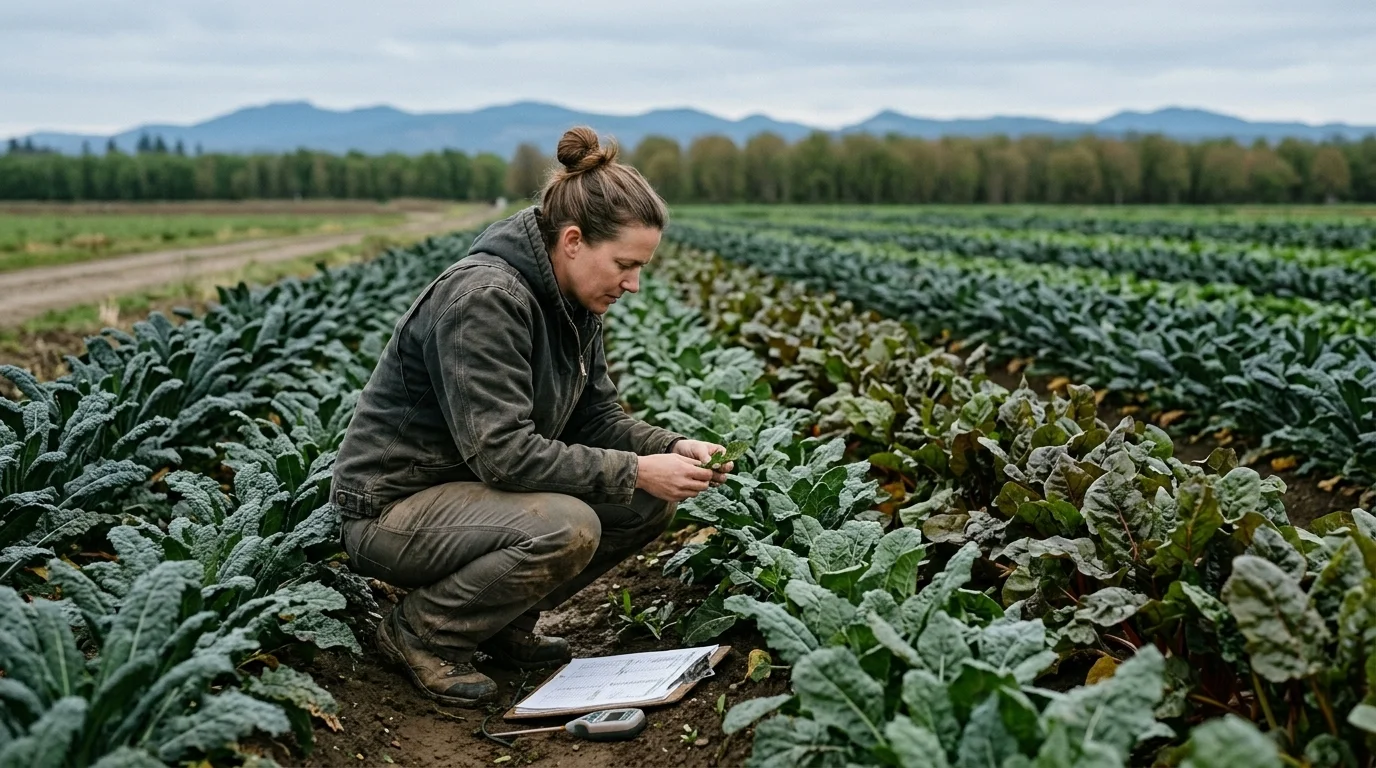
The Genesis Mission is DOE-led but now spans more than 15 federal agencies, and the White House announced more than $5 billion in Mission funding in late July 2026. The cascade reached Oregon almost immediately. On July 1, Oregon State University received $6.96 million from USDA's Specialty Crop Research Initiative, the single largest award and 73% of the 90-day total, running through June 2030. On July 22, USDA explicitly invoked the Genesis Mission and its AgARDA authority to solicit AI tools for crop germplasm data from university partners, the precise domain OSU had just been funded to work in. Three weeks later, the University of Oregon received $1.79 million from DOE's ARPA-E program for energy-AI integration work, followed by a $765,000 NSF Social, Behavioral, and Economic Sciences grant starting August 1.
Source: NationGraph.
OSU's position here was not accidental. The university has 13 faculty embedded in the 2021 AgAID Institute, a $20 million USDA-NSF initiative led by Washington State University that built one of the country's most established agricultural AI research networks. OSU's specialty crops focus, covering Pacific Northwest apples, cherries, mint, and similar high-value commodities, maps directly onto the Genesis Mission's agricultural AI priorities. When USDA went looking for institutions with track records in AI-assisted crop research, Oregon State had a decade of infrastructure to point to.
The University of Oregon's ARPA-E award fits a parallel track. ARPA-E allocated $34 million in April 2026 for AI-autonomous lab projects focused on catalyst development, and UO's grant reflects that expanding AI-for-energy portfolio. The two universities together cover the Genesis Mission's two most active early funding domains without competing against each other.
The broader Oregon research AI portfolio makes the 90-day surge look less like a windfall and more like a payoff on long-term institutional bets. OHSU holds a $14.8 million NIH biomedical AI grant. OSU carries a $2.27 million NSF CISE award. Those existing commitments signal to federal program officers that Oregon institutions can absorb and execute on large AI research grants, reducing the administrative risk of new awards.
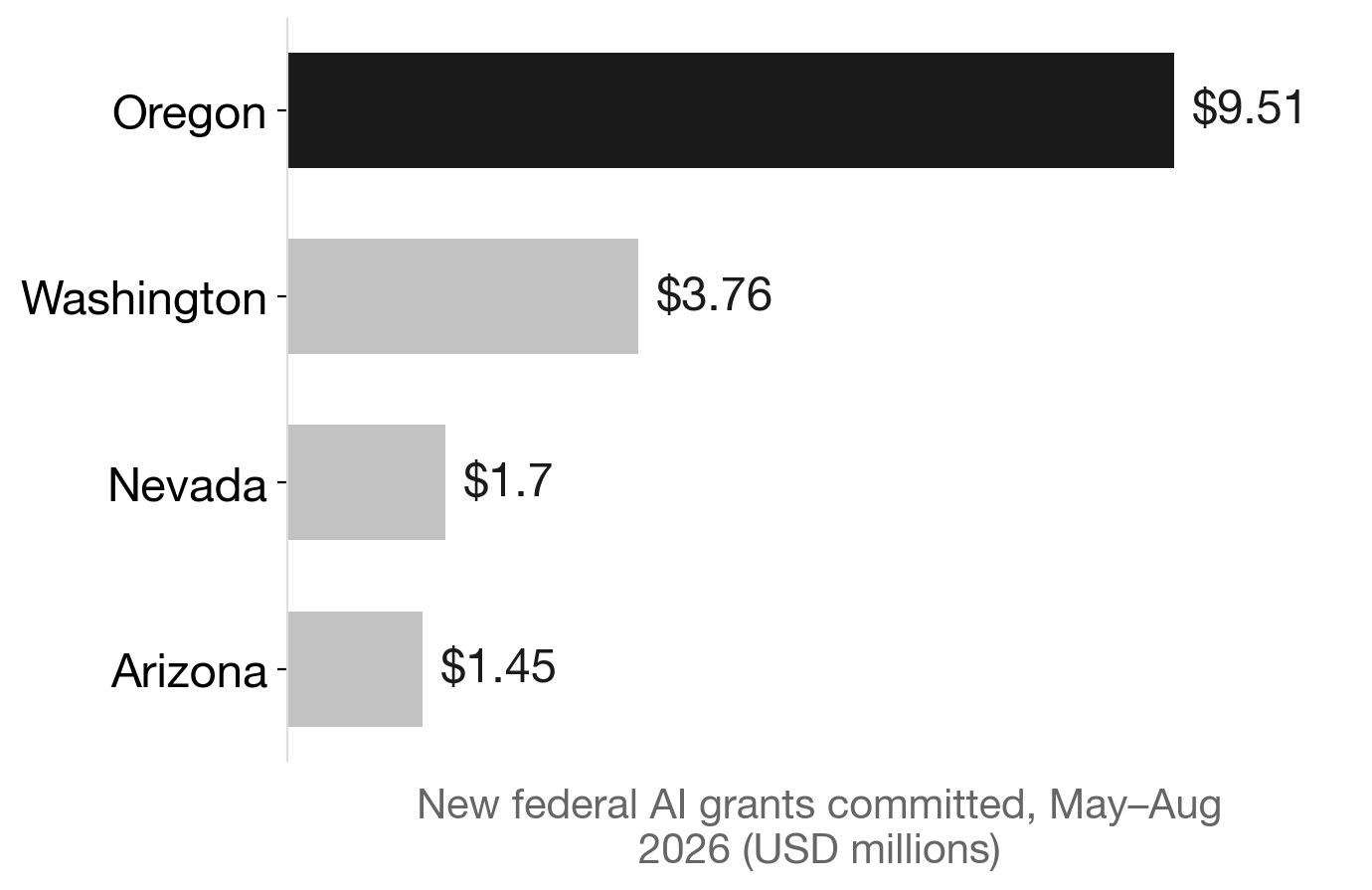
Among western states excluding California, Oregon now ranks second for AI grants in this 90-day window at $9.51 million, ahead of Washington at $3.76 million, Nevada at $1.7 million, and Arizona at $1.45 million. Washington runs the AgAID Institute that Oregon State participates in, which makes OSU's ability to out-pace it in this window a notable reversal.
For Oregonians, the practical effect is that some of the federal government's most ambitious science spending is flowing into state institutions whose research outputs touch industries central to the state's non-tech economy. Agricultural AI tools developed under the OSU award could eventually reach the specialty crop growers who make up a significant portion of Oregon's Willamette Valley and central Oregon agricultural sectors. The ARPA-E energy work at UO sits within a broader DOE push to reduce the time and cost of materials discovery for clean energy applications.
What to watch next: the Genesis Mission is still in early deployment, with agency-level solicitations expected to continue through late 2026 and into 2027. USDA's AgARDA authority, invoked explicitly in July, gives the department new flexibility to structure research agreements outside traditional grant formats, which could benefit institutions like OSU that already have cooperative agreement relationships with the agency. The next signal will be whether OHSU, which holds the state's largest single active AI grant through NIH, sees a comparable surge as the Mission expands further into biomedical AI, an area the executive order named as a priority but that has moved more slowly than agricultural and energy awards so far.