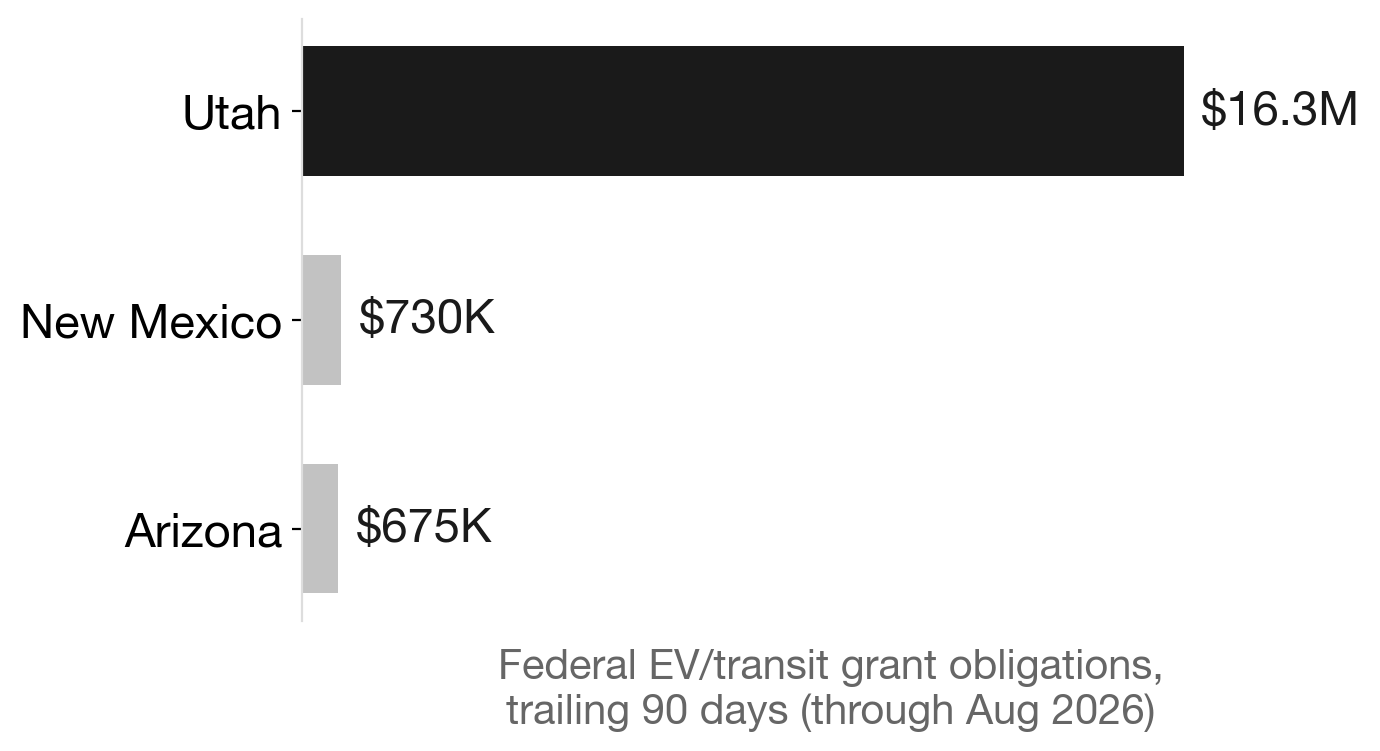
Federal transit electrification money flowing into Utah has jumped 2,016% year over year, from $769,000 in the same 90-day window last year to $16.3 million obligated on July 24, 2026. No other Mountain West state is close: New Mexico and Arizona together received roughly $1.4 million in the same period, about 9% of Utah's total. The state that built its reputation on skepticism of federal mandates is quietly becoming the region's most aggressive recipient of Biden-era transit electrification dollars.
The single grant driving the surge, an FTA "Low or No Emission / Buses and Bus Facilities" award to the Utah Department of Transportation, is not an anomaly. It is the largest disbursement in a capital stack Utah has been assembling for years. The state's active federal EV portfolio now exceeds $130 million, layering a $74.7 million EPA Climate Pollution Reduction Grant (awarded October 2024, running through 2029), $28.8 million in five National Electric Vehicle Infrastructure tranches, and this new $16.3 million FTA bus grant on top of each other.
The timing is not accidental. The FTA's FY2025-2026 Low or No Emission Grant Program disbursed $1.63 billion across 165 projects in January 2026, drawing from the Bipartisan Infrastructure Law's five-year, $5 billion authorization for zero-emission transit. Utah's obligation landed in the final appropriation year of that program, FY2026, which creates a hard deadline: agencies that have completed environmental reviews, secured local matching funds, and demonstrated operational readiness move to the front of the obligation queue. Utah had done all three.
Source: NationGraph.
The Utah Transit Authority's competitive position comes down to two structural advantages its peers in the Mountain West have not replicated. First, UTA published a formal Zero-Emission Bus Transition Plan with a binding 40% electric fleet target by 2040, giving federal reviewers a long-term capital roadmap rather than a one-off grant request. Second, UTA formalized a co-investment partnership with Rocky Mountain Power specifically targeting EV charging infrastructure and grid resilience, a structure the FTA treats as evidence of operational staying power. As the FTA's own program overview notes, repeat competitive winners in the Low-No program consistently share two traits: utility partnerships and transition plans on file.
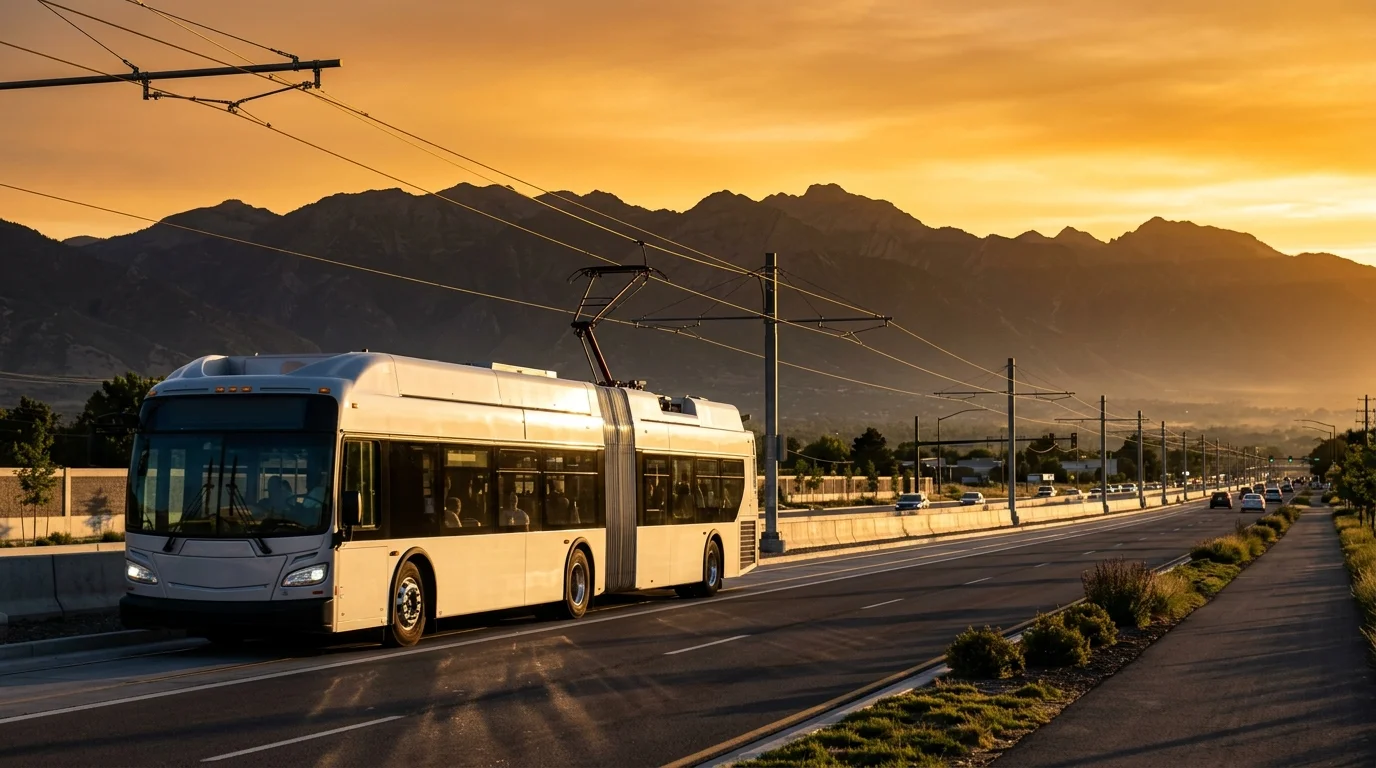
UTA currently operates 38 battery-electric buses and is converting that base into two new fully electric routes. The Midvalley Express launched in April 2026; the Davis-Salt Lake City Community Connector is scheduled for 2028. Both corridors run through some of the metro's fastest-growing suburbs, where Salt Lake City's population expansion is adding transit riders at the same time the electric fleet is scaling to serve them.
The air quality argument runs underneath all of it. Utah's Wasatch Front produces some of the worst winter inversions in the country, a geography-driven pollution trap that traps vehicle exhaust in valley air for days at a time. The EPA grant targeting the state's climate pollution reduction strategy was awarded in part on that basis. Diesel buses idling in that inversion layer are a measurable public health problem; electric buses are not simply a capital investment but a specific response to a documented air quality emergency.
For riders and commuters along the Wasatch Front, the practical near-term signal is service. Both the Midvalley Express and the Davis-SLC Connector are designed as high-frequency electric routes in corridors currently underserved by transit, meaning the electrification buildout and the service expansion are the same project. If federal dollars continue to flow on schedule, riders in those corridors will see new electric buses before the end of 2026.
The next competitive signal to watch is the FTA's FY2026 Notice of Funding Opportunity, published July 27, 2026, which opens a new round with approximately $589 million available. Utah is positioned to stack an additional award on top of the July obligation. Whether UDOT and UTA file for that round, and whether the incoming federal budget cycle leaves the program intact, will determine whether this 90-day surge is a one-time peak or the first installment of something larger.