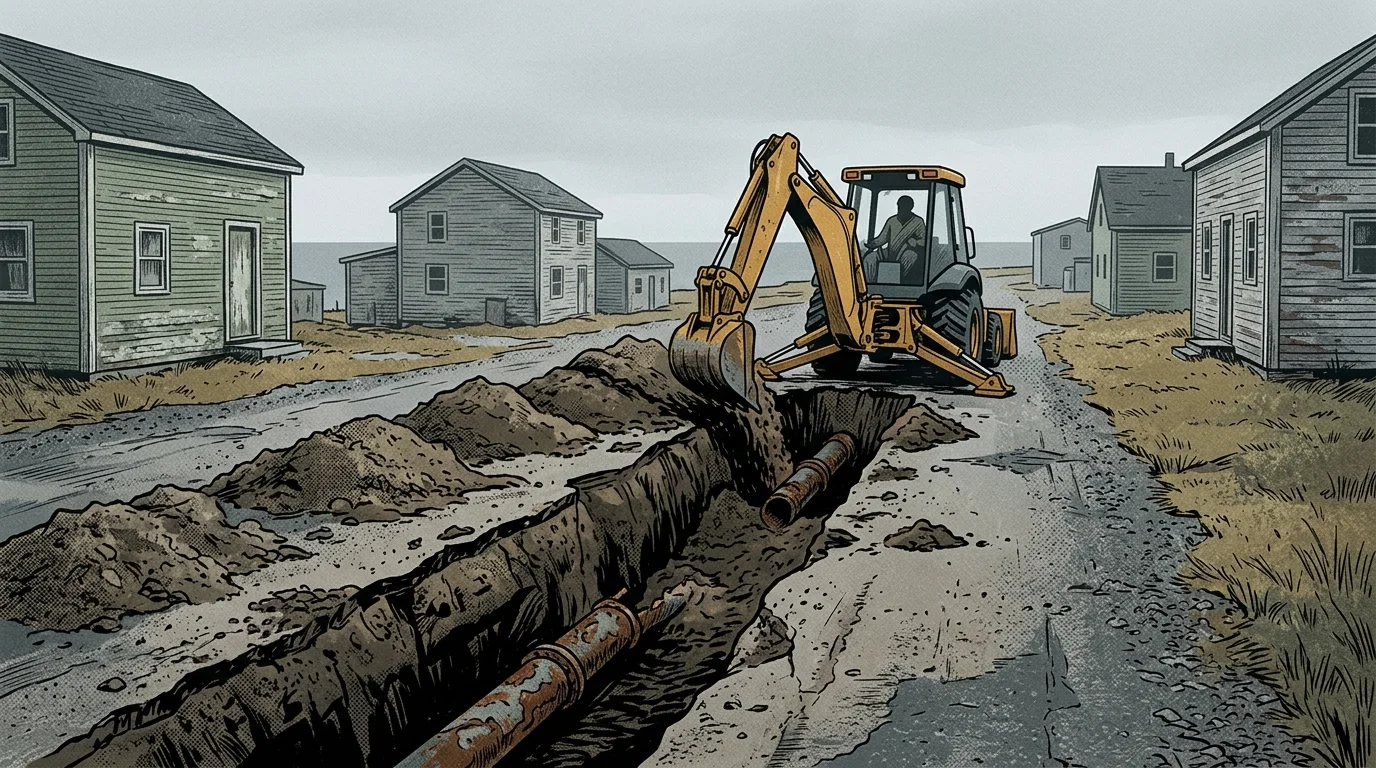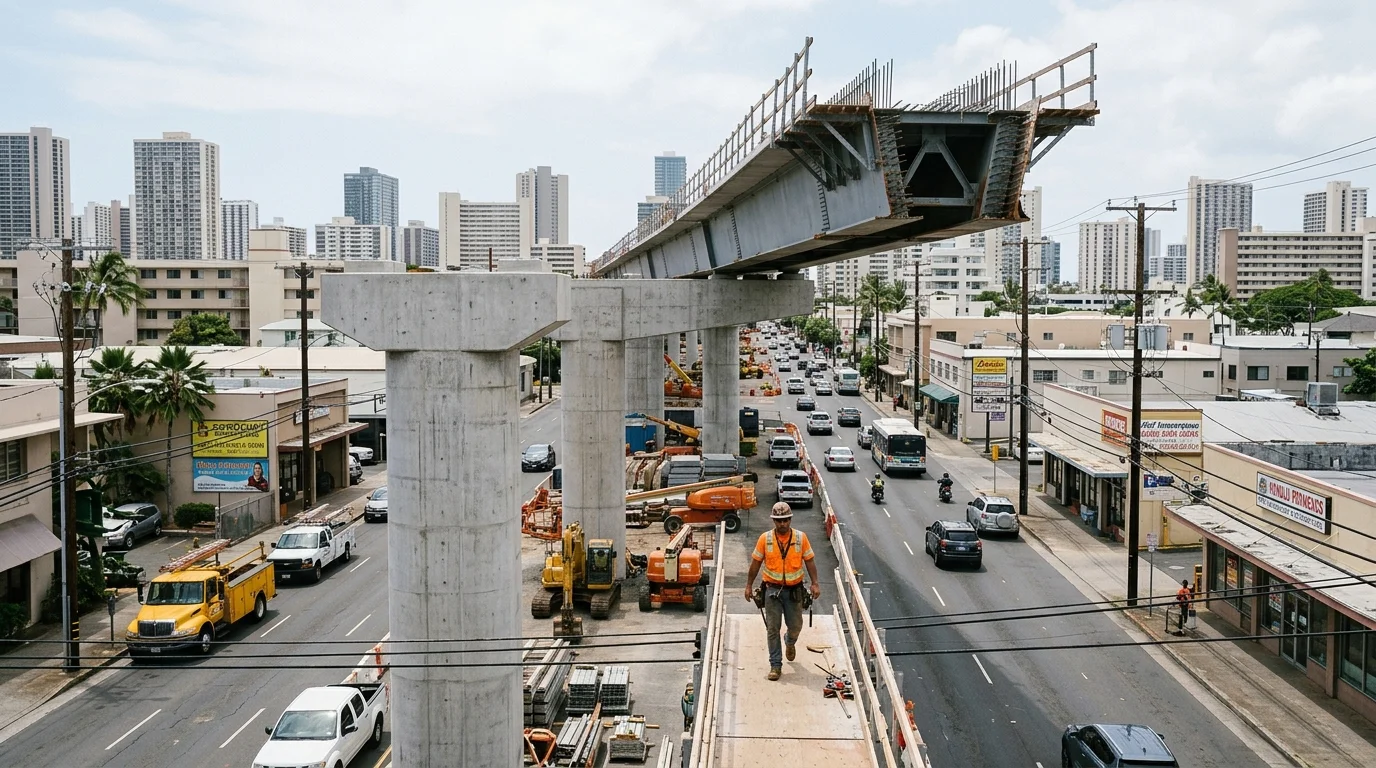
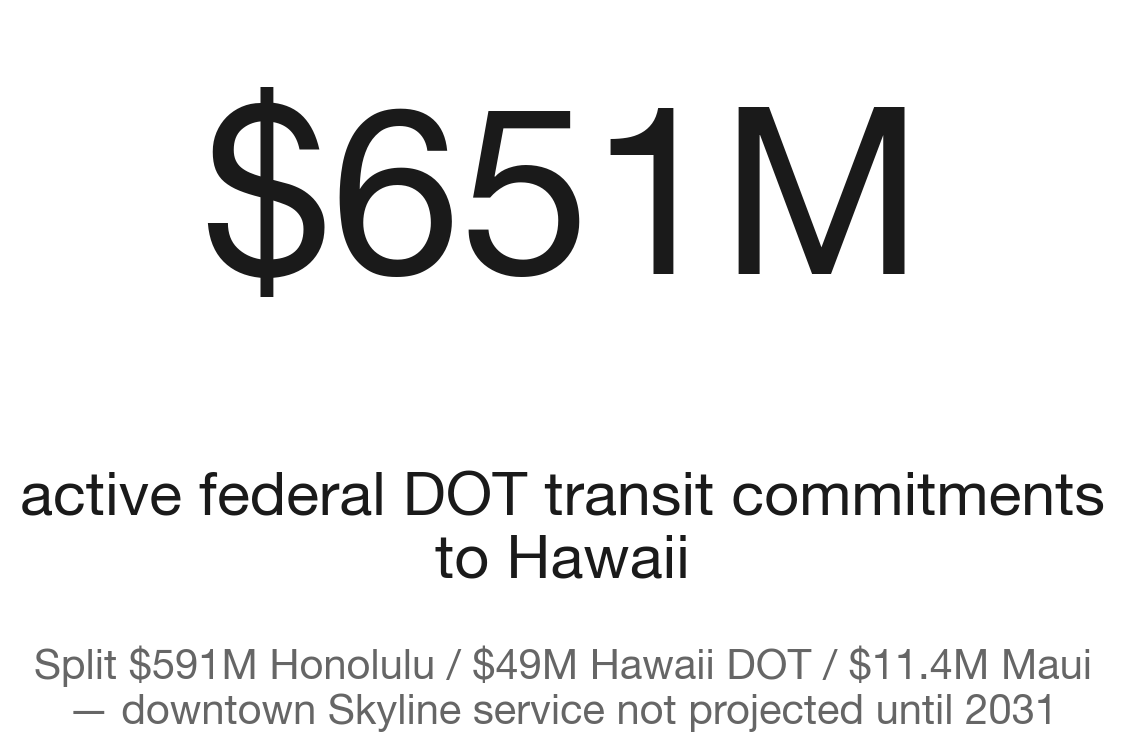
Downtown Honolulu's utility lines are already rerouted underground for a rail corridor that will not carry a single passenger until 2031. That five-year gap between infrastructure committed and service delivered is the defining tension of Hawaii's transit moment, a build-out now backed by roughly $651 million in active federal transit grants and accelerating on every major island simultaneously.
The City and County of Honolulu holds $591 million of that total, anchored by a $500 million Capital Investment Grant that is now 75 percent disbursed. Hawaii DOT holds another $49 million in active commitments, and Maui County $11.4 million. The numbers are large by any state standard, but Hawaii is doing something no other state is: building a fully automated, grade-separated urban rail system from scratch, across a geography where no interstate highway connects any of its counties and where Oahu's single coastal corridor makes the infrastructure logic for rail nearly uncontested even when the costs are not.
The immediate catalyst for the current activity surge was a February 2024 amended Full Funding Grant Agreement between the Honolulu Authority for Rapid Transportation, the City and County of Honolulu, and the Federal Transit Administration. As HART and the FTA announced, that agreement unlocked $744 million in remaining federal rail funding after years of stalled disbursements, with the first $125 million arriving in April 2024. Simultaneously, Bipartisan Infrastructure Law bus-and-facilities formula grants obligated more than $35 million to neighbor-island counties for electric fleet transitions, and the FY2026 FTA Low-No Emission grant program opened a new $589 million national window in July 2026, making Hawaii counties active applicants again.
Source: NationGraph.
On Oahu, construction progress is visible and sequenced. Skyline's Segment 2, covering 5.2 miles from Makalapa to Kalihi Transit Center, opened October 16, 2025. Segment 3, three miles and six stations pushing into the downtown core, is now under active construction: utility relocation finished July 22, 2026, the first guideway span is expected in early 2027, and the state released $89.4 million to HART in May 2026 from the Mass Transit Special Fund to cover first-quarter invoices. Passenger service on Segment 3 is projected for 2031.
The ambitions are already expanding past the current build. A June 2026 HART board report surfaced a planning document outlining subway and streetcar extensions to Waikiki, the University of Hawaii at Manoa, and Ko Olina. Civil Beat reported sharp criticism from fiscal watchdogs who questioned the wisdom of mapping new corridors before the existing ones open, but the document signals that Hawaii's transit planners are treating the current build as a foundation, not a ceiling.
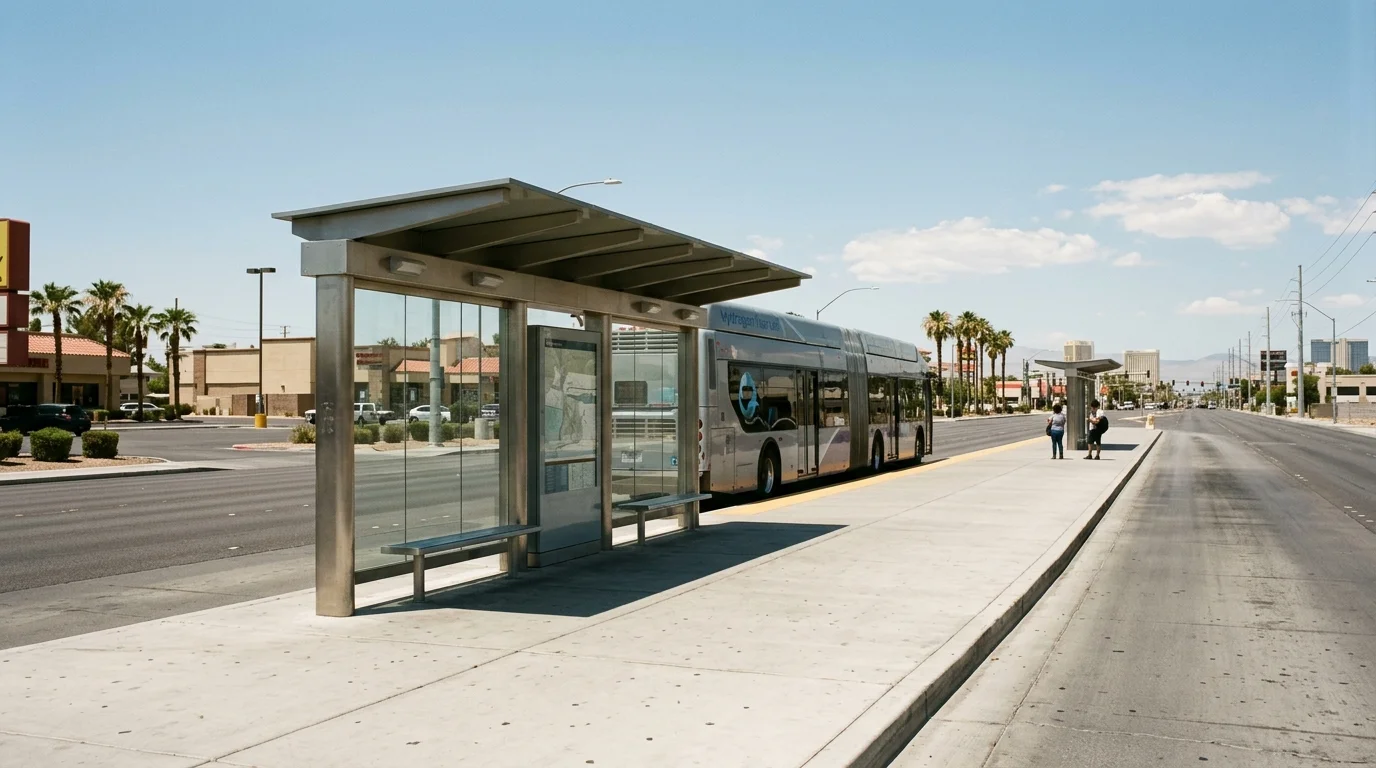
The neighbor islands tell a different version of the same story. Maui, Kauai, and Hawaii Island run small county bus systems that depend almost entirely on federal formula grants to replace aging diesel fleets. When a grant cycle opens, procurement follows directly. Kauai County issued an RFP in June 2026 for three 29-foot heavy-duty clean diesel buses. Maui County has an active August 2026 solicitation for an accessible eight-passenger paratransit vehicle, part of the county's ADA paratransit obligations under the Maui Bus system. Hawaii DOT issued an August 2026 Railway Vegetation Management RFP tied to Skyline Segment 3 corridor work. New formula grants to Hawaii in the past twelve months include $45.5 million to Honolulu (July 2025, running to 2031), and $23.2 million plus $12 million in Low-No bus grants to Hawaii DOT in September 2025. Senator Brian Schatz's office confirmed an additional $5.5 million in federal zero-emission bus funding directed to the state.
For riders, the near-term reality is uneven. On Oahu, Skyline's existing 20-mile western segment is operational, and each construction milestone on Segment 3 narrows the distance to a continuous downtown connection. On the neighbor islands, the bus grants translate into newer, cleaner vehicles on existing routes, but network coverage stays thin. The structural gap between federal commitment and delivered service is widest precisely where the investment is largest.
The next concrete signal to watch is HART's Segment 3 first guideway span, expected in early 2027. If that milestone holds, it will mark the first physical rail infrastructure in downtown Honolulu and begin the clock on the project's most politically consequential stretch. The FY2026 Low-No NOFO deadline will also determine whether Maui, Kauai, and Hawaii Island secure another round of fleet funding before the current BIL formula pipeline closes. Both outcomes will arrive before the next gubernatorial election cycle, giving the state's transit investments an unusually clear political timestamp.