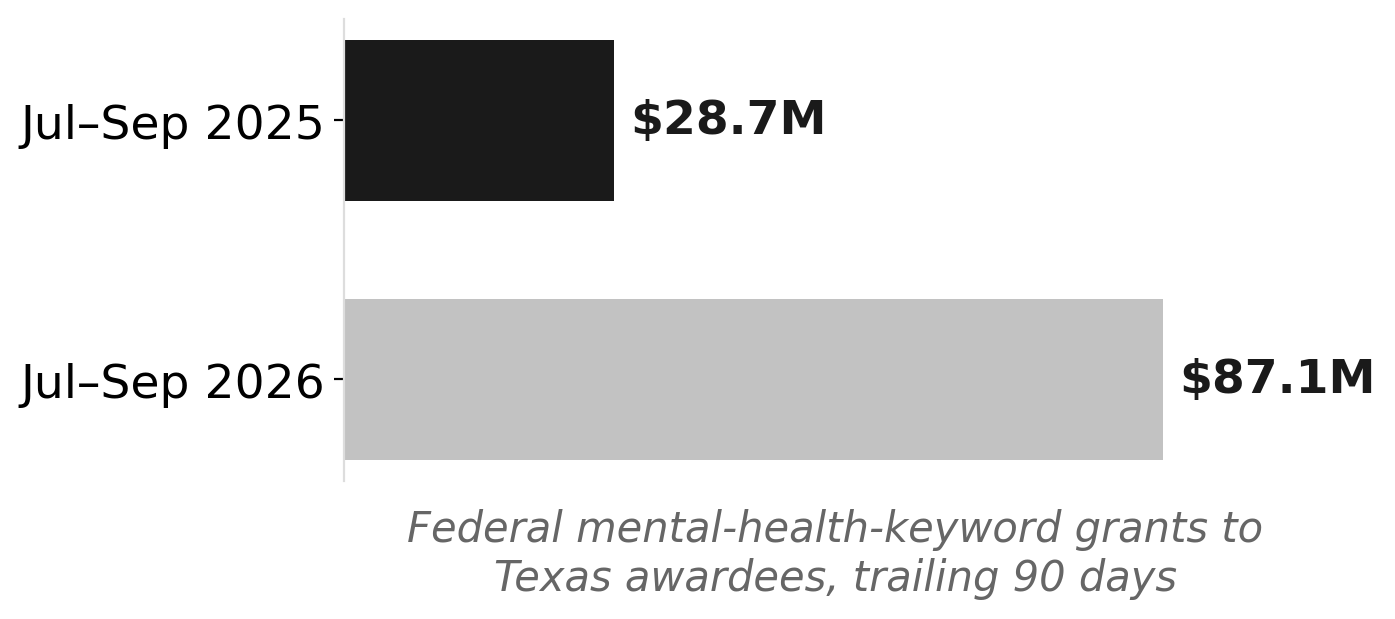
Federal mental health-keyword grants to Texas have reached $87.1 million in the trailing 90 days, triple the $28.7 million awarded in the same window last year, a 204 percent jump driven almost entirely by a single structural force: NIH is legally required to spend or forfeit roughly $1 billion in unobligated extramural funds before September 30, 2026.
The paradox at the center of this surge is worth stating plainly. A year of federal science dysfunction, including a brief January 2026 grant termination wave that was reversed within 24 hours, peer-review slowdowns, and deep staff reductions, left NIH's first-half FY2026 obligations at just $5.8 billion, a 34 percent deficit against FY2024's pace at the same point. Now the same agency that froze the pipeline for eight months must empty it in eight weeks, or the money returns to the Treasury. Texas's sprawling health science ecosystem is one of the primary places it is landing.
The mechanism is NIH's year-end obligation cliff, a recurring feature of federal appropriations law but an unusually large one this cycle. As the AAMC documented in its FY2026 tracking analysis, NIH had made only roughly 27,500 awards as of late June 2026, approximately 25 percent below the pre-2025 pace for comparable dates. NIH ran the same playbook in FY2025, obligating $18.5 billion, more than half its annual extramural budget, in the final three months. A Science/AAAS analysis from June 2026 confirmed the agency was on track to repeat that compression. The FY2026 Consolidated Appropriations Act (P.L. 119-75, signed February 3, 2026) funded NIH at $47.2 billion and explicitly rejected a proposed indirect-costs rate cap, preserving the full grant pipeline that is now clearing.
Source: NationGraph.
Texas was structurally positioned to absorb a surge of this kind. The UT System alone spans six health science campuses. Baylor College of Medicine and Texas A&M Health Science Center add two more major nodes. What these institutions share is precisely what NIH needs in a compressed obligation window: applications that have already cleared peer review with fundable scores, existing indirect-cost agreements with the federal government, and administrative infrastructure capable of executing grant paperwork quickly. An agency racing a fiscal-year deadline does not reach for new entrants; it reaches for known quantities.
The 156 grants awarded to Texas in the current window reflect that logic. Top recipients include the University of Texas Southwestern Medical Center, UT Health Science Center at Houston, UT Austin, Baylor College of Medicine, UT Dallas, and Texas A&M Health Science Center. The program-level breakdown carries the clearest fingerprint of a timing event: nearly every NIH program line shows $0 in awards to Texas in the same 90-day window last year, followed by a large number this year. That uniform absence last year is not what expanded programming looks like; it is what a delayed queue looks like when it finally clears. The one consistently active program, NIMH's Mental Health Research Grants, grew more modestly, from $5.5 million to $6.8 million across 12 grants, suggesting it maintained something closer to normal pacing throughout.
The $87.1 million in new commitments lands on an already-deep foundation. Texas currently carries $1.21 billion in active HHS mental health-keyword grants across 518 awards, with $505 million already disbursed. The new surge represents roughly 7 percent of that active portfolio arriving in a single quarter, not a new entrant receiving its first federal dollars.
It is also worth being precise about what this money funds and what it does not. These are NIH extramural research grants flowing through institutes including NIMH, NIAAA, NINDS, and NICHD to university laboratories and health science centers. They fund basic, translational, and applied biomedical and behavioral health research. They are not the same as SAMHSA community mental health block grants, which fund direct behavioral health services through Texas HHSC and local mental health authorities and are appropriated at roughly flat levels for FY2026. The September surge in Texas grant totals reflects a research funding timing event, not an expansion of community mental health services in Texas neighborhoods.
For Texas research institutions, the practical meaning of this moment is significant: funded projects that sat in administrative limbo for months are now receiving notices of award, and principal investigators are staffing labs and beginning work that was uncertain as recently as spring 2026. For observers of federal science policy, the number to watch is October 1. If NIH meets its September 30 obligation deadline and clears the backlog, the FY2027 pipeline will reset, but the structural conditions that created the dysfunction, including staff reductions and peer-review delays, have not been resolved. Whether FY2027 begins with a functioning front half or another slow-build toward a year-end cliff will determine whether Texas and its peer institutions face a second consecutive compression cycle, or a return to something closer to normal pacing.