Washington state has issued 8 cybersecurity RFPs in the last 30 days, against a 12-month average of roughly 1.9 per month. That 4.2x spike is not coming from Seattle's IT department or state agency procurement offices. Six of those eight solicitations originate from Sequim, a coastal city in Clallam County with about 8,200 residents, covering VEEAM network-security licensing and general cybersecurity software. The other two come from Stanwood in Snohomish County (pop. ~9,400) and Stevenson in Skamania County (pop. ~1,600).
The common thread is not threat level. It is a federal funding deadline.
The State and Local Cybersecurity Grant Program (SLCGP), created under the 2021 Infrastructure Investment and Jobs Act, is in its final authorized year. The national allocation fell from $279 million in FY2024 to $91.75 million in FY2025, and CISA's grant program page confirms that FY2025 represents the last appropriation under the original IIJA authorization. Washington holds $7.47 million in active DHS/SLCGP grants, administered primarily through the Washington Military Department, with 80 percent of that sum legally required to pass through to local governments. For jurisdictions like Sequim and Stevenson, which have never had dedicated cybersecurity budgets, that pass-through represents a rare and possibly singular chance to purchase software and infrastructure they could not otherwise afford.
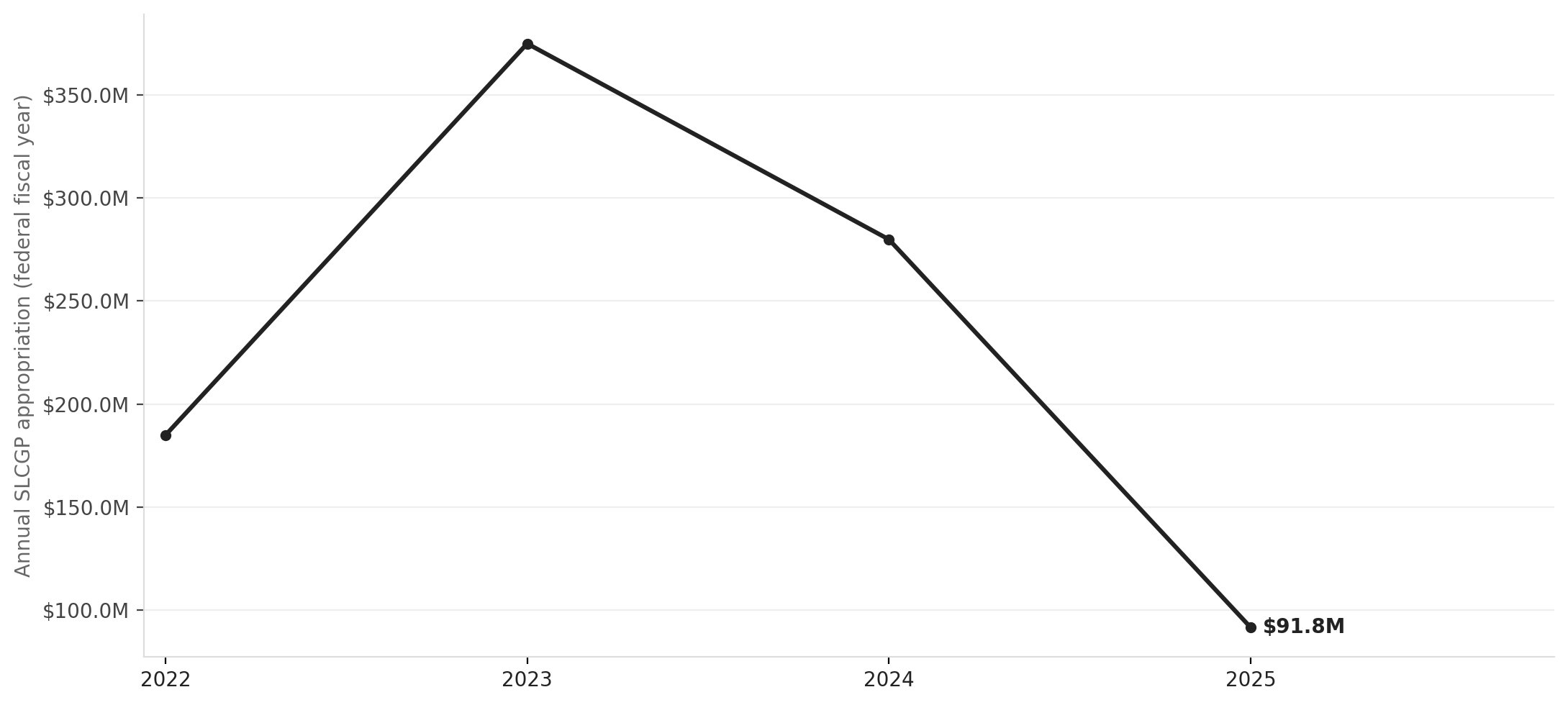
Source: NationGraph.
The procurement wave has been building since January 2026. Monthly RFP counts ran at 7 in February, 5 in March, then dipped to 1 in April before hitting 8 in May. The shape of that curve matches a recognizable bureaucratic rhythm: plan approvals from CISA arrived in late January (CISA required all cybersecurity plan resubmissions by January 30, 2026), sub-award negotiations followed through the winter, and spring brought the conversion of approved budgets into vendor contracts. WaTech confirms that more than $16.6 million has been allocated from FY2022 through FY2024 awards to Washington jurisdictions, and the agency scheduled SLCGP sub-award webinars for May 14 and June 5, 2026, which coincides almost precisely with the current procurement peak.
The SLCGP's structure actually requires that 25 percent of funds reach rural areas, which maps directly onto Washington's geography. Small, resource-constrained jurisdictions are not incidental beneficiaries of this program; they are the intended ones. WaTech's State CIO Bill Kehoe convened a state-industry technology summit at St. Martin's University on April 14, 2026, signaling that the state is actively moving sub-awardees toward execution. The Confederated Tribes of Colville Reservation and the Swinomish Tribe also hold active SLCGP grants totaling more than $800,000, reflecting the program's parallel emphasis on tribal governments.
The reauthorization question is what makes this a deadline rather than a routine procurement cycle. The PILLAR Act, which would extend the SLCGP, passed the U.S. House on November 18, 2025, but remains pending in the Senate with no confirmed floor date. WaTech's own news page notes the House passage while flagging that Senate action is uncertain. Security administrators in Washington are treating that uncertainty as a hard stop: the money that exists now is the money to spend, and the federal budget calendar will not wait for Sequim's IT team to finish deliberating.
Federal political cover for the spending surge exists on both sides of the aisle. The Trump administration's Executive Order 14390, issued March 6, 2026, explicitly directs CISA to prioritize resilience-building for state, local, tribal, and territorial partners, reinforcing the same infrastructure the IIJA built. Washington's own governance framework adds another layer of pressure: the state's data-breach notification law under RCW 19.255.010 mandates 30-day disclosure for breaches affecting state agencies, and WaTech's annual compliance attestation requirement gives local IT managers a concrete institutional reason to upgrade systems while grant dollars are available.
For residents in these communities, the practical result is that small city networks will carry enterprise-grade backup and security software that most comparable jurisdictions still lack. For procurement watchers, the next signal is whether June's RFP activity sustains the May peak or begins to taper as sub-award windows close. If the Senate does not act on the PILLAR Act before the fall appropriations cycle, the pipeline that has been driving this wave will dry up, and the next round of rural jurisdictions on the sub-award list will be spending their own general-fund dollars, or nothing at all.