Eight California water agencies issued infrastructure RFPs in the last 30 days after going silent for more than a year, a burst of procurement activity that tracks almost exactly with two events: the State Water Board's June 23 release of its FY2026-27 Drinking Water and Clean Water SRF Intended Use Plans, and the opening of competitive applications under Proposition 4's $3.8 billion water allocation.
These agencies are not returning from a position of strength. They are returning because the window is open now and may not be this wide again for years.
The driver is straightforward. Proposition 4, the $10 billion climate bond California voters approved in November 2024, earmarked $3.8 billion explicitly for water, drought, and flood infrastructure. Roughly $1.2 billion of that allocation was authorized in the 2025-26 spending plan, distributed on a competitive grant basis. The State Water Board's release of its FY2026-27 Drinking Water SRF Intended Use Plan on June 23 was the formal starting gun: agencies that have projects aligned with funding criteria can apply now. Agencies that are still in planning mode cannot.
Source: NationGraph.
That deadline pressure explains why the returner cohort looks the way it does. Seeley County Water District in Imperial County, a small agricultural border district with no meaningful rate base to self-finance capital projects, is seeking comprehensive energy and water infrastructure modernization. Sonoma County issued a Regional Water Supply Engineering qualifications solicitation. The City of Brisbane in San Mateo County moved on utility-adjacent infrastructure work. These are not adjacent jurisdictions coordinating a regional push. They are dispersed agencies, across California's geographic spread, that each made an independent calculation: apply now, or sit out another cycle.
The federal backdrop makes that calculation sharper. The Trump administration's FY2026 budget proposed cutting federal State Revolving Fund programs by $2.4 billion nationally, a figure that would have gutted the capitalization grants California's State Water Board depends on to extend low-interest loans to local agencies. The final FY2026 appropriations act (P.L. 119-74, signed January 23, 2026) held SRF funding steady at $3.04 billion nationally, averting the cut for now. But the Association of California Water Agencies, which represents roughly 470 local water agencies serving more than 90 percent of the state's population, is already urging the State Water Board to insulate programs from ongoing federal uncertainty. ACWA's public posture signals that its member agencies are not treating this year's SRF reprieve as a stable baseline.
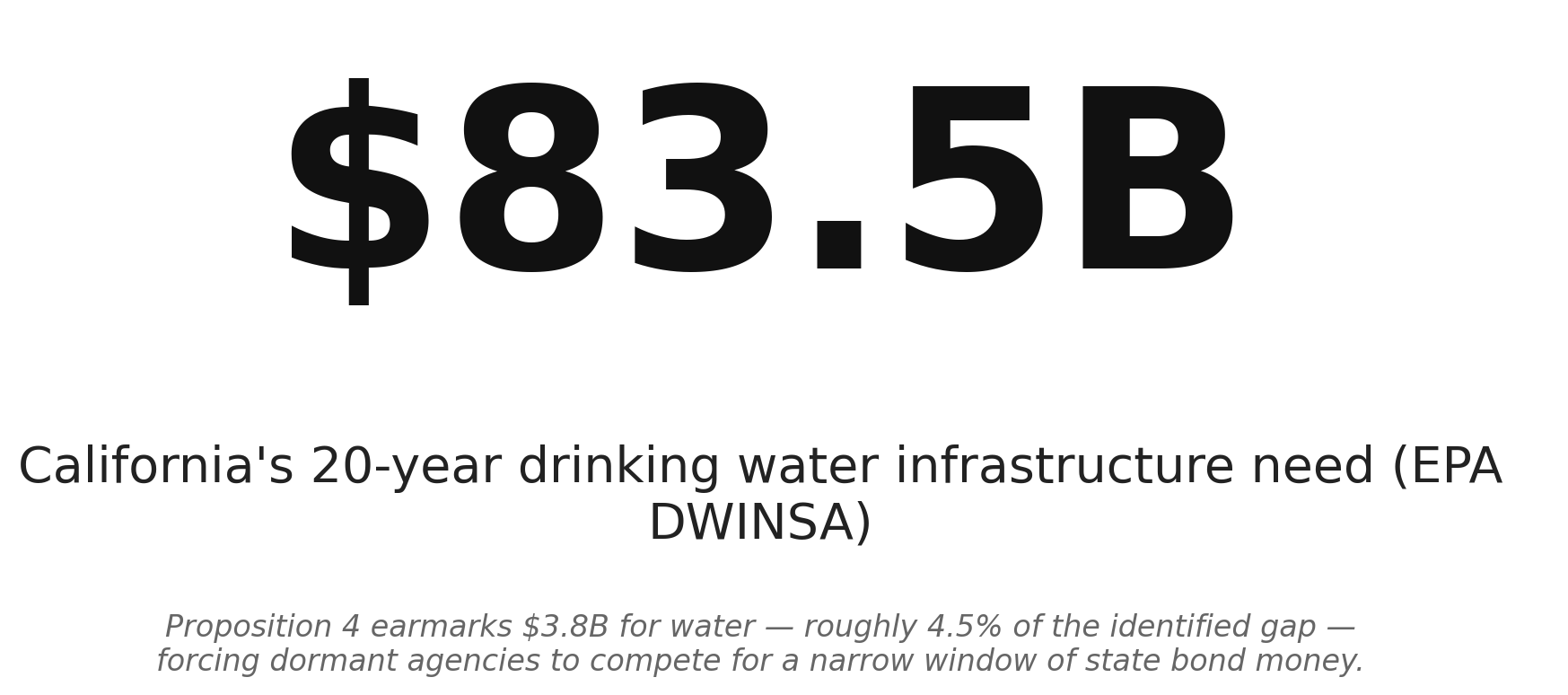
California's State Water Resources Control Board currently holds more than $540 million in active EPA Clean Water and Drinking Water SRF grants running through 2028-2030, providing real capital for local projects. But that number sits against a much larger backdrop: EPA's Drinking Water Infrastructure Needs Survey estimates California's 20-year drinking water infrastructure need at $83.5 billion. Proposition 4's full $3.8 billion water allocation, deployed over multiple years to hundreds of competing applicants, covers less than five cents on that dollar. Governor Newsom's proposed 2026-27 budget adds $792 million more in water-related appropriations on top of Prop 4, but the math still leaves a structural gap that no single funding cycle closes.
That gap is precisely what makes the timing of the Prop 4 competitive window so consequential for smaller districts. Agencies like Seeley, serving a low-income agricultural community in the Imperial Valley, cannot finance a water system overhaul through rate increases. The Prop 4 grant cycle is not an opportunity they can defer. Missing the early application rounds means waiting for a subsequent phase with a smaller pot and more experienced competing applicants.
The eight returners represent agencies that understand this. Monthly RFP activity in California water infrastructure ran between 6 and 23 institutions per month from August 2025 through June 2026. The returner cohort sat out that entire cycle, presumably completing planning work, securing local approvals, or simply waiting for a funding mechanism with realistic odds. The Prop 4 competitive window, aligned with the SRF Intended Use Plan release, gave them a concrete target to move toward.
The next signal to watch is the State Water Board's formal application scoring and award schedule under the FY2026-27 IUPs. Agencies that submitted procurement solicitations in the last 30 days are almost certainly positioning to have contractors or engineers on board before application deadlines close. If a second cohort of dormant agencies follows in August and September, it would suggest the Prop 4 pipeline is pulling forward years of deferred demand at once. If the July burst proves isolated, it may reflect a narrower slice of agencies that were already close to shovel-ready. Either way, the competitive clock is running.