Eight Massachusetts municipalities issued water infrastructure procurement solicitations in the last 30 days after going silent for at least a year, a sudden burst of activity that reflects something more urgent than routine capital planning. The Bipartisan Infrastructure Law's supplemental water grants, available since 2022, expire at the end of FY2026. For communities that don't get engineering contracts signed this fall, the funding landscape that follows will be materially worse: smaller loan pools, higher financing rates, and no zero-interest PFAS remediation loans.
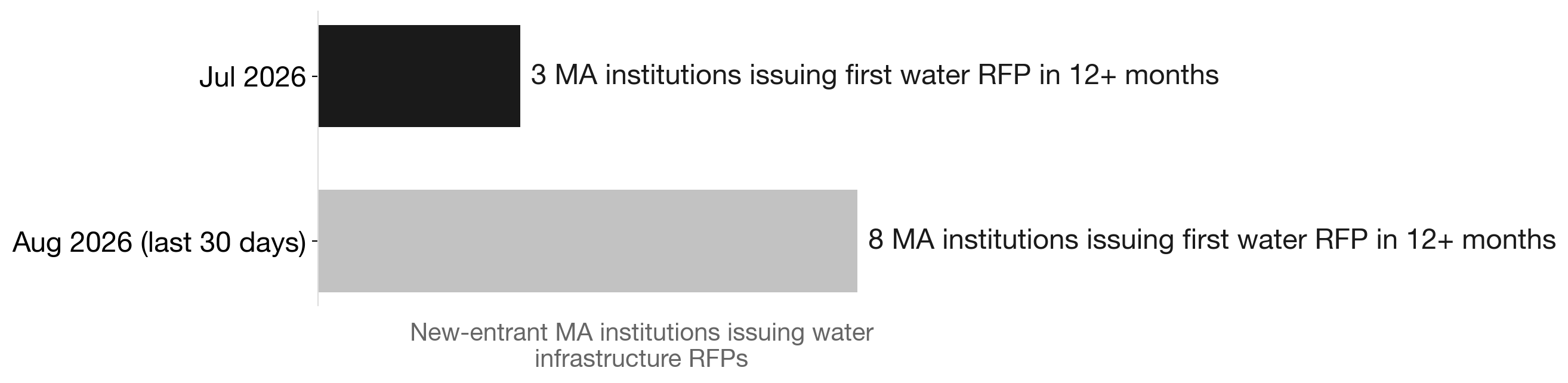
The trigger for this August surge was set in motion on April 2, 2026, when the Healey-Driscoll Administration announced $1.16 billion in State Revolving Fund loans for 70 Massachusetts projects. The accompanying 2026 Intended Use Plans, released by the Massachusetts Clean Water Trust and MassDEP, imposed a June 30 local appropriation deadline on participating communities. That deadline has now worked its way through municipal budget cycles, and towns are landing in procurement queues almost simultaneously. Six institutions issued eight RFPs in August alone, compared with three institutions and six solicitations in all of July.
MassDEP's own language in the 2026 IUP is unambiguous about what comes next. With BIL supplemental grants ending after this fiscal year and federal baseline SRF allocations declining, the agency warned of "less state capacity to fund new projects in future IUPs." The 2026 cycle also ended the zero-interest PFAS loan offering that smaller communities had relied on for contamination remediation. Communities that delay will pay higher financing costs on the same projects.
Source: NationGraph.
The new entrants span the state geographically, which matters: this is not a regional procurement spike but a cross-jurisdictional response to the same deadline structure. Brewster, on Cape Cod, is soliciting a full Water Department asset management and capital improvement plan. East Brookfield (population 2,194) in Worcester County issued an engineering RFQ for water main off-main infrastructure. Northbridge, also in Worcester County, launched Phase 2 of a combined road-and-water reconstruction. Holbrook's Department of Public Works is procuring a chlorine booster station and SCADA system. The Dennis Water District is pursuing advanced metering infrastructure. MassDEP itself issued a Drinking Water Infrastructure Needs Survey RFQ, a procurement that will shape which communities are positioned for future funding cycles.
The smaller communities on that list, East Brookfield and Holbrook among them, have a separate, parallel deadline pushing them. A May 19, 2026 EPA announcement of $18.6 million in PFAS and emerging contaminant grants for Massachusetts targeted exactly these kinds of small and disadvantaged water systems. To access those funds, communities need engineering assessments already in hand. Issuing an RFP now is not optional preparation; it is the prerequisite.
The scale of what Massachusetts has built through the SRF program helps explain why the expiration of BIL supplements carries such weight here. The state has financed roughly $8.1 billion in water loans to nearly 300 communities, serving 97 percent of the state's population. The active EPA water grant portfolio in Massachusetts now stands at more than $582 million in obligated funds across 86 active grants. The Massachusetts Clean Water Trust has started more than $137 million in new Drinking Water SRF loans since mid-2024 alone. The program is large enough that the gap created by BIL's exit will be visible immediately in future IUP project lists.
Cape Cod and Worcester County towns are particularly exposed. Their water distribution systems were built before modern standards, their rate bases are small, and they have historically depended on subsidized SRF capital to finance upgrades that larger systems fund through bond markets. For a town like East Brookfield, losing access to zero-interest financing is not an accounting footnote; it can be the difference between a project happening this decade or not.
EEA Secretary Rebecca Tepper, announcing the April awards, cited "bigger storms, more often" as the rationale for urgency. That framing pointed to climate resilience, but the procurement data points to something more mechanical: a funding architecture with a specific end date, and municipalities that have spent the better part of a year getting local appropriations passed and are now moving into the engineering market all at once.
The signal to watch this fall is whether the August RFP volume holds through September and October, when engineering firms will begin returning proposals. If the same communities that issued solicitations in August fail to award contracts before year-end, they risk missing the IUP cycle entirely. MassDEP's next Intended Use Plan will tell the story: a shorter project list, at higher financing costs, for communities that waited.