Federal cybersecurity grants flowing into Florida have hit $5.6 million in the trailing 90 days, a 680% jump over the $718,000 that arrived in the same window a year ago. The money came in three awards, all in August 2026: the University of Central Florida received $1.96 million, the University of West Florida received $1.74 million, and the University of South Florida received $1.9 million. The surge is not incremental, it marks Florida's entry into a new generation of federal workforce programs that did not exist twelve months ago.
The engine behind the jump is NSF's CyberAICorps Scholarship for Service program, launched in April 2026 under solicitation NSF 26-503 and drawing on authority from the CHIPS and Science Act. The program explicitly merges AI competency into the federal cybersecurity workforce pipeline for the first time, replacing the 25-year-old CyberCorps SFS program that preceded it. UCF and UWF are among the first universities in the country to receive CyberAICorps awards, making Florida the only state with two institutions in the inaugural cohort. UCF's grant is framed around AI applications in space, defense, and modeling and simulation. UWF's FORCE program targets DoD cyber roles directly.
The USF award comes from a different spigot: the Department of Energy's Cybersecurity, Energy Security and Emergency Response program, which focuses on hardening the power grid and energy infrastructure rather than building the academic workforce pipeline. Together, the three grants represent the federal government placing simultaneous bets on Florida through NSF, DOE, and, separately, DHS, a concentration that stands out even at the national scale. Florida ranks third among major states in trailing-90-day cybersecurity grant intake, behind North Carolina at $8.6 million and Texas at $6.3 million, but leads in the share going specifically to workforce-pipeline awards.
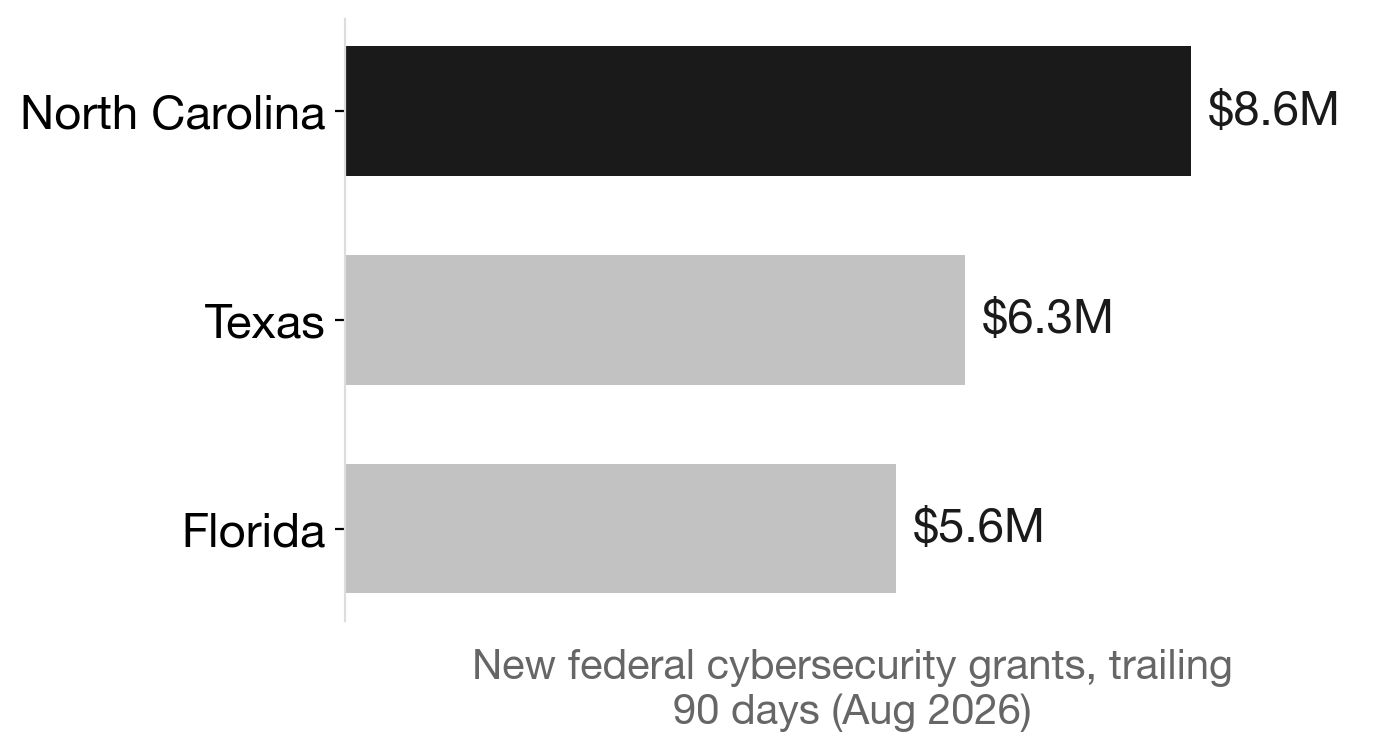
Source: NationGraph.
The timing carries a political dimension that the dollar figures alone don't capture. In 2022 and 2023, Florida and South Dakota were the only two states in the country to refuse the original CISA State and Local Cybersecurity Grant Program, with state officials describing the reporting requirements as invasive and administratively burdensome. Florida now appears in SLCGP recipient data for both the FY2024 and FY2025 cycles, and the Florida Division of Emergency Management currently holds $8.8 million in active DHS cybersecurity grants. The state is simultaneously running its own $15 million Local Government Cybersecurity Grant Program, funded through the FY2025-26 General Appropriations Act and administered by Florida Digital Service, with no local match required and procurement handled directly by the state on behalf of applicants.
The geographic concentration of the new awards points to something more specific than a statewide rising tide. UWF's Pensacola campus is accumulating a disproportionate share of national defense-adjacent cyber training dollars. The $1.74 million CyberAICorps award sits alongside a separate $9.6 million DoD GenCyber grant that UWF already holds, the largest in the university's history. UWF's Center for Cybersecurity and AI now runs multiple overlapping federal programs out of a single institution in a mid-sized Gulf Coast city. The end market for that workforce is visible on the map: NAS Pensacola sits fewer than ten miles from campus, and Patrick Space Force Base and MacDill Air Force Base anchor the state's other major military clusters.
For Florida residents, the most direct implication is a new class of federally funded scholarships that cover tuition, fees, and a living stipend in exchange for post-graduation federal service. CyberAICorps stipends run between $27,000 and $37,000 annually depending on degree level, funded entirely by the federal government and placed at institutions already producing graduates with DoD clearances and relevant technical backgrounds. The state's own parallel grant program means local governments can simultaneously apply for hardening their own IT systems without putting up matching funds.
The active portfolio now exceeds $45 million across DoD, DHS, NSF, and DOE programs with end dates running into 2028 and 2030. February 2026 saw 14 cybersecurity-related RFPs from Florida public entities in a single month, well above the monthly baseline, suggesting implementation spending is accelerating to absorb the incoming award pipeline.
The next signal to watch is whether NSF's second round of CyberAICorps awards, expected in 2027, expands Florida's cohort beyond UCF and UWF, and whether the state's own $15 million program produces enough documented local-government adoption to sustain its appropriation in the next budget cycle.