New Hampshire's Department of Health and Human Services has published seven opioid-related RFPs in the last 30 days, against a monthly average of roughly 0.75 over the prior year, a 9.3x spike, and the state's highest single-month procurement burst in at least 18 months. The timing is not an accident. It is a response to a federal clock.
HRSA posted simultaneous July 2026 deadlines for its two flagship rural opioid grant programs: RCORP-Impact (HRSA-26-037), a $60 million national pool offering up to $750,000 per year per grantee over four years, and RCORP-Planning (HRSA-26-036), a $4 million pool offering up to $100,000 per year over two years. According to HRSA's program page, these are the primary federal vehicles for building and sustaining rural opioid treatment infrastructure, and their simultaneous posting created what one grant-tracking outlet described as "the largest single window of competitive rural-opioid money this fiscal year." NH HHS responded by issuing RFPs in three waves, July 9, July 17, and July 26, covering the full RCORP suite: Impact, Planning, Technical Assistance, Medication-Assisted Treatment, Emergency Department Alternatives to Opioids, Tribal Opioid Response, and Rural Opioid Technical Assistance Centers.
The state is also explicitly targeted by HRSA's Northern Border Rural Workforce RCORP program, which covers Maine, New Hampshire, New York, and Vermont at up to $400,000 per year per grantee, a narrower but guaranteed pool that gives NH a second lane into federal dollars. No other New England state has matched NH's procurement pace: Maine logged four opioid RFPs in the same window, New York three, Massachusetts one.
Source: NationGraph.
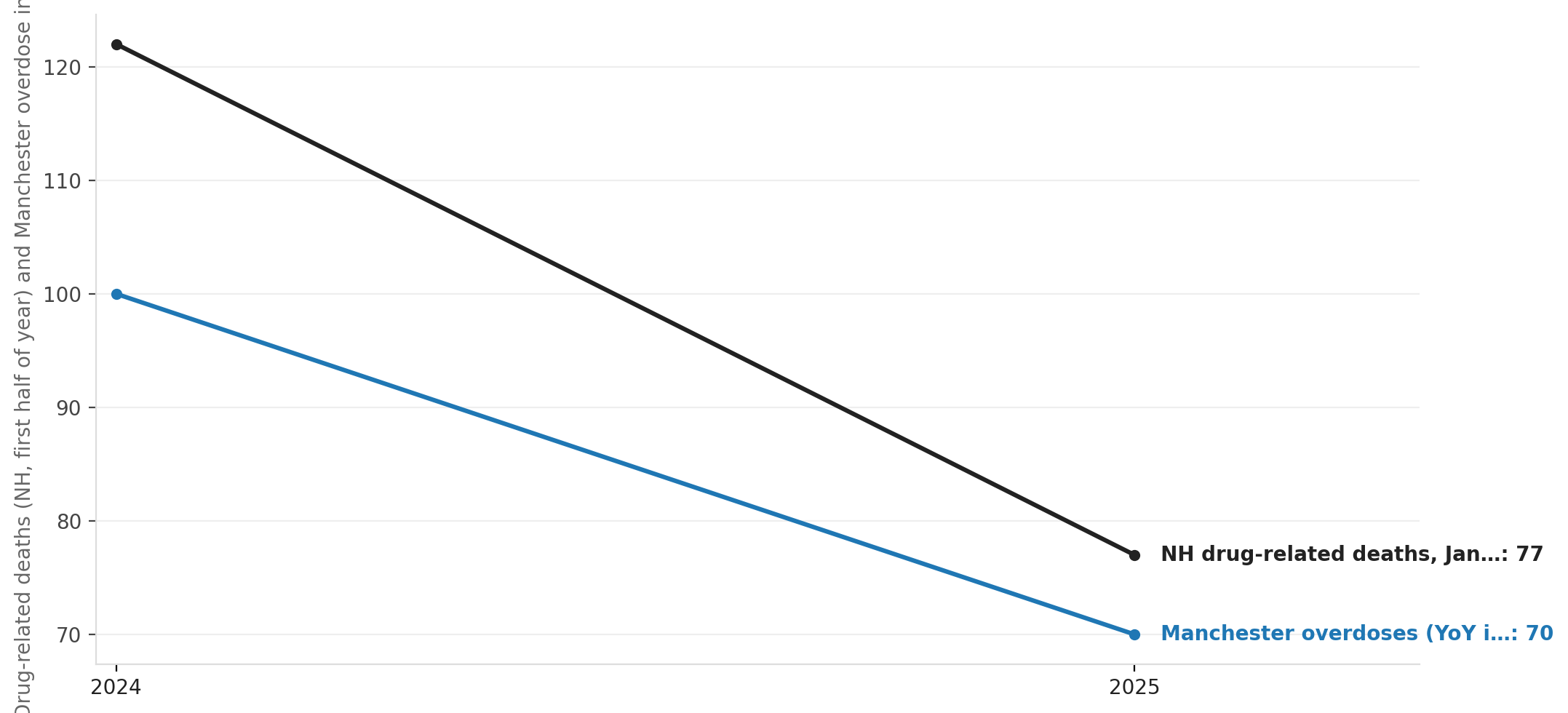
What makes this moment unusual is what NH is bringing to its grant applications. The state recorded its lowest opioid overdose numbers in a decade in 2025: Manchester, historically one of the state's hardest-hit cities, saw a 30 percent year-over-year reduction in overdoses, and preliminary first-half 2025 death data showed 77 drug-related fatalities versus 122 in the same period of 2024. Governor Kelly Ayotte called New Hampshire "a model for fighting addiction and saving lives." That language is not just political; it is a grant narrative. Competitive federal RFPs reward demonstrated outcomes from prior investment, and NH now has precisely that story to tell.
The prior investment is substantial. NH currently holds a $60.7 million SAMHSA State Opioid Response grant running through September 2027, with roughly $41 million still to be disbursed. Its active opioid grant portfolio across HHS, DOJ, and Dartmouth College research programs exceeds $90 million. The state is not starting from scratch; it is trying to layer the next funding cycle onto an architecture that is already producing measurable results.
The urgency is sharpened by where NH still stands. Despite 2025's progress, the state's overdose death rate remains 54 percent above the national average. New Hampshire has historically ranked second in the nation for opioid-related deaths per capita. The statistical improvement is real, but the baseline from which it is improving is severe. Letting the federal funding cycle lapse without a successor grant structure would risk unwinding the staffing, treatment capacity, and recovery support services that produced the 2025 numbers.
For residents, the immediate effect of the RFP surge will be felt at the contractor and provider level: rural clinics, recovery housing operators, hospital emergency departments, and tribal health programs will see new subgrant opportunities flowing from the state before the end of the year, assuming NH's federal applications succeed. The deeper effect will be whether treatment and recovery infrastructure in the state's rural counties, Grafton, Carroll, Sullivan, Coos, can be staffed and sustained through the next four-year federal cycle rather than renegotiated annually.
The open question is competitive position. Seven RFPs is a strong signal of organizational readiness, but HRSA's RCORP-Impact awards are national, and rural states across the country are filing into the same pool. NH's combination of demonstrated outcomes, existing grant infrastructure, and the Dartmouth academic-clinical research axis gives it an unusually strong application profile for a state of 1.4 million people. Whether that translates into awards will become clear when HRSA announces results later this fall.