Michigan has pulled in $12.7 million in federally obligated cybersecurity grants over the past 90 days, a 79% jump from the $7.1 million obligated in the same window a year ago, and the pressure driving that acceleration is not slowing down. Two overlapping deadlines are converging right now: local governments that received FY2022 grant money through the State and Local Cybersecurity Grant Program must spend it before performance periods expire between August and November 2026, and the next round of the same program closes applications on October 11.
Michigan is, in other words, simultaneously racing to finish spending one cohort of federal cyber-defense money and competing for the next.
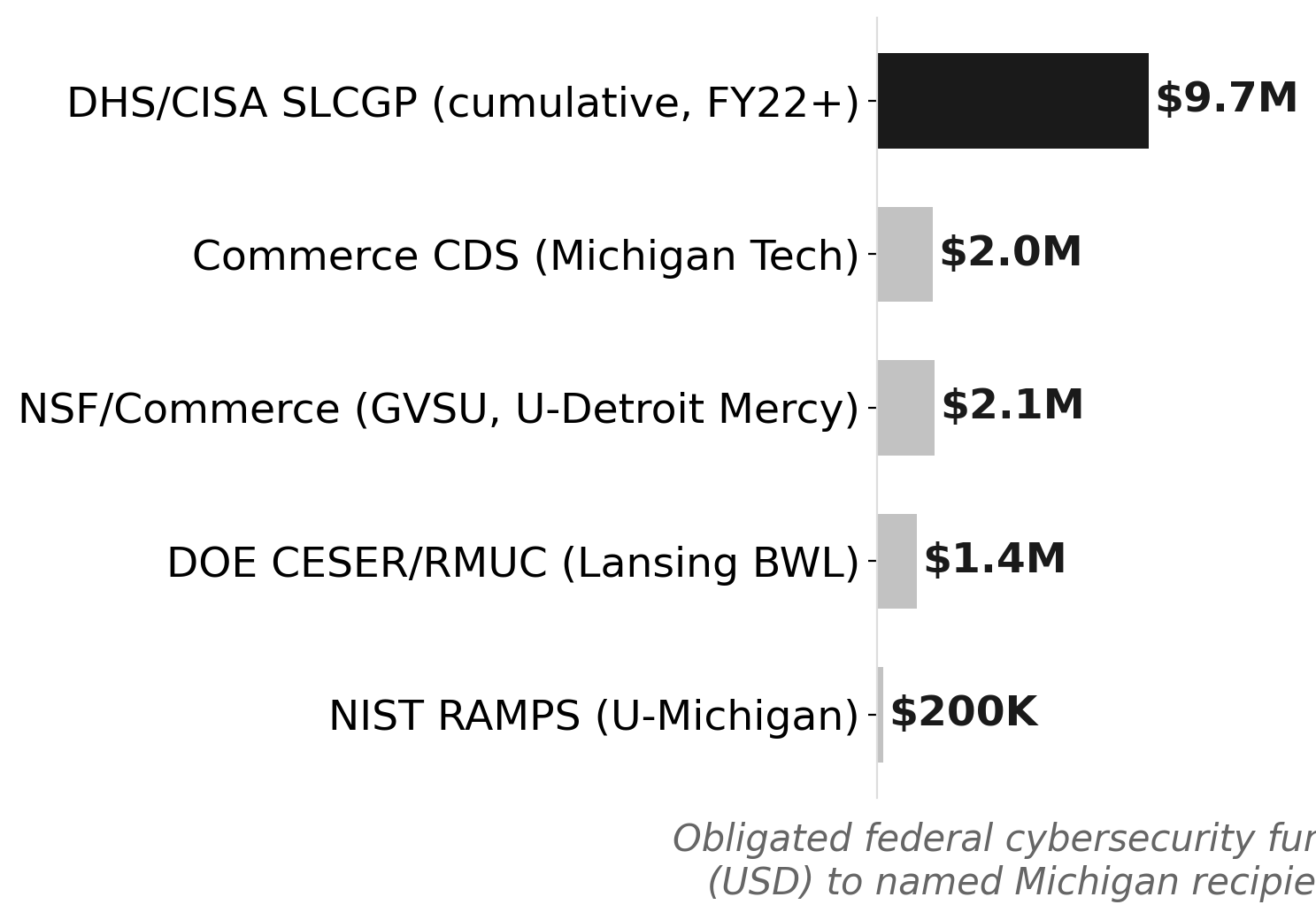
The surge is not the product of a single program or a single award. Five distinct federal mechanisms, all authorized under the Bipartisan Infrastructure Law, are hitting their mature disbursement phase at the same time, sending money to different corners of Michigan's public sector for different purposes. Collapsing them into one story would obscure how unusual the moment actually is.
Source: NationGraph.
The largest and most structurally significant is DHS/CISA's State and Local Cybersecurity Grant Program, which has obligated a cumulative $9.7 million to Michigan and its tribal governments across the FY2022 through FY2025 cohorts. Michigan's Department of Technology, Management and Budget serves as the pass-through administrator, re-awarding funds to local governments and tribes for multi-factor authentication, endpoint detection, vulnerability assessments, and incident response capabilities. DTMB is covering the full cost-share match for sub-recipients, an unusual state-level commitment that signals genuine executive priority beyond compliance.
The FY2025 application cycle opened September 14, 2026, with a deadline of October 11. That cycle explicitly targets water and wastewater systems, energy infrastructure, and transportation, and reserves 25% of awards for rural organizations, with bonus points for counties under 50,000 in population. Rural Michigan has historically had the widest gap between its cyber exposure and its IT capacity, and the FY2025 cycle is the first designed to close it directly.
While DTMB manages the local-government pipeline, two other federal programs are running parallel tracks aimed at utilities and universities. The Department of Energy's CESER program awarded Lansing Board of Water and Light $1.41 million in August 2026 for energy-grid cybersecurity hardening, a three-year project running through July 2029. The Lansing utility serves both the state capital and East Lansing and has participated in DOE's Liberty Eclipse cybersecurity exercises alongside major national utilities, which suggests the award reflects operational readiness rather than a first-time entry into cyber hardening. DOE's Rural and Municipal Utility Advanced Cybersecurity program, which funded the award, is backed by $250 million authorized over five years under the IIJA.
On the workforce side, the University of Michigan was named a NIST RAMPS recipient in September 2026, receiving $200,000 to build a Great Lakes Region cybersecurity workforce pipeline. NIST awarded $1.7 million across nine institutions nationally in this cohort, expanding its regional employer-education network to 55 communities. The RAMPS mechanism is a cooperative agreement, not a block grant, NIST is a partner in the work, not just a funder, and its output is a regional labor market for cybersecurity jobs aligned to the federal NICE Workforce Framework.
Separately, congressionally directed Commerce Department earmarks sent $2.0 million to Michigan Tech and $1.03 million each to Grand Valley State and University of Detroit Mercy, all with October 2026 start dates. NSF's Computer and Information Science and Engineering program added roughly $2.0 million more across Michigan universities in the same window.
Michigan's target profile makes the timing matter beyond the grant calendar. The state's infrastructure includes automotive manufacturing networks, Great Lakes water systems, the Lansing-area state government cluster, and the Detroit financial sector, all categories that have appeared in federal ransomware threat advisories. The $39 million active cybersecurity grant portfolio now running across Michigan, from six federal agencies, is the broadest the state has carried in a single period.
Michigan ranks second in the Midwest for 90-day cybersecurity grant volume, behind Ohio at $14.0 million. That gap likely reflects Ohio's larger urban-government footprint, but Michigan's per-capita investment picture has shifted materially in the last year.
The immediate signal to watch is the October 11 SLCGP deadline. Any Michigan local government or tribal nation that has not yet submitted a FY2025 application has days, not weeks. After that window closes, attention shifts to whether FY2022 sub-recipients can complete procurement before the November performance-period expiration, and whether the state's unusual full-match commitment continues into FY2026 budget negotiations.