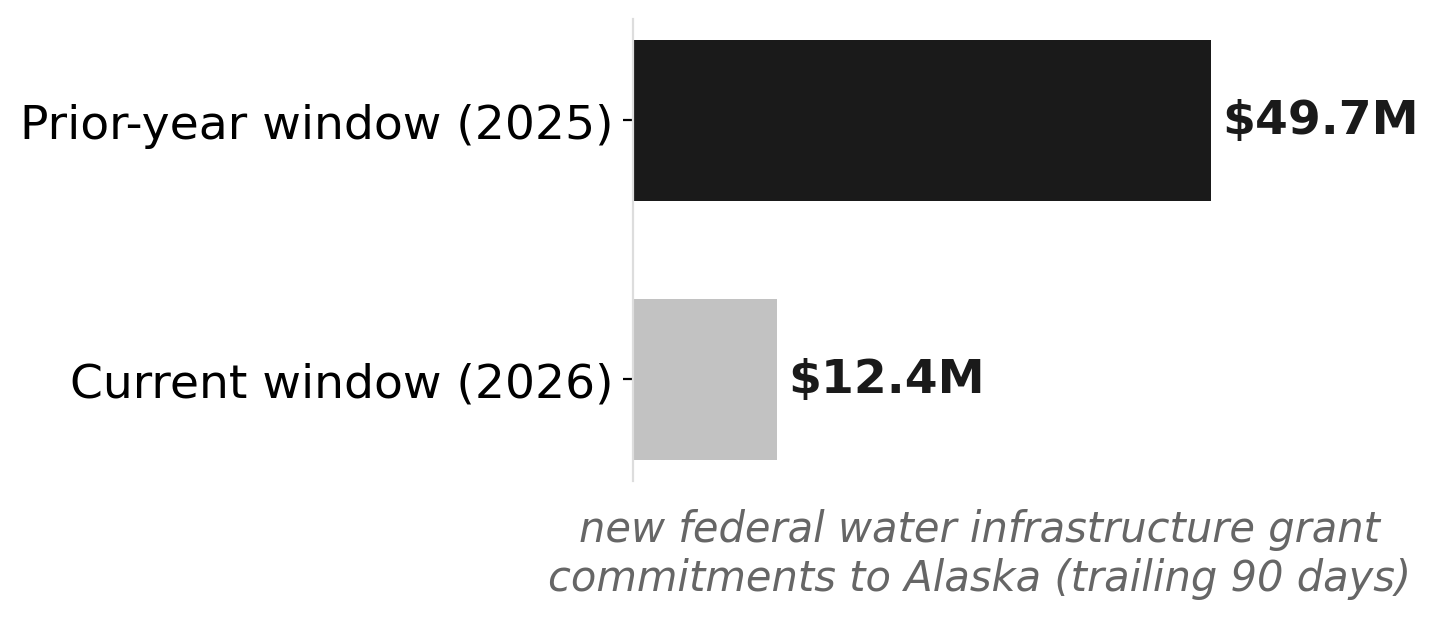
Federal water infrastructure grants newly committed to Alaska in the trailing 90 days total $12.4 million across just three awards, a 75 percent drop from $49.7 million in the same window last year. The more telling number is the zero: EPA has started no new water grants to Alaska in this period. Every dollar that landed came from DOT port and bridge programs, not the water agency whose grants form the backbone of rural Alaska's sanitation finance.
The prior-year window was anchored by three large EPA commitments: a $37.8 million WIIN emerging-contaminants grant, a $22.9 million Drinking Water State Revolving Fund capitalization grant, and a $13.6 million Clean Water SRF grant, all to the Alaska Department of Environmental Conservation, all starting July 1, 2025. None of those mechanisms have produced a new Alaska commitment this cycle. The three awards that did arrive were a $11.2 million DOT Port Infrastructure Development Program grant to the City and Borough of Juneau for the Don Young Port cargo terminal, an $881,000 National Infrastructure Investments grant to Petersburg Borough, and a $400,000 IIJA bridge grant to Alaska DNR. Port concrete and bridge steel are real infrastructure, but they do not install wells, sewer lines, or water treatment systems in villages where floods are swallowing the land.
The collapse in new commitments reflects two distinct federal shocks that are compounding each other in the same construction season.
Source: NationGraph.
The first is executive: the Trump EPA canceled approximately $280 million in Biden-era grants to Alaska communities in 2025, terminating direct grants to villages, tribes, and nonprofits for water and sewer installations, erosion barriers, and flood protection. These were not SRF loans; they were already-awarded grants that communities had planned and in some cases begun permitting around. The legal distinction matters: canceling an awarded grant mid-stream requires different remedies than a legislative failure to appropriate new money. A coalition of Alaska tribes and nonprofits, including the Native Village of Kipnuk, filed suit against EPA over the terminations. That case is still working through the courts while the construction window closes.
The second shock is structural: the Infrastructure Investment and Jobs Act's water authorization expires September 30, 2026, with no reauthorization bill introduced in Congress. The IIJA directed $55 billion nationally over five years for water infrastructure, and Alaska's DEC had anticipated $423.7 million in SRF capitalization grants across that window. FY2026 allotment tables still show Alaska receiving $36.4 million in Drinking Water SRF base and supplemental funds and $20.5 million in emerging-contaminants SRF for the current cycle, but the timing of grant starts for those allotments is now uncertain, and over $2.3 billion in IIJA allocations have already been rescinded nationally by FY2026 spending legislation. The active EPA portfolio in Alaska remains large, at $434 million across 80-plus grants running through 2028 to 2030, but that reflects commitments made in prior years. The new-commitment spigot has effectively closed.
Sen. Lisa Murkowski pressed EPA Administrator Lee Zeldin on SRF cuts in a May 2025 Senate Appropriations hearing, warning that categorical reductions would devastate tribal nations and rural communities that rely on these funds for basic infrastructure. Alaska's senators have pointed to a $100 million Denali Commission allocation for fuel tank upgrades and additional pipeline funding as a partial bridge for some affected villages, but the commission and community advocates have said the new money is smaller in scope and will not fully restore what was canceled.
The urgency is specific to Alaska's geography. Hundreds of rural and Alaska Native communities lack piped water and flush toilets and have no access to municipal bond markets or state credit mechanisms to fill a federal gap. The construction season runs roughly from May through September. A grant that does not start by early spring does not translate into ground broken that year. In a place where permafrost thaw is accelerating coastal erosion and threatening the water systems of communities that are already at the edge, a lost build year is not an abstraction, it is another winter without running water, or another riverbank closer to collapse.
The September 30, 2026, IIJA expiration is the next concrete deadline. If Congress does not pass a reauthorization, the competitive grant rounds and SRF appropriations that Alaska DEC depends on for FY2027 planning will have no statutory authority behind them. The EPA's proposed FY2026 budget has already called for sharp reductions to Clean Water and Drinking Water SRF programs. Watch for whether any reauthorization language attaches to a continuing resolution or reconciliation package before the fiscal year ends, and whether the pending lawsuit over the $280 million in canceled grants produces any court-ordered restoration before the construction window closes again.