Kentucky has pulled in just $15.2 million in new federal water infrastructure grants over the past 90 days, against $44.6 million in the same window last year, a drop that looks, on the surface, like a two-thirds collapse in federal support for the state's pipes, treatment plants, and waterways. It is not. What it actually reflects is a structural timing gap, a distorted prior-year baseline, and a national slowdown in new grant starts that is hitting Tennessee ($3.6 million in the same window) and Ohio ($843,000) just as hard.
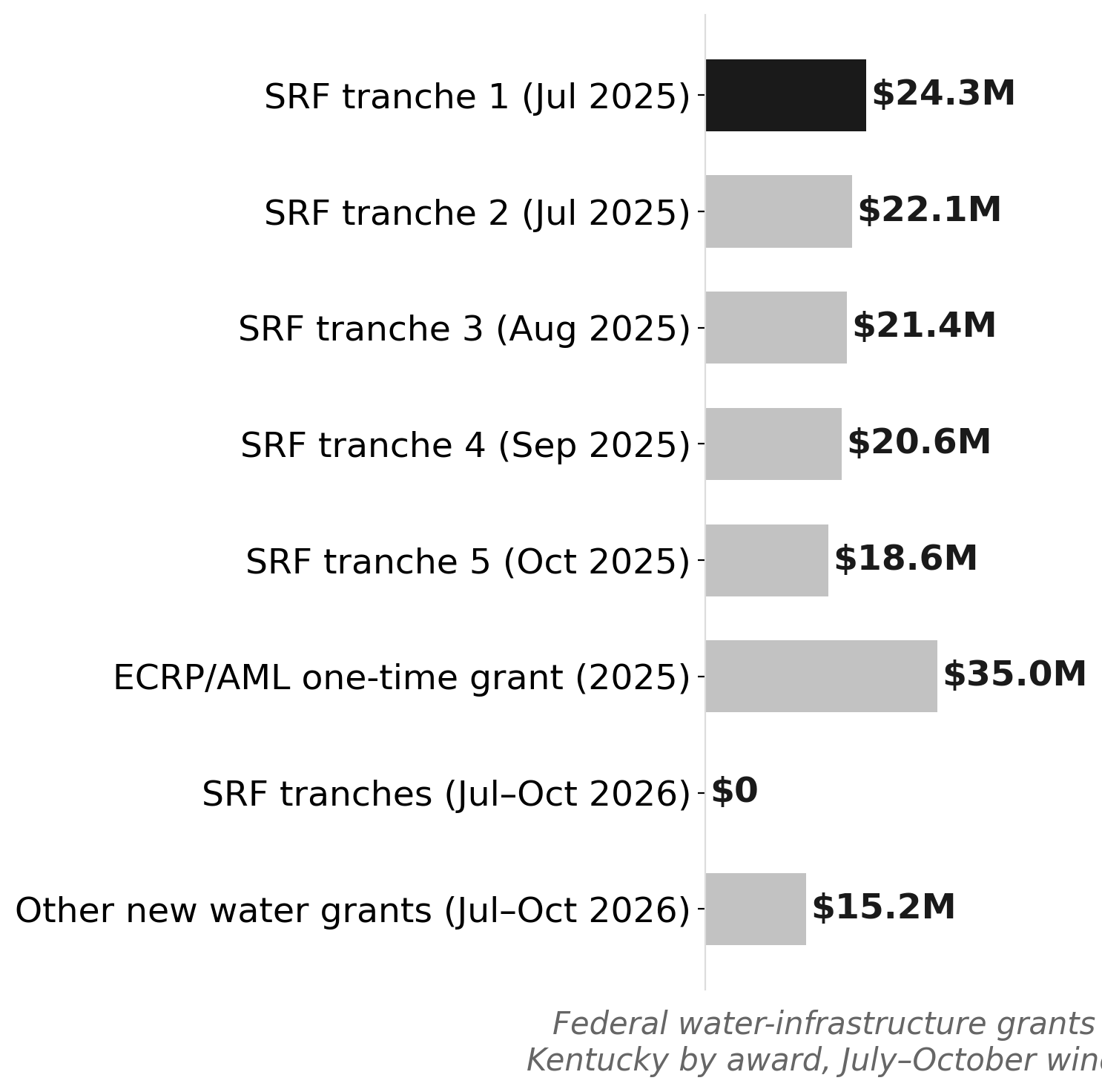
Two forces created the gap. The first is a calendar problem. The Kentucky Infrastructure Authority, the state body that channels EPA Clean Water and Drinking Water State Revolving Fund capitalization grants into low-interest loans for municipalities and utilities, received five separate EPA SRF tranches totaling more than $107 million starting July 1, 2025. None of those tranches have appeared in the equivalent July-October 2026 window. The federal fiscal year turns October 1, meaning the current 90-day window sits at a structural trough regardless of policy. The SRF capitalization grants are almost certainly in transit, not canceled.
The second force is a baseline illusion. Last year's comparison window was inflated by a $35 million Energy Community Revitalization Program grant from the Department of Interior to Kentucky's Energy and Environment Cabinet, a multi-year award for abandoned mine land reclamation that includes water infrastructure remediation in coal-impacted communities. That grant started July 2025 and runs through 2030. It does not recur as a single lump-sum start in the same July window in FY2026. Subtract it from the prior-year total and the underlying gap narrows considerably.
Source: NationGraph.
The two programs are also doing fundamentally different things and should not be read as one stream. The EPA SRF capitalization grants flow through KIA to fund subsidized loans to water and wastewater utilities. The Interior ECRP grant flows to the state cabinet for physical reclamation of abandoned mine land, with water remediation as one component. A third program, the Abandoned Mine Land Economic Revitalization program (AMLER), operates on yet another cycle: Kentucky had $29.5 million available for FY2026 applications that closed in May, and $6.6 million was already announced in June 2026 for Knott and Wolfe counties for drinking water and wastewater projects. Those awards fall outside the keyword filter that produced the 90-day metric and are disbursed in tranches rather than as a single block, which is why they do not show up in the headline number.
The underlying federal commitment to Kentucky water infrastructure remains substantial. The state's active EPA water-related grant portfolio totals more than $610 million, with an additional $296 million in active Interior grants. The pipeline is intact. The question is whether it stays that way.
Here is where the story turns genuinely uncertain. According to the EPA's April 2026 SRF allotment memo issued under P.L. 119-74, SRF funding available to states in FY2026 decreased because Congress reintroduced Congressionally Directed Spending earmarks drawn directly from SRF appropriations, a mechanism that was absent in FY2025. The memo also noted that replacement capitalization grant allotments had not been finalized as of April 2026. That delay is structural, not administrative. The national Clean Water SRF base appropriation for FY2026 is $746.1 million; the Drinking Water SRF base is $410.7 million. Kentucky's historical share of each has exceeded $50 million annually. But those shares are smaller this cycle than last, and the timing of when KIA will see the money remains open.
The larger deadline is harder to wave away. FY2026 is the final authorized year of the Infrastructure Investment and Jobs Act's supplemental SRF funding, which has added billions annually to the base program since FY2022. Congress has not yet reauthorized the core Clean Water and Drinking Water SRFs, both of which face statutory reauthorization deadlines by the end of 2026. Advocacy groups tracking the reauthorization process have flagged the gap: the SRF programs have no guaranteed funding beyond the IIJA window unless Congress acts. For a state like Kentucky, which is structurally dependent on SRF capitalization grants relative to its own fiscal capacity and whose greatest water infrastructure needs are concentrated in Appalachian eastern counties still recovering from flooding in 2022 and 2025, that is not an abstract legislative question.
KIA has published its FY2026 Intended Use Plans for both the CWSRF and DWSRF, confirming it has entered into a grant agreement with EPA for FFY2025 funds and is anticipating FY2026 capitalization grants. The state has projects queued. The money has not arrived yet.
The 90-day number is a trough, not a trend. The signal worth watching is whether Congress moves on SRF reauthorization before the IIJA supplemental authority expires, and whether KIA's FY2026 capitalization tranches arrive before eastern Kentucky communities counting on that pipeline run out of runway.