Federal AI grants newly awarded to Nevada totaled $7.7 million in the trailing 90 days, a 245% increase over the $2.2 million committed in the same window a year ago. Every dollar went to one entity: the Board of Regents of the Nevada System of Higher Education, the public university system that encompasses UNLV, UNR, and the Desert Research Institute.
That concentration is the story. Nevada has no major private tech sector, no venture-backed AI startup corridor, and no state AI procurement push driving the numbers, the NationGraph database shows zero Nevada state or local government AI contracts in the same period. What it has, increasingly, is a public university system that has learned to compete for federal research dollars at a scale it couldn't manage even five years ago.
The upstream catalyst is NSF's $100 million expansion of its National AI Research Institutes program, announced in July 2025 in partnership with Capital One and Intel, described by NSF as the largest expansion of the program since its 2020 launch. That round feeds subawards and associated competitive grants into the following academic year, which explains the July-August 2026 surge visible in Nevada's numbers. The largest single new award is a $4.5 million NSF Mathematical and Physical Sciences grant that began in August 2026 and runs through July 2029. Two additional NSF Engineering grants totaling $1.45 million started in the same window, alongside a $1.15 million USDA Agriculture and Food Research Initiative grant applying AI methods to food systems research, a separate federal program with a distinct purpose, but pointing in the same direction.
Source: NationGraph.
Across all active grants, NSHE now holds approximately $21.9 million in federal AI commitments across 22 awards from NSF, HHS, USDA, the Department of the Interior, and DOJ, with the longest running through 2031. NSF alone accounts for 18 of those awards, totaling $16.4 million obligated to the system.
None of this happened by accident. NSHE's NV-DICE initiative, a two-year NSF planning grant run in partnership with Internet2, held its second Research Technology Strategy Workshop in June 2026, explicitly aimed at preparing the system's campuses for competitive federal funding cycles. NV-DICE is not itself a research grant; it is infrastructure for winning research grants. The distinction matters. NSHE has been building the coordination layer, shared cyberinfrastructure planning, multi-campus proposal alignment, faculty grant-readiness, that allows individual researchers to compete for programs that previously flowed to universities in California, Texas, and the Northeast.
The payoff is visible beyond the 90-day window. UNR received 24 NSF CAREER awards over the last four years, nearly double the 11 it received in the prior four-year period. The Desert Research Institute, a nonprofit NSHE campus, led a separate $2.7 million federal initiative announced in February 2026, funded through the U.S. Department of Education's Fund for the Improvement of Postsecondary Education, to prepare K-12 educators across Nevada to teach AI and computer science. That initiative, which includes a $775,507 subaward to UNR, draws on Executive Order 14277 on advancing AI education for American youth, which NSF has cited as a direct policy anchor for the institutes program.
Context for why this is notable: both UNLV and UNR received Carnegie R1 classification, the highest research-activity designation, only in 2018 and 2021, respectively. They are among the newest entrants to the tier of universities that routinely competes for programs like the NSF AI Institutes. Senator Catherine Cortez Masto's office noted in a March 2026 grants newsletter that Nevada chronically under-captures federal grants relative to eligible pools, a gap that NSHE's coordinated infrastructure push is designed to close.
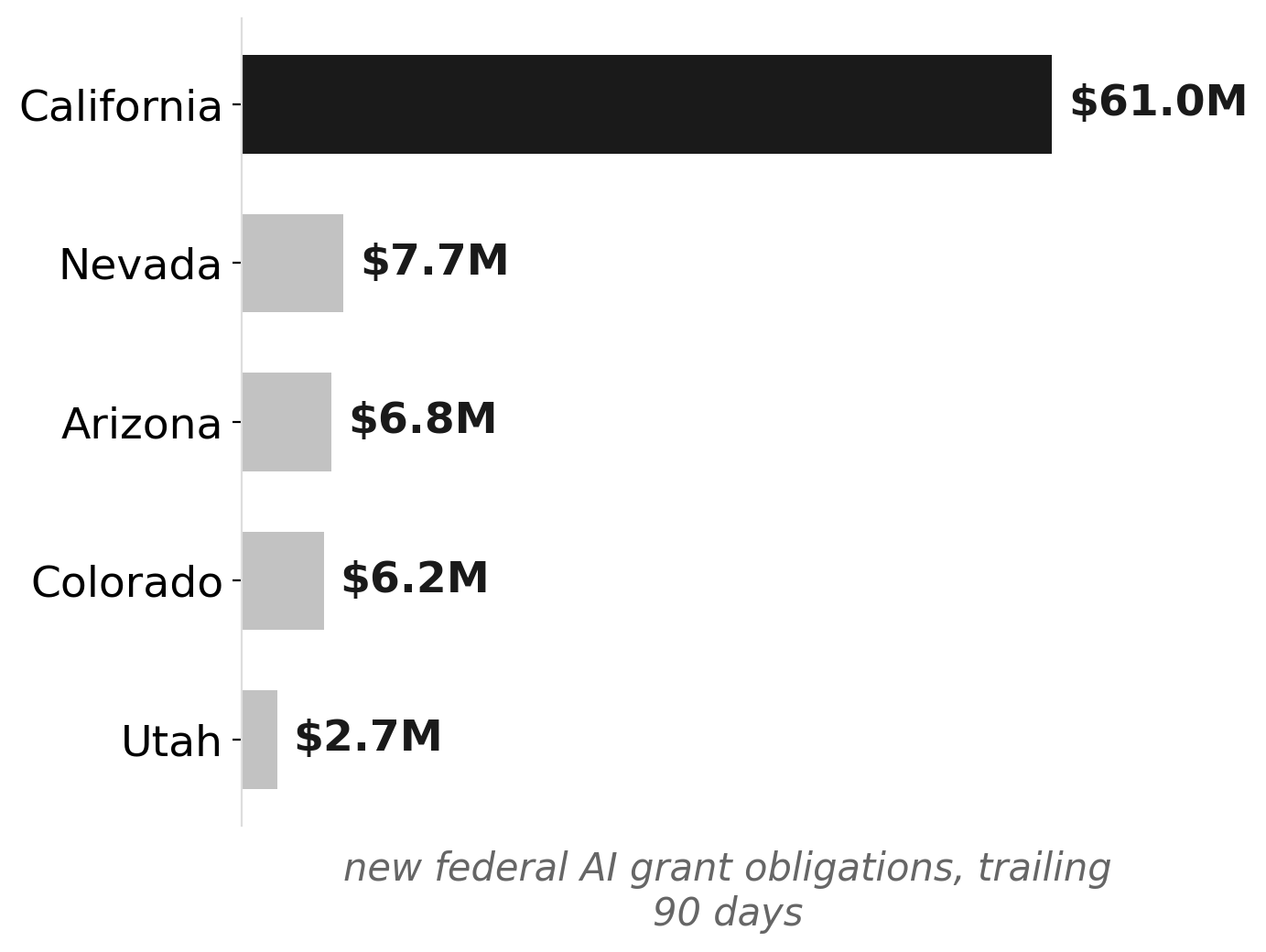
By the numbers, Nevada now ranks second among immediate Western peers in new 90-day AI grant commitments, trailing California ($61 million across 72 grants) and running ahead of Arizona ($6.8 million), Colorado ($6.2 million), and Utah ($2.7 million). For a state whose economy runs on hospitality and gaming, that positioning reflects a deliberate policy bet: that federal research funding is the only realistic path to building durable AI capacity, and that building the grant-capture machinery is as important as the science itself.
The next signal to watch is whether NSHE's active portfolio, now running to 2031, translates into the kind of industry partnerships and faculty retention that convert federal seed money into something self-sustaining. The NV-DICE planning process wraps up in 2026; what the system does with the infrastructure coordination it has built will determine whether this summer's numbers represent a new baseline or a one-cycle spike.