Six Missouri institutions issued their first stormwater management RFP in over a year, or ever, within the past 30 days. The prior comparable period produced zero. The timing is not a coincidence.
On August 1, 2026, the Missouri Department of Natural Resources issued a renewed MS4 stormwater permit to Columbia, Boone County, and the University of Missouri. The permit introduced new requirements for illicit discharge detection and encampment-related pollution control, and MoDNR was explicit in the permit language: these requirements will be incorporated into renewed permits for regulated communities across Missouri going forward. That sentence, landing in the dead of summer, appears to have functioned as a starting gun.
The mechanism behind the surge is a two-track regulatory renewal wave. MoDNR is simultaneously renewing two Phase II MS4 Master General Permits that together govern roughly 160 Missouri communities. The Phase 2 Small MS4 Master General Permit (MOR04000) covers smaller regulated municipalities and saw its public comment period close in February 2026. The Phase 2 Comprehensive MS4 Master General Permit (MOR04C000), which applies to larger co-permittee arrangements like St. Louis County's suburban cluster, had its comment period close June 1, 2026, with agency responses issued in July. The two instruments apply to different jurisdictions and are not interchangeable, but they impose the same six Minimum Control Measures and are renewing on overlapping timelines. For communities that had been watching the rulemaking calendar, the July agency responses plus the August Columbia permit combined into a single, unmistakable compliance signal.
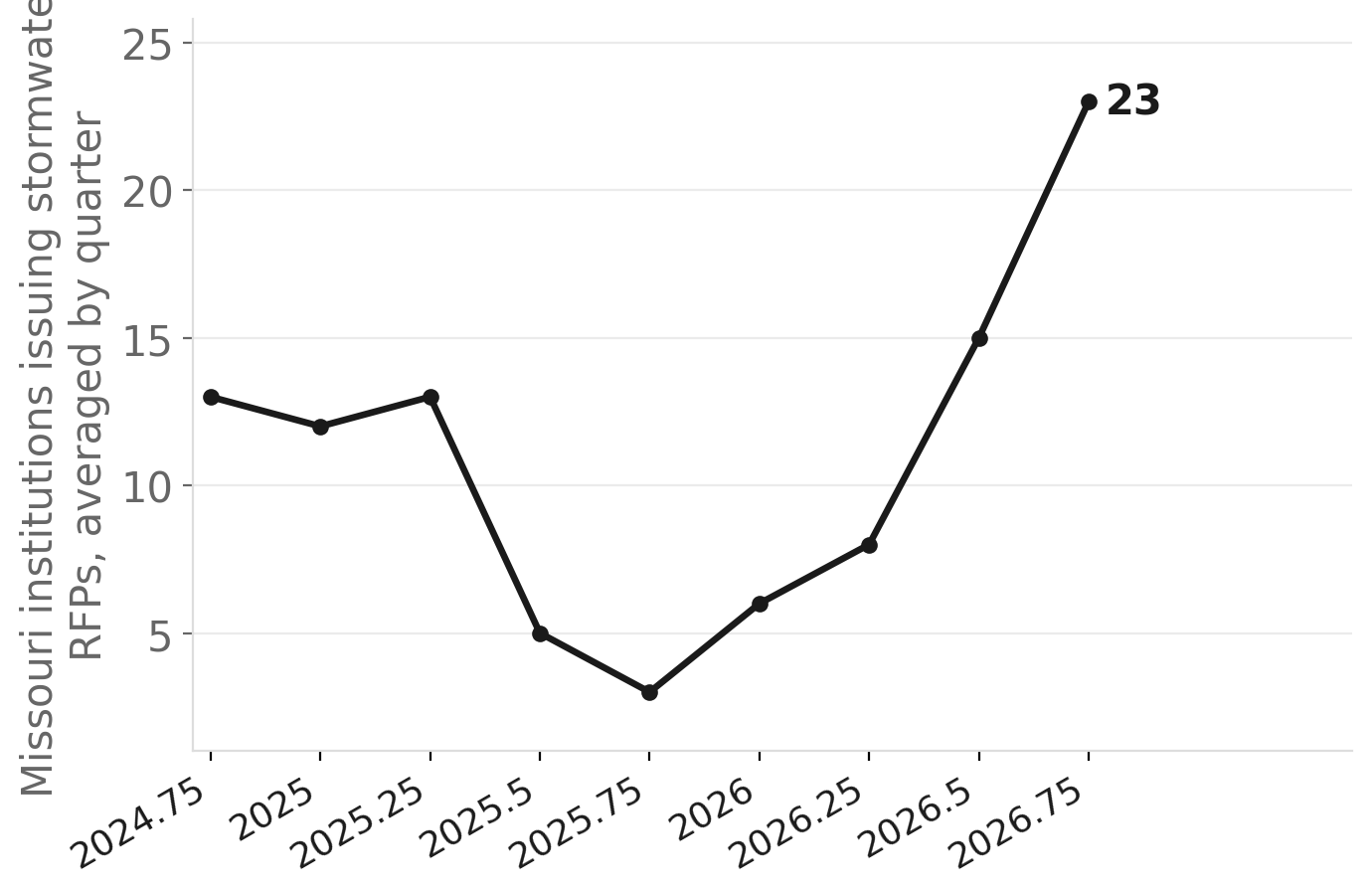
Source: NationGraph.
Three of the six newly active issuers have no prior stormwater RFP in the procurement database at all. University City in St. Louis County, Maryville in Nodaway County, and Springfield Public Schools in Greene County all appear to be issuing for the first time. Three others had simply gone quiet: the City of Brentwood (410-day gap), Parkway C-2 School District in Chesterfield (413-day gap), and the Missouri Department of Transportation (400-day gap). None of these entities were outside the MS4 regulatory framework during their dormant period. They were waiting.
What they were waiting for is now resolved. The Columbia permit made concrete what the comment periods had only previewed: stricter illicit-discharge detection ordinances, post-construction runoff controls, and new requirements tied to encampment-related water quality impacts. As stormwater trade press noted when the Columbia permit dropped, the illegal dumping provisions in particular represent a substantive policy shift, not a routine permit refresh. For a municipal engineer trying to scope a stormwater contract, that kind of shift means the RFP template from 2024 may not cover what the renewed permit will require.
The geography of the surge reinforces the regulatory interpretation. St. Louis County suburbs account for four of the recent issuers, consistent with the co-permittee structure under MOR04C000, where a county-level permit renewal concentrates compliance pressure across multiple municipalities simultaneously. But the wave is not limited to the St. Louis metro: Maryville sits in the far northwest of the state, and Springfield Public Schools is in Greene County, roughly 200 miles southwest of St. Louis. A procurement spike that spans Nodaway County and St. Louis County in the same 30-day window is not a localized response to a single city's problem. It reflects a statewide regulatory calendar coming due.
Farmington, in St. Francois County, illustrates the timeline pressure from another angle: its site-specific MS4 permit expires in September 2026, and the city held a public meeting on August 13 for its 2026-2031 permit cycle. Communities in that position, permit expiration imminent and new requirements confirmed, have little room to delay procurement.
For residents, the practical consequence is that stormwater infrastructure spending is likely to accelerate across Missouri through late 2026 and into 2027. What that spending covers will look different than previous cycles: the new permits emphasize detection and enforcement of illegal discharges, not just pipe capacity. Communities will need to demonstrate that they can identify and respond to dumping events, which requires both engineering infrastructure and updated ordinances. School districts in the RFP pool, Parkway C-2 and Springfield Public Schools among them, face the same compliance obligations as municipalities under the MS4 framework, which is worth noting for anyone who assumes stormwater regulation is purely a city hall concern.
The next signal to watch is MoDNR's issuance of the renewed Master General Permits themselves. When MOR04000 and MOR04C000 are formally signed and published, each of the roughly 160 regulated communities will receive its updated compliance schedule. That publication, whenever it arrives, is likely to produce a second procurement wave for communities that have been watching the Columbia permit but have not yet moved.