Federal wildfire grants flowing to Arizona hit $9.9 million in the 90 days ending mid-September 2026, almost exactly double the $4.96 million committed in the same window a year ago. The surge is not a response to a single catastrophic fire season. It is the product of a slower, structural shift: the Bipartisan Infrastructure Law's $5 billion national wildfire envelope, signed into law in 2021, is now entering its fourth and fifth years of active disbursement, and Arizona is drawing from it faster than nearly every other Western state.
Across ten separate federal awards in that window, the state's Department of Forestry and Fire Management (DFFM) captured $5.6 million, the largest share, through a combination of USDA Cooperative Forestry Assistance grants, Hazardous Fuel Reduction programs, and Good Neighbor Authority agreements. Northern Arizona University received $2.2 million under the USDA's Southwest Forest Health and Wildfire Prevention program for applied research on forest resilience. The Fredonia Natural Resource Conservation District, a smaller, rural entity in the Arizona Strip north of the Grand Canyon, received $800,000 under an Infrastructure Investment and Jobs Act Restoration/Revegetation vehicle, representing one of the first significant federal commitments to that jurisdiction.
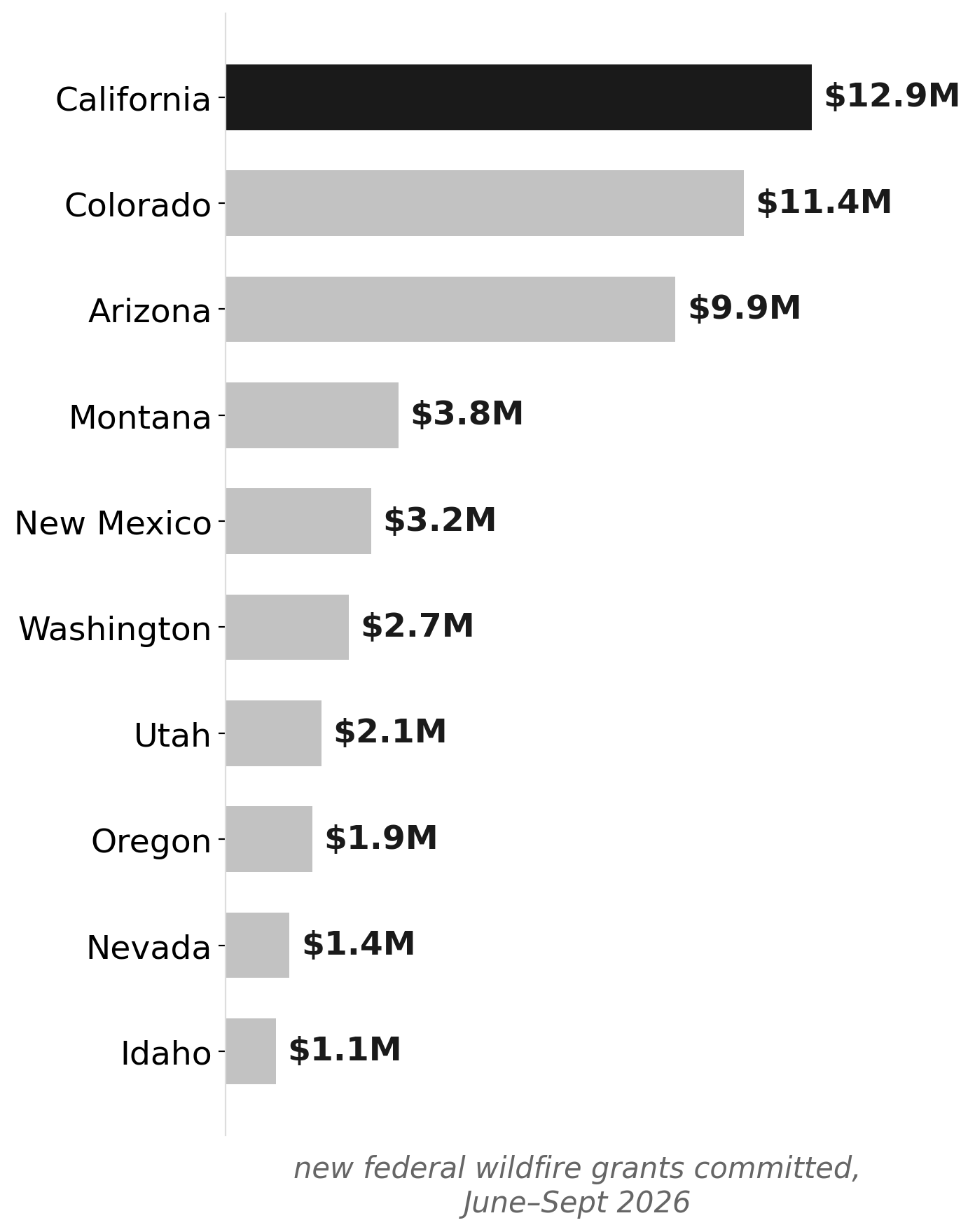
In a peer comparison of ten Western states over the same trailing 90-day window, Arizona ranks third, behind California ($12.9 million) and Colorado ($11.4 million), and ahead of Montana, New Mexico, Washington, and Oregon. That positioning matters: a regional funding surge would show every state moving together. Arizona's doubling against a relatively flat peer group suggests the state's grant pipeline, the maturity of its Community Wildfire Protection Plans, DFFM's growing institutional capacity, and its university research infrastructure, is earning a disproportionate share of competitive federal dollars.
Source: NationGraph.
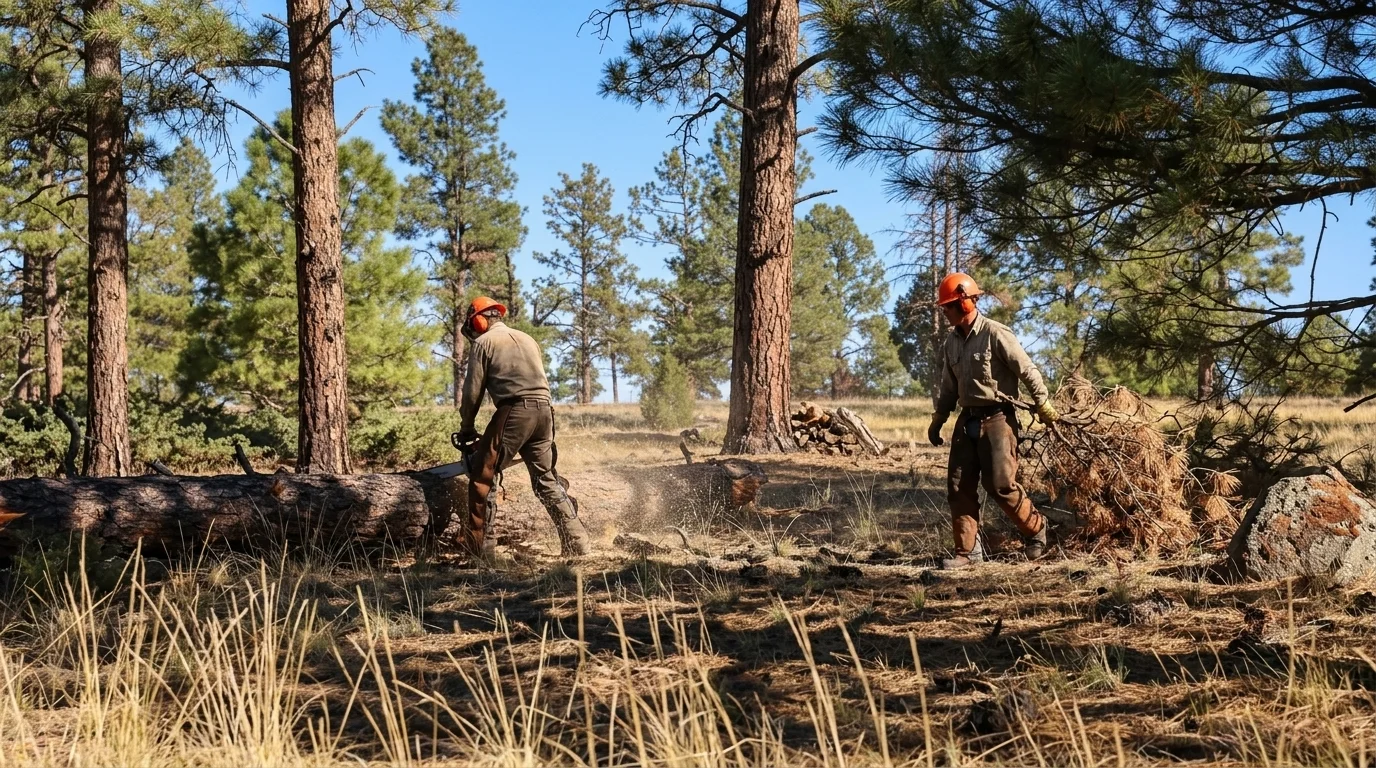
The single most visible new commitment came on September 17, 2026, when the Kaibab National Forest and DFFM announced a Good Neighbor Agreement covering nearly 14,000 acres in northern Arizona. The agreement draws on $6.4 million in BIL funding, matched by Salt River Project, and authorizes DFFM crews to conduct fuel treatments on federal land alongside Forest Service personnel, a cross-boundary model that has been expanding nationally but represents one of the largest single collaborative actions in Arizona this year.
Two months earlier, in July 2026, DFFM's Healthy Forest Initiative allocated $1.8 million for 12 fuels management projects covering 4,500 acres. That program operates differently from the direct federal awards: DFFM acts as an intermediary, sub-granting competitively to local fire districts, nonprofits, and government entities using federal BIL and USDA pass-through funds. The distinction matters for understanding how the money actually reaches the ground. Direct federal awards to DFFM and its university partners account for most of the 90-day total; the Healthy Forest Initiative represents a parallel channel that distributes smaller amounts more broadly across the state.
A separate statutory change is reshaping DFFM's role in ways that compound its appeal as a federal co-grantee. Arizona Laws 2025, Chapter 167, effective May 2026, required utilities to file wildfire mitigation plans with DFFM for the first time, giving the agency new regulatory authority over a sector that controls thousands of miles of high-voltage transmission corridors running through fire-prone landscape. That law does not fund any of the grants described here, but it has meaningfully enlarged DFFM's footprint and positioned it as a more credible partner in federal co-investment discussions. A utility-scale wildfire mitigation requirement and a federal land management agreement are different instruments, but both are concentrating resources and authority in the same agency at the same moment.
For residents of northern Arizona's wildland-urban interface, communities in Coconino, Yavapai, and Mohave counties where exurban growth has pushed neighborhoods into ponderosa pine corridors, the practical effect of this investment cycle will be more visible than previous years' funding. The Four Forests Restoration Initiative, a federal priority landscape since 2012, has long been the framework for large-scale thinning in the region; the BIL funding is now providing the sustained financial pressure to actually move acreage. Arizona has 13 active Community Wildfire Protection Plans that keep local jurisdictions eligible for competitive federal cycles, including the Community Wildfire Defense Grants program, which funded 58 projects nationally totaling $200 million in its September 2025 cycle.
The open question is capacity. DFFM is administering more concurrent grant vehicles than at any point in its recent history, direct federal awards, Good Neighbor agreements, sub-grant competitions, and now utility plan reviews. Whether the agency can execute $5.6 million in new commitments while simultaneously standing up a utility oversight function will be visible in project delivery timelines over the next two to three fire seasons. The BIL wildfire appropriation runs through fiscal year 2026; the pace of disbursement in the final year of the pipeline will test whether Arizona's absorption capacity matches its grant-capture success.