New York has issued 23 flood-control RFPs in the last 30 days, more than double its 12-month average of roughly 11 per month, putting the state virtually even with Texas in raw procurement volume and well ahead of Florida and California. The surge is not a one-month blip: May logged 21 RFPs, June 19, and July is pacing to approximately 16. What the numbers describe is a procurement wave, three or four months in the making, where planning money has finally converted to construction contracts.
The force behind it is a convergence of three funding programs, each with its own hard deadline in the first half of 2026. Governor Hochul's FloodSafe NY initiative, announced in her January 2026 State of the State, unified NYSDEC watershed studies, implementation grants, and stream monitoring under a single coordinated structure. The $60M Resilient Watersheds Grant Round 2, drawn from the state's $4.2 billion Environmental Bond Act, opened March 26 and closed June 26, the precise window overlapping the sharpest rise in RFP volume. Institutions that wanted to compete for Round 2 dollars needed construction-ready scopes of work; the June deadline forced them to procure. Separately, the New York State Homes and Community Renewal RISC Infrastructure NOFA is deploying $68.2 million in HUD CDBG-DR funds tied to Hurricane Ida, with a deadline extended to August 3, 2026, targeting Westchester, Nassau, Suffolk, Rockland, Orange, and Dutchess Counties, the downstate suburbs where Ida caused the highest per-capita infrastructure damage.
The most striking single procurer is CUNY. The university system has issued four flood-mitigation RFPs in the last 30 days, covering Brooklyn College, Medgar Evers College, and the College of Staten Island. The titles are specific and construction-oriented: campus-wide flood mitigation systems, drainage improvements, water remediation. CUNY campuses absorbed significant infrastructure damage when Ida's remnants swept through New York City in September 2021, and the Bond Act created a durable funding pipeline that does not depend on federal BRIC allocations. That matters, because City and State NY has reported that FEMA's suspension of the BRIC program halted roughly $200 million in NYC cloudburst hub funding, concentrating pent-up demand onto state-level dollars. SUNY Stony Brook has issued two additional RFPs, and unnamed state agencies account for nine more, reflecting how broadly the procurement wave has spread beyond any single institution.
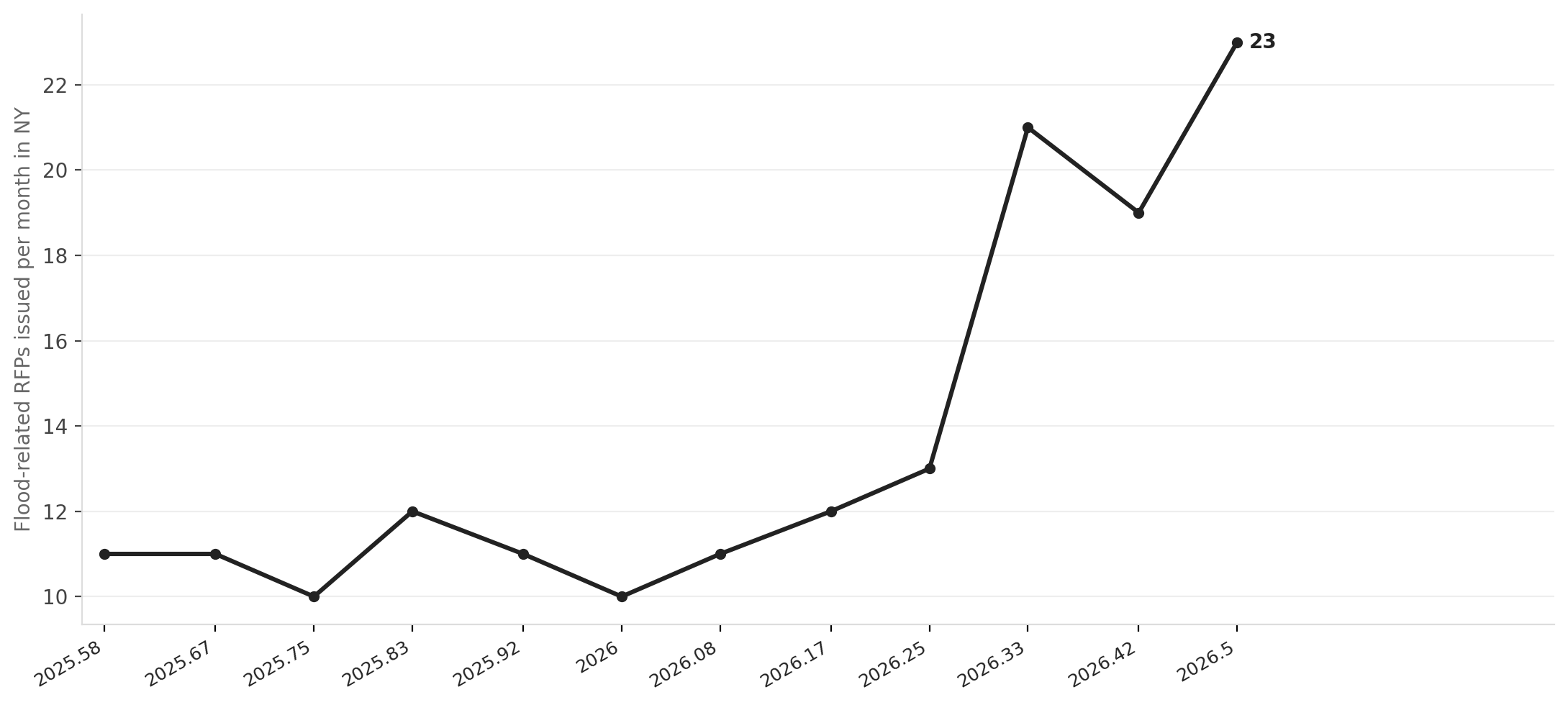
Source: NationGraph.
The suburban dimension of the surge is equally significant. New Rochelle and the Village of Mamaroneck are among the smaller municipalities now in active procurement. Westchester County holds HUD's designation as the most-impacted-and-distressed county from the Ida disaster declaration (FEMA DR-4615), and the RISC NOFA is structured to prioritize exactly these communities. The August 3 application deadline means any municipality submitting to HCR still needs construction-ready documents in hand, which explains the procurement activity running in parallel with the grant application window rather than after it.
The underlying federal portfolio confirms this is execution, not aspiration. New York currently holds 76 active federal flood grants with $836 million obligated and $507 million already disbursed. FEMA approved $2 million in additional flood mitigation funding for New York in April 2026, and the agency announced nearly $10 million in Pre-Disaster Mitigation projects for the state in late June, including slope stabilization in Yonkers and a flooding mitigation project in Freeport. Those are smaller line items against a large portfolio, but they illustrate that federal project-specific approvals are continuing even as the larger BRIC program remains suspended.
New York's flood exposure spans two distinct geographies: the coastal and urban areas that absorbed Sandy and Ida, and the inland watersheds of the Catskills, Hudson Valley, and Finger Lakes. The current RFP wave is concentrated in the former. The Bond Act's multi-round structure, NYSDEC awarded $55 million to 15 recipients in Round 1 on January 15, 2026, before opening Round 2 at $60 million, means the inland watershed communities are likely to generate a second procurement wave when Round 2 grants are awarded in late 2026 or early 2027.
For residents in Westchester and Long Island, the most immediate signal to watch is whether their municipality filed under the RISC NOFA before August 3. Awards from that program will determine which suburban drainage and stream projects reach the construction phase in 2026 versus waiting another funding cycle. For the CUNY campuses already in procurement, the question is how quickly contractors can respond: a 2.1x surge in RFP volume across a 90-day window tests the capacity of the regional engineering and construction market to absorb the work before institutional budget calendars reset.