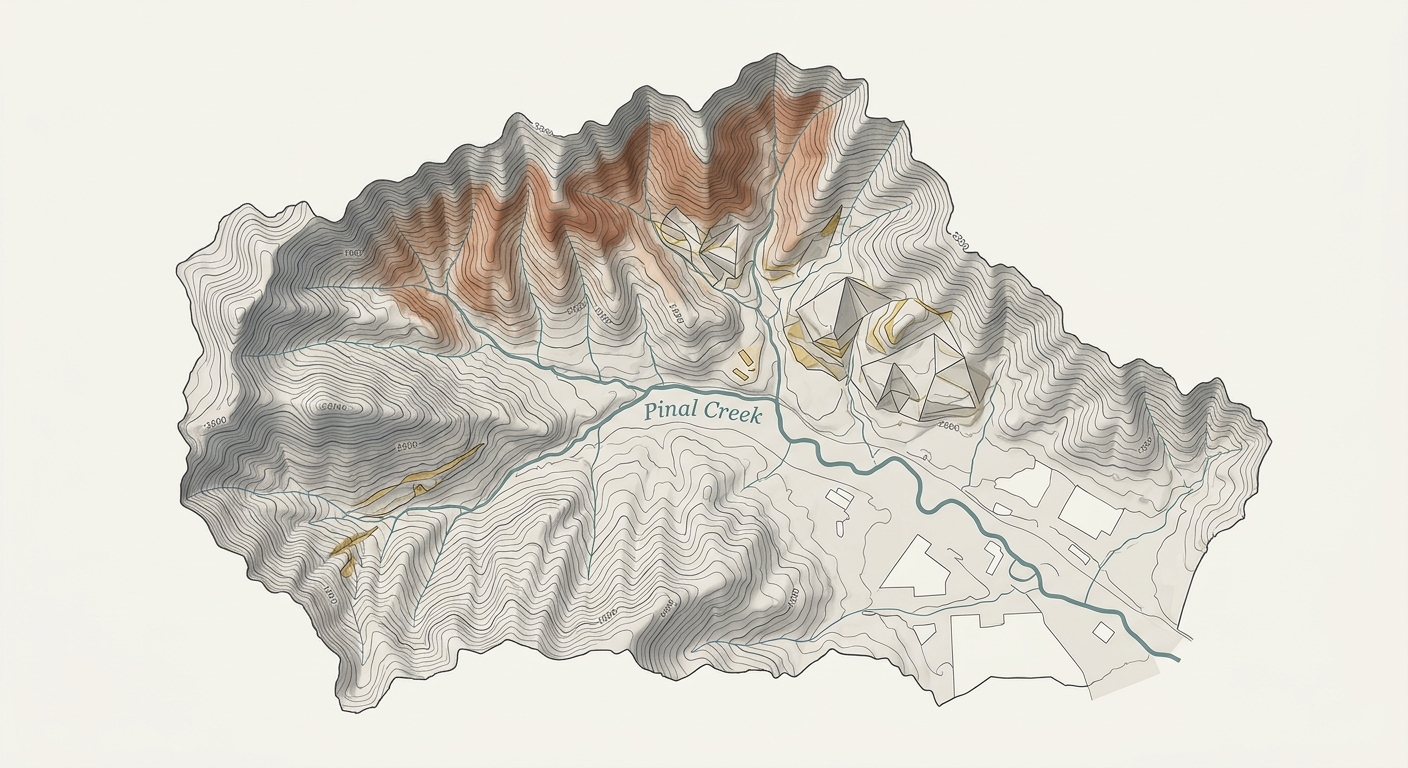
Gila County, Arizona is moving forward with a major cleanup of Pinal Creek after 2025 flooding tore through the Globe-Miami corridor, dislodging sediment and eroding streambanks in a watershed already battered by decades of copper mining and a recent wildfire.
The U.S. Department of Agriculture awarded a $19.3 million Emergency Watershed Protection Program grant in early March to fund sediment removal and streambank stabilization along Pinal Creek, a Salt River tributary that runs through the heart of the old mining district. The work follows a formal damage assessment by the USDA's Natural Resources Conservation Service, which documented conditions severe enough to warrant one of the larger single-site emergency watershed grants in the state.
The flooding struck terrain that was already compromised. The 2021 Telegraph Fire burned more than 180,000 acres in the Pinal Mountains near Globe, stripping hillsides of the vegetation that slows runoff during Arizona's monsoon season. When intense monsoon rains hit those bare, fire-scarred slopes in 2025, the results were predictable: fast-moving floodwaters loaded with sediment, eroded banks, and disrupted drainage throughout the valley.
But Pinal Creek carries an additional hazard. More than a century of copper mining in the Globe-Miami district has left tailings piles, contaminated groundwater, and sediments laced with copper, manganese, and other metals throughout the watershed. Floodwaters don't just move dirt here — they can redistribute mining-era material that has sat in place for generations, raising concerns about downstream water quality for communities along the Salt River, including the San Carlos Apache Indian Reservation, which borders the area to the east.
The $19.3 million in federal funds cover roughly 75 percent of the project's estimated cost under standard EWPP terms, leaving Gila County or a local conservation district responsible for approximately $6.4 million in matching funds. That's a significant ask for a county of about 54,000 people with a limited tax base and aging infrastructure. The county has historically depended heavily on state and federal support for disaster recovery, and this project is unlikely to be an exception.
With the grant now awarded, the county and NRCS will need to move through contractor selection and mobilization before the next monsoon season intensifies the risk further. How quickly the county can arrange its share of the funding will determine whether that timeline holds.