Federal mental health grants newly started in North Carolina have reached $21.2 million in the trailing 90 days, up 63% from $12.9 million in the same window a year ago. The money is real and the growth is significant. But most of it is landing at Duke University and UNC-Chapel Hill, not at the county jails where incarcerated people wait an average of six months for a state psychiatric bed.
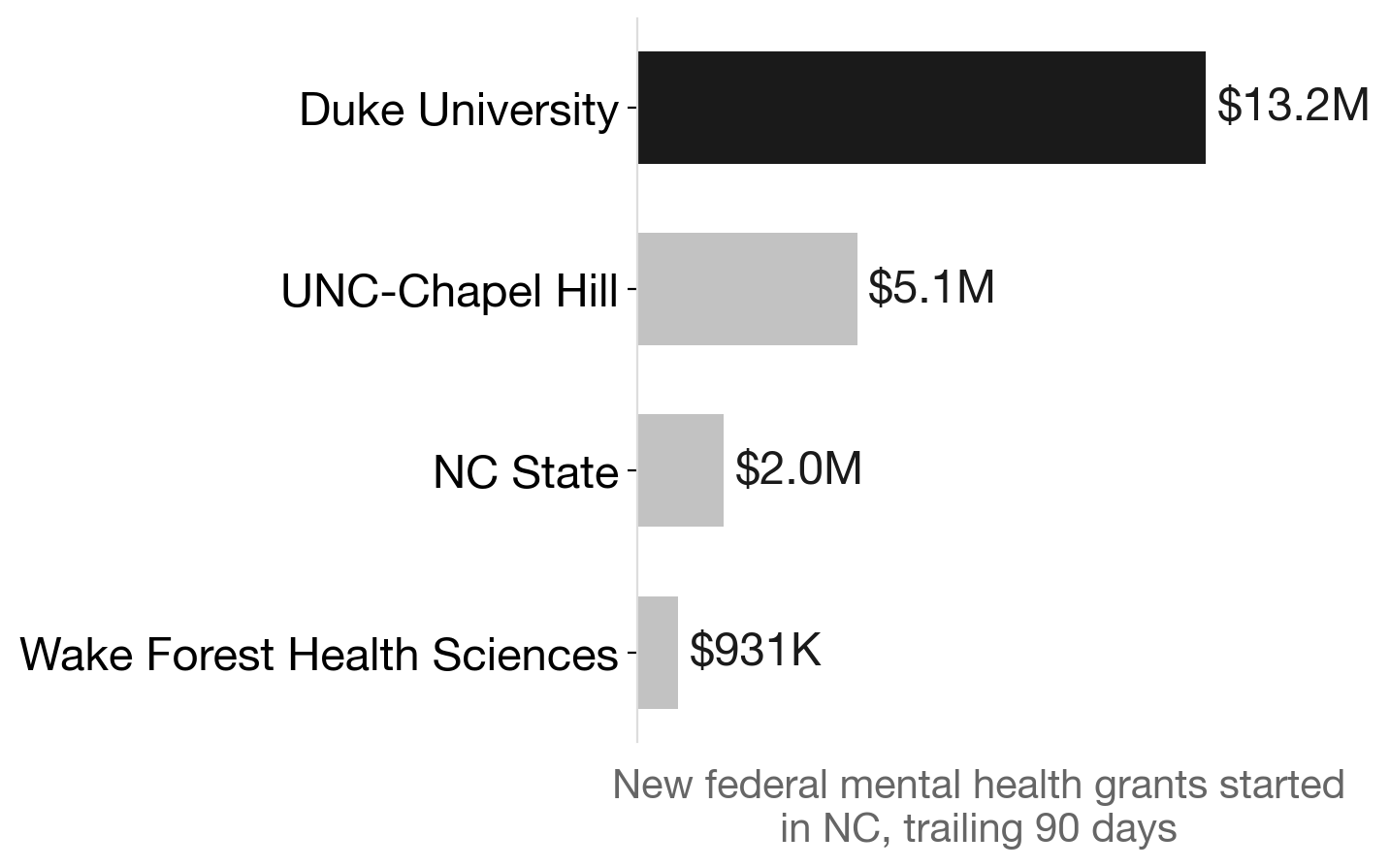
Duke alone accounts for $13.2 million across 15 NIH grants in the current window. UNC-Chapel Hill follows with $5.1 million across six grants, including a new $1.94 million Mental Health Research Grant running through 2031. NC State and Wake Forest Health Sciences account for another $3 million combined. All of it flows through HHS and NIH, directed by the federal grant cycle rather than by the acute pressure Governor Josh Stein has been applying since February.
That pressure is considerable. Stein signed Executive Order No. 33 on February 5, 2026, directing multiple cabinet agencies to overhaul how behavioral health and criminal justice systems interact. The order came directly after the 2025 Charlotte light-rail killing and other high-profile incidents involving individuals with documented mental illness histories. The governor has also proposed a $195 million public safety package with behavioral health components, though the legislature has not yet funded it. In April 2026, a bipartisan General Assembly committee issued its own report calling for urgent reforms: telehealth expansion inside jails, more psychiatric beds, and a workforce push. NC lawmakers have recommended the reforms, but funding questions remain unresolved.
Source: NationGraph.
On the service-delivery side, federal dollars are already flowing at a larger scale, though through older channels. NC DHHS holds a $29.5 million Community Mental Health Services Block Grant running through September 2026, and a new $9.5 million block grant cycle began in October 2025 and runs through 2027. SAMHSA has also directed $13.7 million in project grants and $8 million specifically for children with Serious Emotional Disturbances to the state. These commitments predate the current political moment and reflect SAMHSA's biennial renewal cycle more than Stein's executive order.
The result is a state spending aggressively on two largely separate tracks. Research universities are capturing NIH dollars at a rate that reflects North Carolina's unusual grant-capture capacity: Duke, UNC-CH, and NC State together give the state a concentration of research infrastructure that few can match. The service side is being held up by SAMHSA block grants and the state's own budget, which included a reported $835 million behavioral health investment across the 2023-2025 biennium. NCDHHS opened seven new Behavioral Health Urgent Care centers in 2025 alone, with two more planned for Lenoir and Wake counties in 2026.
What those numbers obscure is the staffing reality underneath them. Hundreds of psychiatric facility beds across the state sit unused because there aren't enough workers to staff them. Involuntary commitment petitions in North Carolina exceeded 106,000 in 2021, nearly double the 2011 figure. Emergency departments are absorbing patients who cannot be placed. As NCDHHS's own February 2026 progress report acknowledges, the infrastructure gap remains significant even as new centers open.
There is a further complication that does not show up in grant totals. North Carolina recorded the largest ACA marketplace enrollment drop in the country in 2026, a 21% decline after premium tax credits expired. The people leaving those plans overlap substantially with the population most likely to need outpatient mental health services. Medicaid expansion in 2023 extended coverage to hundreds of thousands of previously uninsured adults, but the ACA enrollment cliff is now chipping at the edges of that gain for working-age adults who earn too much for Medicaid but can no longer afford marketplace premiums.
For a resident navigating this system, the picture is uneven. Access to crisis stabilization has improved in some urban counties. The research coming out of Duke and UNC will eventually produce better treatments and protocols. But if someone is sitting in a county jail today waiting for a psychiatric placement, the 63% increase in federal grant dollars this quarter does not shorten the six-month queue.
The next signal to watch is the General Assembly's budget process. The bipartisan committee report has been issued; the question is whether any of its recommendations, psychiatric bed funding, telehealth infrastructure for jails, workforce incentives, make it into the next appropriations bill. Stein has the executive order in place and the federal dollars are flowing. Whether the legislature moves on the structural fixes will determine whether this investment surge translates into shorter wait times or longer research papers.