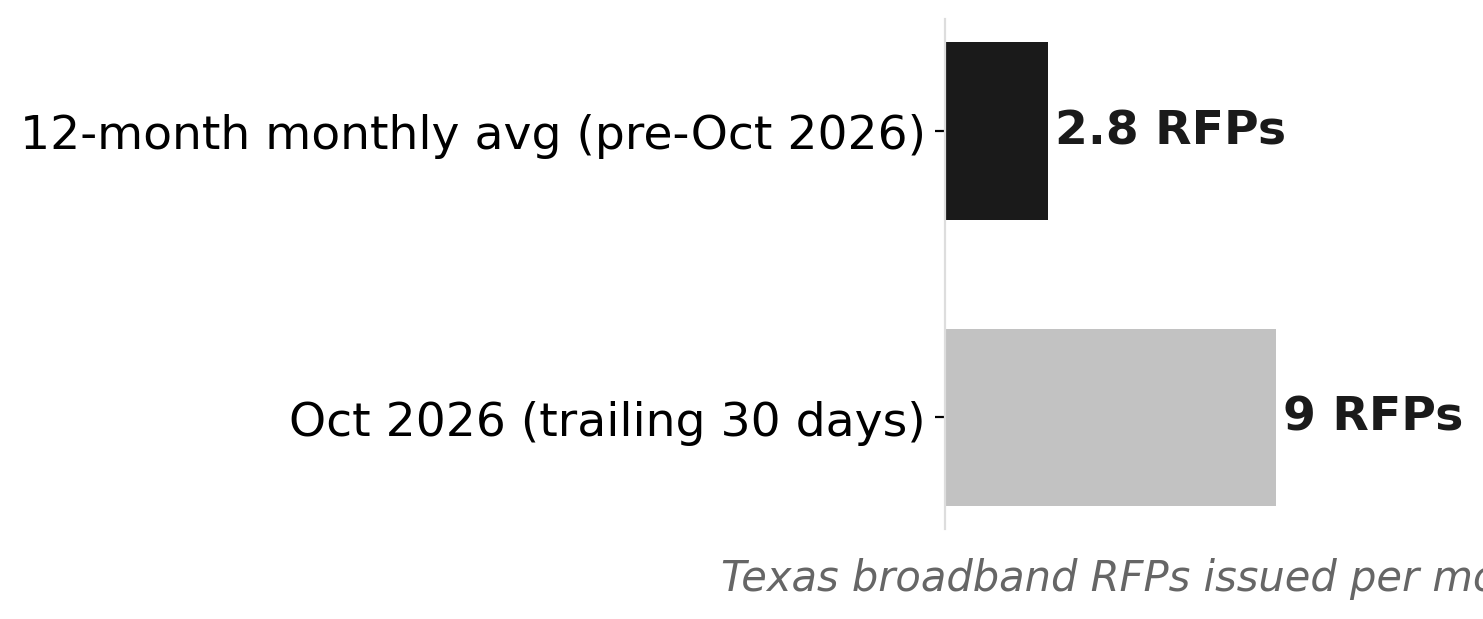
Nine Texas broadband RFPs were issued in the last 30 days, against a 12-month monthly average of roughly 2.8. That 3.3x surge is not a coincidence. On October 21, 2026, USAC opened the E-Rate FY2027 administrative window, starting the clock on the competitive bidding process that school districts must complete before they can file for federal broadband subsidies. Eight of the nine RFPs in the current spike come from school districts. Six name E-Rate explicitly.
The districts moving fastest include Humble ISD in Harris County, Waxahachie ISD in Ellis County, Coppell ISD and DeSoto ISD in Dallas County, Killeen ISD in Bell County, and Palestine ISD in Anderson County. These are not the state's largest or wealthiest systems. They are districts spread across suburban, exurban, and rural Texas that have done the math on a program with a hard deadline and a budget that locks the moment you use it.
The math is compelling. The FY2026–2030 E-Rate Category 2 budget resets at $201.57 per student, a 20.7% increase over the prior cycle and the highest per-student allotment in the program's 25-year history. Category 2 funds cover the internal connections districts need: wireless access points, switches, routers, the cabling that makes a broadband pipe actually reach classrooms. Critically, the five-year budget is use-it-or-lose-it. A district that files in Year 1 locks its full allocation for the cycle. A district that waits forfeits whatever it didn't claim. The window that opened October 21 is when that clock starts.
Source: NationGraph.
Texas layered on additional urgency. The Texas Education Agency administers a State Match Fund for E-Rate, a separate state appropriation worth up to $5 million annually, that covers a portion of the local share remaining after federal E-Rate discounts. It runs on a first-come-first-served basis, tied to the same Form 470/471 competitive bid process that the federal program requires. Districts that move early on E-Rate are also first in line for state supplemental dollars. Those that wait risk both.
The competitive bidding process itself has a fixed sequence. A district posts a Form 470, effectively an open RFP, and must wait at least 28 days for vendor responses before selecting a provider and filing a Form 471 funding request. The RFPs appearing in procurement databases now are those Form 470s made public. They are the opening move, not the finish line, which is why the pipeline spike is visible weeks before any money actually moves.
The broader backdrop makes E-Rate's relative reliability more conspicuous. Texas holds the nation's largest BEAD allocation, $3.3 billion in federal Commerce Department funds obligated to the Texas Comptroller's office for broadband infrastructure deployment to unserved and underserved locations. BEAD targets ISPs building out physical infrastructure, not school districts buying service, so the two programs serve different actors. But they were supposed to reinforce each other: BEAD buildout would extend fiber to rural communities, and E-Rate would help schools in those communities get on the network once it arrived.
That sequencing has stalled. In June 2026, four ISP winners withdrew from BEAD commitments, leaving roughly 31,000 homes and businesses, about 13% of Texas's BEAD-eligible locations, without a committed provider. In August 2026, the state temporarily halted BEAD disbursements as a new comptroller restructured the broadband office. Final contracts have since been signed with 17 ISPs covering approximately 208,000 locations at roughly $1.07 billion, well below the original $3.3 billion allocation after revised federal rules permitted satellite and fixed wireless providers to compete. Construction runs through 2030.
For a district in Anderson County or Bell County, 2030 is not a planning horizon. E-Rate funding can move within months of the filing window closing. The districts issuing RFPs now are not waiting for fiber to arrive. They are securing the federal and state subsidies that will pay for whatever connectivity exists when the school year continues.
The one non-school issuer in the current batch is the Houston-Galveston Area Council, soliciting broadband ISP qualifications for the Galveston Housing Authority, a different program and a different population, but further evidence that procurement activity around broadband access is compressing into this same calendar window.
For residents in the counties where these districts operate, the near-term signal is straightforward: school board votes to approve vendor contracts will follow competitive bid periods of at least 28 days. The further signal to watch is whether districts that miss this Year 1 window try to access their Category 2 budgets later in the cycle, and whether the State Match Fund's $5 million is exhausted before they get there. That fund does not roll over.