New York issued 14 homelessness-related RFPs in the trailing 30 days of October 2026, more than double the 12-month average of roughly 6 per month and the highest single-month count in the past year. The volume is not an accident. Three separate forces are pressing on the procurement system simultaneously, and in New York, the system cannot legally absorb that pressure any way except by contracting more beds.
New York City operates under a court-enforced Right to Shelter mandate unique in the United States. Every person who presents at a DHS intake facility is legally entitled to a contracted placement the same night, regardless of capacity. That mandate creates a procurement floor with no ceiling. When demand rises, the city's only legal response is to buy more shelter.
Demand is rising from three directions at once.
The first is structural. Mayor Mamdani took office in January 2026 with a shelter census of more than 98,000 people and quickly signed executive orders to close the megashelter hotels that former Mayor Adams had used as emergency overflow. Closing those facilities without first building replacement capacity means the standard DHS system must absorb the displaced residents. The administration has moved fast on contracts: a $1.9 billion hotel-shelter agreement in March 2026, followed by a $1.86 billion renewal in August covering operations through June 2029. DHS's FY2027 budget reached $4.2 billion, up $700 million from the prior year. The October RFP surge is the visible leading edge of that rebuild: NYC's own procurement system re-posted a single family shelter solicitation at least five times in 30 days, a signal that the city is still hunting for operators who can meet its specifications.
The second force is a federal funding cliff. HUD's Emergency Housing Vouchers, which enabled a surge of shelter exits under the Adams administration, are being defunded after 2026. The Coalition for the Homeless estimates that roughly 5,500 NYCHA-administered EHV households face the loss of their subsidy. Unlike the Section 8 Housing Choice Vouchers that make up the bulk of the state's active federal rental assistance portfolio (approximately $275 million obligated), EHVs were a time-limited emergency instrument. When they expire, the households they supported have nowhere to go but the shelter system. State government has moved to partially offset the loss: Governor Hochul's budget included $50 million for a new Housing Access Voucher Program and $153 million for the Homeless Housing and Assistance Program in SFY2027, a $25 million increase. But the state HAVP is a rental voucher program and HHAP is a capital program that builds and preserves units; they operate on different timelines and serve different functions, and neither was designed to absorb 5,500 households in a single fiscal year.
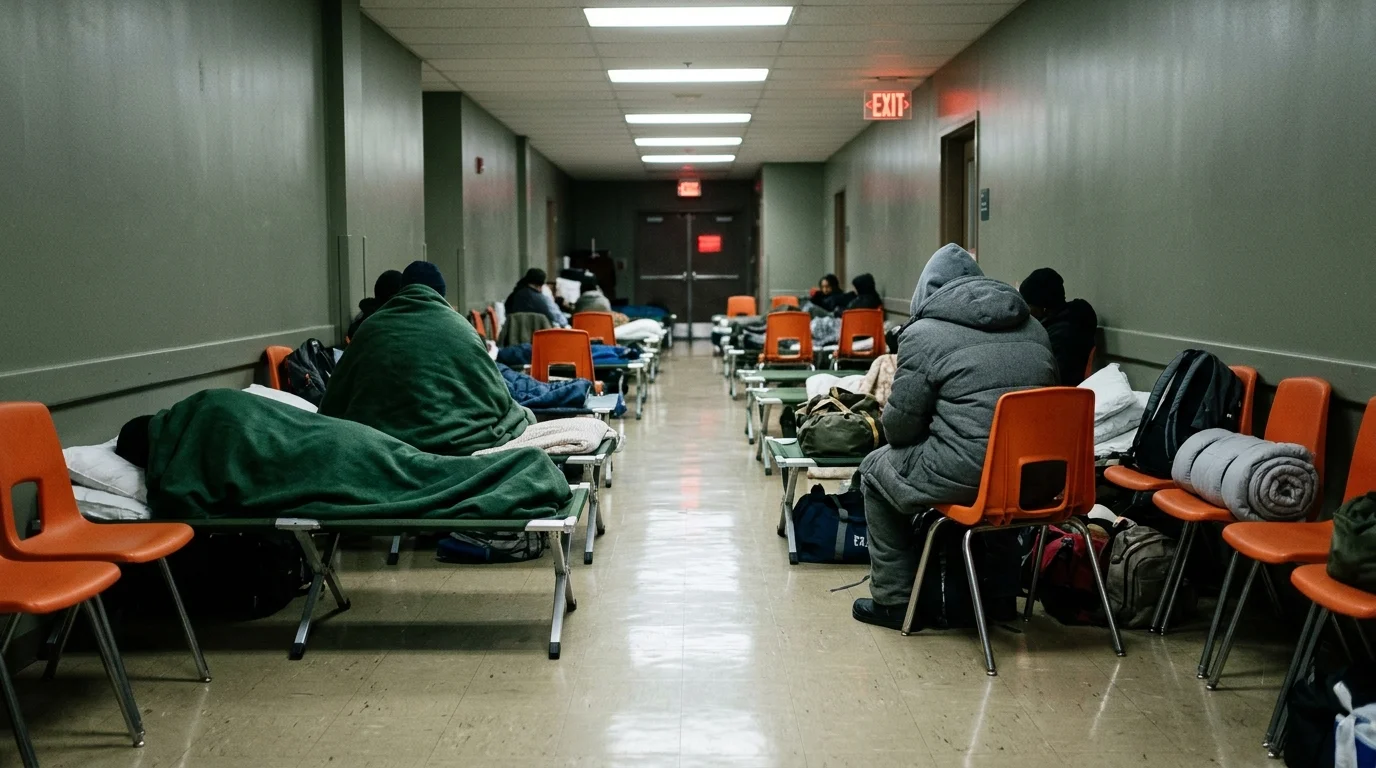
The third force is winter. New York State's Code Blue protocols legally require counties to open emergency shelter when temperatures drop below threshold, and that procurement is happening now. Erie County issued at least four Code Blue RFPs with due dates of October 28. Steuben and Tompkins counties posted similar solicitations. Westchester issued three separate RFPs for the Grasslands Homeless Shelter, suggesting an active operator transition there. These upstate postings are running on their own calendar, independent of the New York City dynamics, and they account for roughly half of the October surge.
What makes the current moment unusual is what is not cushioning the spike. New federal grant starts in New York in the trailing 90 days totaled approximately $94 million across all homelessness-related programs, sharply below the $499 million in the same window a year earlier. The state's active federal homelessness grant portfolio of roughly $540 million is holding, but there is no new surge of federal dollars underwriting the procurement wave. Local and state governments are contracting ahead of need without a corresponding federal backstop.
For New Yorkers living in counties where Code Blue shelters are opening, the practical effect is visible: warming centers and emergency beds are being stood up weeks earlier than in prior years, and the operators running them were being competitively selected as recently as last week. For the roughly 5,500 households still holding EHVs, the coming months will clarify whether the state's new Housing Access Voucher Program can scale fast enough to provide continuity before federal funding lapses.
The next signal to watch is whether NYC's repeated family shelter solicitation, reposted at least five times without apparent resolution, finds a qualified operator before the first major cold-weather event. If it doesn't, the Right to Shelter mandate ensures the city will house those families regardless. The procurement system just has to catch up to the legal obligation.