At least five Washington state governments issued flood-control procurement bids in the last 30 days, the most concentrated burst of local flood infrastructure activity the state has seen in over a year. The timing is not a sign that federal money has arrived. It is a sign that local governments have stopped waiting for it.
The December 2025 atmospheric river event forced evacuation orders for more than 100,000 Washingtonians, damaged nearly 4,000 homes, and breached levees across Snohomish, Skagit, Clark, and Pierce counties. The U.S. Army Corps of Engineers performed emergency levee repairs. Governor Ferguson estimated roughly $182 million in infrastructure damages. President Trump approved a federal major disaster declaration in April 2026, which unlocked roughly $173 million in FEMA coverage for immediate response costs. But the declaration also triggered a separate process, the Hazard Mitigation Grant Program, which funds the longer-term infrastructure work that actually prevents the next flood. FEMA denied Washington's HMGP request the same month, with Associate Administrator Gregg Phillips saying only that the grants were "not warranted" and offering the state 30 days to appeal.
The HMGP denial landed on top of an earlier blow. In April 2025, the Trump administration terminated FEMA's Building Resilient Infrastructure and Communities program, known as BRIC, calling it wasteful. BRIC had been the primary federal pathway for pre-disaster mitigation work: the kind of levee upgrades, crossing replacements, and drainage improvements that counties apply for in calm years to reduce damage in bad ones. With BRIC gone and HMGP blocked, Washington's counties found themselves with flooded roads and washed-out infrastructure and no federal mitigation pipeline to fund repairs.
FEMA did release a long-delayed tranche of approximately $21 million in Flood Mitigation Assistance grants for Washington and Oregon in April 2026, a separate program from HMGP that funds projects protecting structures insured through the National Flood Insurance Program. But that figure, which Rep. Suzan DelBene noted had been approved in June 2025 and sat unsigned for months, amounted to $300,000 for Snohomish County and $930,000 for Enumclaw. None of it flows directly to the county road crossings, park washouts, and barrier systems now appearing in local procurement notices.
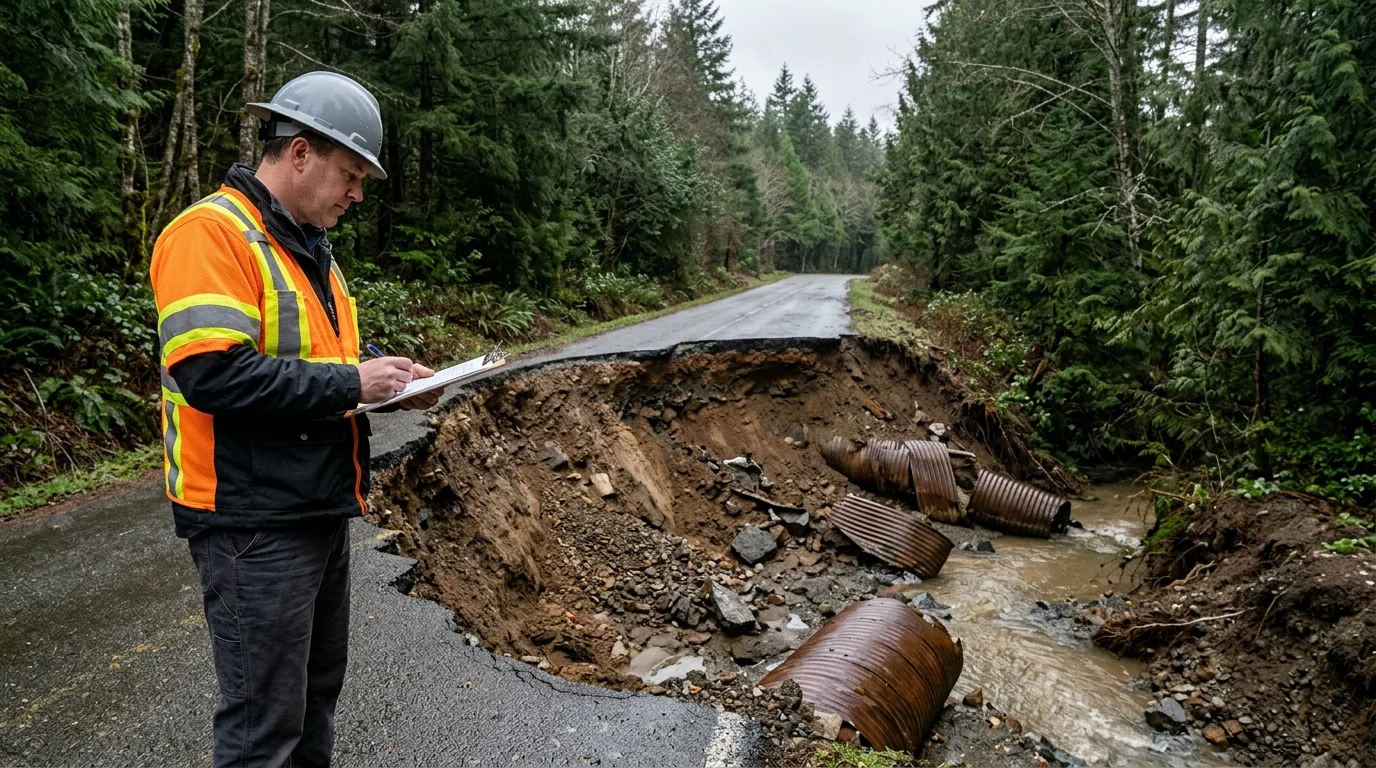
Clark County, which saw significant road and park flooding in December, issued its first flood-related request for proposals in more than 12 months: a bid for engineering work on the NE Allworth Road Rock Creek Crossing, a crossing that took damage in the storms. Skamania County Parks and Recreation District No. 1, covering a largely rural stretch of the Columbia River Gorge, issued its own first flood RFP in over a year, seeking civil engineering services to restore a washed-out section of Donovan Park. Both are local capital projects funded outside any active federal grant.
Pierce County has been the most active, issuing five flood and river infrastructure RFPs since May 2026, including a Flood Barrier RFP and a River Infrastructure Assessment. The City of Woodinville and the City of DuPont have also issued updated flood-related bids. Taken together, the five governments represent a cross-section of western Washington's flood geography, from the Columbia River corridor to Puget Sound tributaries, and a common administrative condition: capital needs that exceed what any current federal program will cover.
Washington state opened applications for $25 million in state disaster assistance in early 2026, which may be part of what is enabling some of this local procurement activity. But state disaster funds are typically reimbursement-based and oriented toward immediate recovery, not the multi-year capital improvements that RFPs for crossing replacements and barrier systems represent. The counties writing these bids are largely doing so against their own capital budgets, with the expectation that the work must proceed regardless of what federal reimbursement eventually materializes.
The question hanging over this procurement wave is what happens when the bills come due at scale. Western Washington counties along the Snohomish, Skagit, and Columbia river corridors face aging levee systems and recurring inundation cycles. The local tax bases in rural counties like Skamania are not sized for repeated capital investment in flood infrastructure. Clark County's Regional Flood Control District exists precisely because the funding problem is too large for individual municipal budgets.
The HMGP appeal window has likely closed or is closing. Congress has not moved to restore BRIC. The next atmospheric river season over the Pacific Northwest begins in fall. Whether Washington's appeal of the HMGP denial succeeded, or whether additional federal mitigation money emerges through other channels, will determine how much of the repair load stays on county balance sheets heading into the next flood year.