Five Pennsylvania public institutions issued solar procurement requests in the last 30 days that represent their first such activity in more than a year, a sharp reversal from the near-total freeze that followed the federal government's cancellation of Pennsylvania's $156 million Solar for All grant in August 2025.
The five agencies span the state's geography in a way that makes the wave hard to dismiss as regional noise: West Vincent Township in Chester County, the Western Allegheny County Municipal Authority outside Pittsburgh, Montgomery County's Eagleville Campus, the South Central Transit Authority in Lancaster, and Orangeville Borough in Columbia County (population 478). A water authority, a rural borough, a county government, a mid-state transit agency, a suburban township. These are not the early adopters. These are the institutions that were waiting to see what happened first.
What happened was a convergence of three pressures arriving at roughly the same moment in mid-2026.
Source: NationGraph.
The most immediate is the net-metering clock. PPL Electric, which serves a large swath of central and eastern Pennsylvania, has proposed replacing its current 1:1 net-metering policy with hourly locational marginal pricing credits. If that shift takes effect as proposed in mid-to-late 2026, systems installed now would likely be grandfathered under the more favorable structure. For a township or transit agency running the numbers on a 20-year solar contract, the difference between the two rate structures is not marginal. It is the difference between a project that pencils out and one that doesn't. That deadline is creating a procurement window that will close whether or not the General Assembly acts on pending net-metering legislation (HB2348).
The second pressure is financial: IRS Elective Pay, the direct-pay mechanism created under the Inflation Reduction Act, allows tax-exempt public entities to receive the 30% federal Investment Tax Credit as a direct IRS cash payment rather than a paper credit they cannot use. None of the five institutions issuing RFPs this month are eligible for Governor Shapiro's Solar for Schools Grant Program, which is a state appropriation administered by DCED and restricted to school districts, intermediate units, charter schools, community colleges, and career-technical schools. But all of them can access Elective Pay regardless of state program participation, which substantially changes the economics of a rooftop installation.
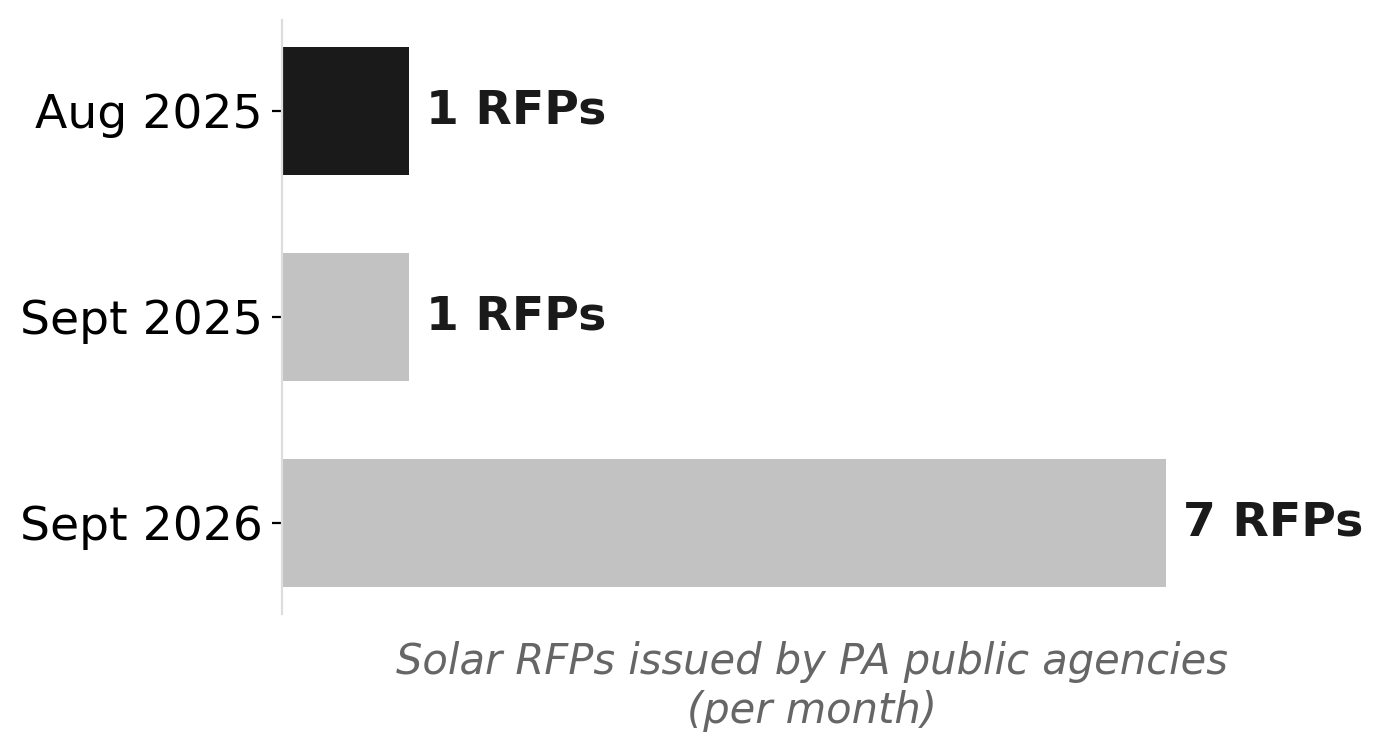
The third pressure is the void left by Solar for All. Pennsylvania's $156 million EPA award, intended to fund solar installations for roughly 12,500 low-income households, was canceled by the Trump administration in August 2025. Pennsylvania joined a multi-state legal challenge, and as of this writing that litigation remains unresolved. As The Allegheny Front reported, solar advocates warned the cancellation could become 'an excuse for not moving forward.' The RFP data from fall 2025 suggests many agencies took that pause: just one solar RFP from a Pennsylvania public institution in August 2025, one in September 2025. The current September 2026 figure, six RFPs statewide in the last 30 days, represents a clear reactivation of stalled pipelines.
The Solar for Schools program is the connective tissue here, even for agencies it does not directly fund. The Shapiro administration announced a second consecutive $25 million appropriation in the 2026-27 budget, signed July 2026, building on the $27.2 million already disbursed to 84 schools across the state. The first-round demand was extreme: DCED received 88 applications from 25 counties requesting $88 million against just $25 million available, 3.5 times oversubscribed. That oversubscription didn't just reflect school district interest. It demonstrated, across every county that submitted an application, that the solar procurement process is navigable for a public agency. The RFP template, the contractor landscape, the interconnection pathway, these are now familiar terrain in Pennsylvania in a way they weren't three years ago.
Pennsylvania led neighboring states in solar RFP volume over the last 30 days: seven RFPs against New Jersey's six, New York's four, Ohio's four, and Maryland's three. That's notable given that SEIA has consistently described Pennsylvania's solar market as relatively underdeveloped compared to its neighbors. The current procurement wave may be the leading edge of the market catching up.
The policy backdrop adds urgency. Act 44 of 2026, signed July 20, created Pennsylvania's first statewide solar decommissioning framework, a signal that the legislature views utility-scale solar as a permanent fixture of the state's energy mix, not a speculative bet. House Bill 501, which would require 35% renewable generation within 10 years, remains stalled in committee, meaning the regulatory floor for solar hasn't shifted yet. That makes the economics of acting now, under current net-metering rules and with Elective Pay available, more attractive than waiting for a mandate that may be years away.
The next signal to watch is whether PPL Electric's net-metering proposal moves to final rulemaking before year's end. If it does, the grandfathering deadline becomes concrete, and agencies that haven't yet issued RFPs will face a hard choice: move before the window closes, or reprice their projects under a less favorable credit structure. The five agencies that acted this month made their bet. Others are still deciding.