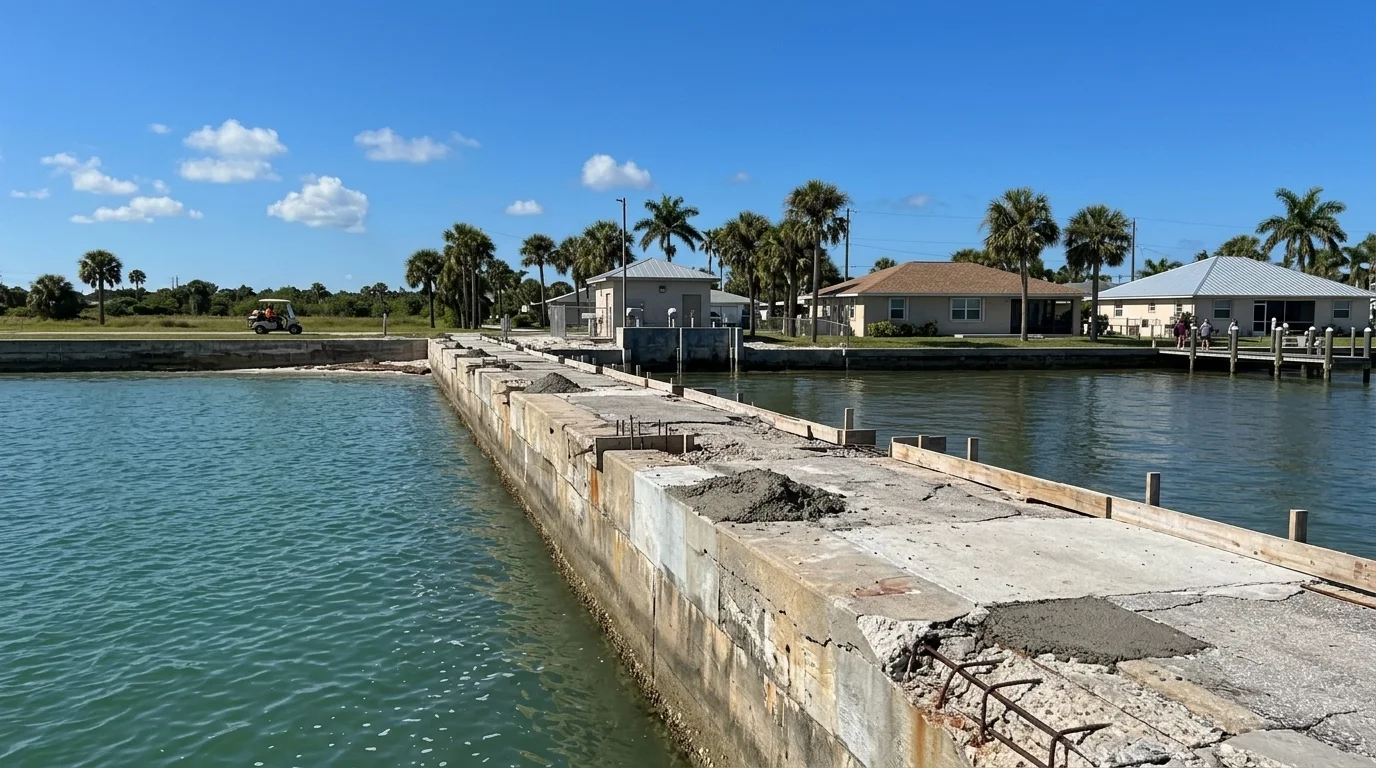
Seven Florida institutions issued a seawall or coastal hardening RFP for the first time in more than a year during the 30 days ending August 3, 2026, a category that had zero new entrants in the comparable prior period. The burst spans eight counties and every section of Florida's coastline: Bay and Escambia on the Panhandle, Franklin and Nassau on the Big Bend and Atlantic shores, Brevard and Pinellas mid-coast, Charlotte to the south, and Bal Harbour and Medley in Miami-Dade. No single storm prompted this. A federal clock did.
The driver is Florida DEP's Resilient Florida Grant Program, which channeled American Rescue Plan Act funds to local governments for coastal implementation projects starting in 2021 and 2022. Those grants carry a hard federal deadline: project completion, reimbursement, and grant closeout must all occur in 2026. DEP made the pressure explicit, running dedicated virtual office hours every week through June 30 specifically for ARPA-funded grantees racing to comply. The message to small cities was unambiguous, build now or return the money.
The result is a procurement wave that looks nothing like normal seasonal buying. Florida's seawall RFP volume ran at a steady 9 to 14 institutions per month from March through May 2026, dipped in June, then jumped back to 8 institutions and 10 RFPs in July. That July spike is the statistical fingerprint of a grant deadline, not a hurricane response or a budget cycle. Institutions that had gone dormant on procurement, many for more than a year, are re-entering the market simultaneously because they all accepted ARPA money at roughly the same time.

Source: NationGraph.
The cities appearing on the RFP boards now are telling. Treasure Island (Pinellas County), Fernandina Beach (Nassau), Melbourne Beach (Brevard), Carrabelle (Franklin), and Bal Harbour (Miami-Dade) are small cities, most with populations between 1,000 and 14,000 and without large in-house engineering departments. That profile explains the dormancy: these governments had the grant awards and the vulnerability assessments, the Resilient Florida Program has placed nearly 95 percent of Florida's counties and municipalities through the planning phase, but lacked the staff bandwidth to move a construction procurement forward without a forcing function. The deadline is that function.
The scale of money behind the sprint is substantial. Florida DEP's Resilient Florida Program has invested more than $1 billion statewide in sea-level rise and flooding resilience, with an additional $300 million-plus in ARPA-backed implementation grants flowing to local governments. Miami Beach's FY 2025-26 award alone, $17.96 million for North Beach seawalls and living shorelines at a 50 percent state match, illustrates the size of individual projects now entering the construction pipeline. When a city of that profile issues a procurement, contractors notice. When seven smaller cities follow in a single month, the regional construction market tightens.
Florida's lead over peer coastal states reinforces the point. Nine Florida institutions issued seawall RFPs in the last 30 days. Texas produced two. North Carolina produced one. Georgia, South Carolina, Louisiana, and Virginia combined for zero. Those states also have coastlines and storm exposure; what they lack is Florida's specific combination of completed vulnerability assessments, ARPA implementation grants, and a single unified deadline bearing down at once.
The pressure compounds because the same municipalities closing out old grants are simultaneously eligible for new ones. The next Resilient Florida application cycle opened July 1 and closes September 1, 2026. A city finishing a seawall under an expiring ARPA grant can, in the same fiscal quarter, apply for the next round. That sequencing means the procurement activity visible right now is likely a leading indicator of another wave to follow in 2027 and 2028, as new awards mature into construction timelines. FEMA's July 8 announcement of $584 million in national resilience and recovery funding adds a further backstop to that pipeline.
For residents of these communities, the immediate consequence is construction. Cities that have held public meetings about seawall vulnerability for two or three years are now at the stage where contractors show up. For the construction and engineering market, the signal is congestion: a cluster of small municipalities with limited project management capacity are all seeking bids in the same narrow window, which tends to reduce competitive pressure and raise unit costs.
The next marker to watch is the September 1 application deadline for the new Resilient Florida cycle. How many of the seven institutions that just issued RFPs also submit new planning or implementation grant applications will indicate whether this is a one-time closeout sprint or the beginning of a sustained procurement posture for Florida's smaller coastal cities.