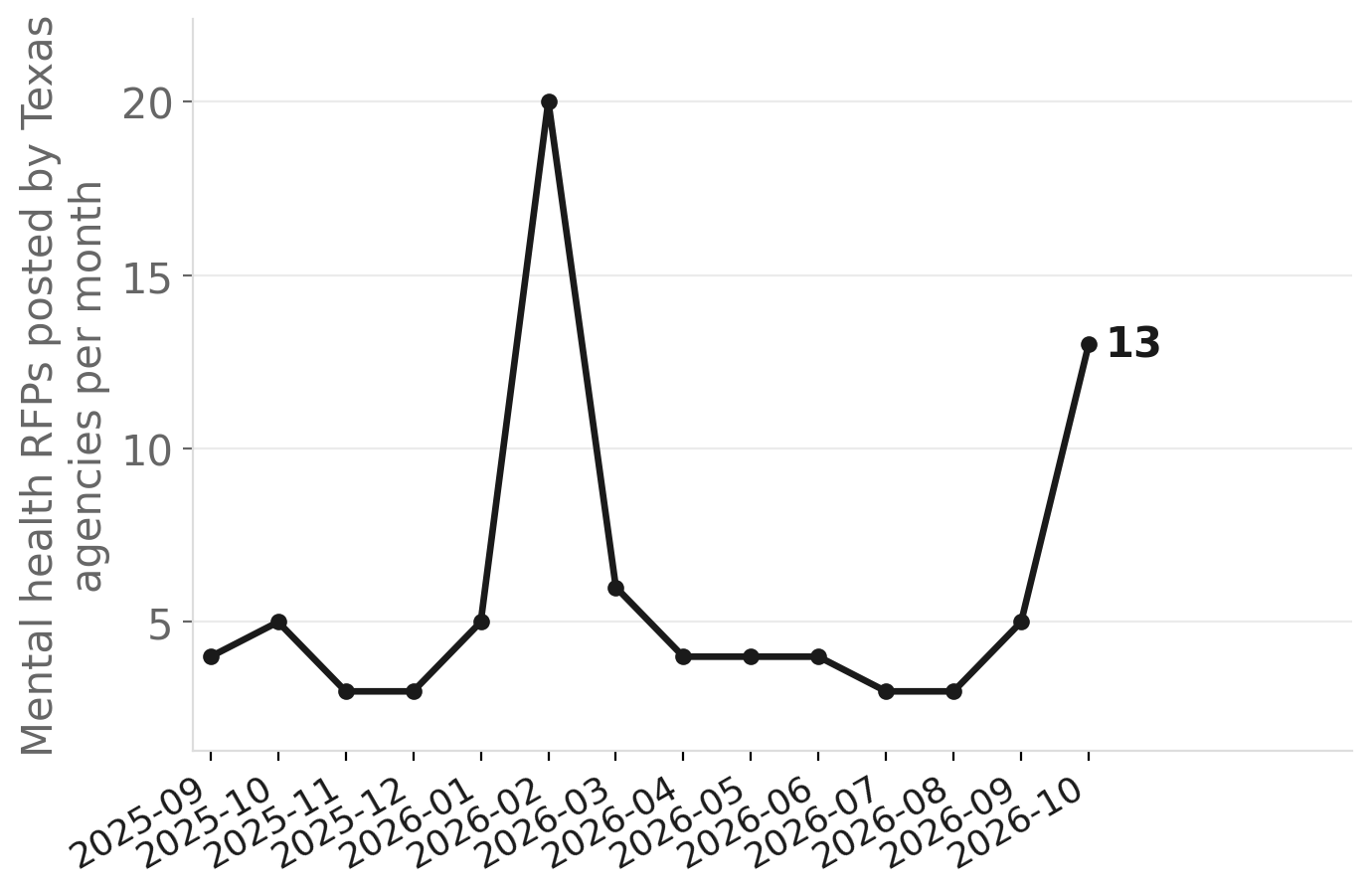
Texas posted 13 mental health RFPs in the 30 days ending October 24, 2026, 2.7 times its trailing 12-month average of about 4.75 per month, and no single agency is responsible. The breadth is the point.
The spike is the procurement exhaust of Texas SB 1, the 89th Legislature's 2026–27 General Appropriations Act, which allocated $10.41 billion for behavioral health across 30 state agencies. That figure is nearly 60 percent above 2015 levels. When the state fiscal year opened on September 1, 2026, that appropriation became spendable, and the 39 Local Mental Health Authorities (LMHAs), school districts, education service centers, county agencies, and municipalities that receive HHSC-distributed dollars all entered their contracting windows simultaneously.
The issuing agencies in October cut across the full delivery ecosystem: LMHAs including Burke, Gulf Coast Center, and Hill Country MH-MR Center; Bexar County; school districts in El Paso, Southwest, and Waxahachie; ESC Region 19; Collin County Community College; and the city of Texas City. When procurement signals appear across that range of institutional types at the same time, it reflects a system-wide funding event, not a localized one.
Source: NationGraph.
Two distinct funding streams inside SB 1 are driving most of the recurring service-delivery contracting. HHSC's community mental health services line (Strategy D.2.1) carries $728.5 million for FY2026 alone, disbursed through the LMHA network statewide. A separate community mental health grant program (Strategy D.2.4, Rider 50) adds $117.8 million per year, $235.5 million over the biennium, covering matching grants for community programs, justice-involved individuals, veterans, and SMART innovation grants. Those two streams, totaling roughly $3.2 billion for the biennium in community behavioral health alone, are the engine behind LMHA procurement activity.
A third, structurally different stream is producing a separate class of RFPs on a different timeline. HB 500, a supplemental appropriations bill also signed in June 2025, directed one-time capital funds toward specific facilities: $33.6 million for a Uvalde Behavioral Health Campus, $45 million for the Sunrise Canyon facility, and $43.4 million for El Paso inpatient capacity expansion. Those construction projects require their own downstream operating contracts, service-delivery RFPs that will appear in procurement databases months or years after the capital work begins. The October surge is primarily the recurring-services wave; the HB 500 operating-contract wave is still forming.
The federal dimension amplifies the signal. Texas currently carries $1.27 billion in active federal mental health grants across 657 awards. The largest single instrument is an $82.5 million SAMHSA Community Mental Health Services Block Grant running through September 2027, which flows through HHSC to LMHAs as a federal match layered on top of state dollars. A newer $11.7 million SAMHSA grant targets 988 crisis infrastructure specifically, running through September 2029. Under Rider 45, LMHAs are required to leverage state appropriations against federal matching funds, meaning every new legislative dollar is structurally designed to pull down an additional federal dollar. That matching obligation multiplies the contracting work, and the visible RFP volume, at the local level.
The calendar pattern here is not accidental. February 2026 was the single highest month in the dataset, at 20 RFPs, which corresponds to the first full month of FY2026 contract execution after the prior fiscal year opened in September 2025. October 2026's 13 RFPs land in the same Q1-to-Q2 window of the new fiscal year. The Texas Legislative Budget Board's behavioral health tracker shows FY2026–27 non-Medicaid behavioral health funding at $6.5 billion in All Funds. When that much money flows on an annual cycle, the procurement calendar becomes predictable: expect another surge in the February–March 2027 window as agencies execute the second half of their biennial contracts.
For vendors, providers, and community organizations, the practical consequence is that the October and February windows are when the doors open widest. An LMHA in one region posting an RFP for crisis stabilization services and a school district in another posting one for school-based counseling are competing for the same licensed workforce, often at the same moment. That labor-market pressure is a constraint the appropriation does not resolve.
The next signal to watch is whether the HB 500 facility projects, Uvalde, El Paso, Sunrise Canyon, begin generating operating-contract RFPs as construction timelines firm up. If they follow the capital-to-operations lag typical of state psychiatric infrastructure, those procurements will appear in the 2027–28 window, layering a new class of RFPs on top of the recurring annual cycle that is already running at 2.7 times its historical baseline.