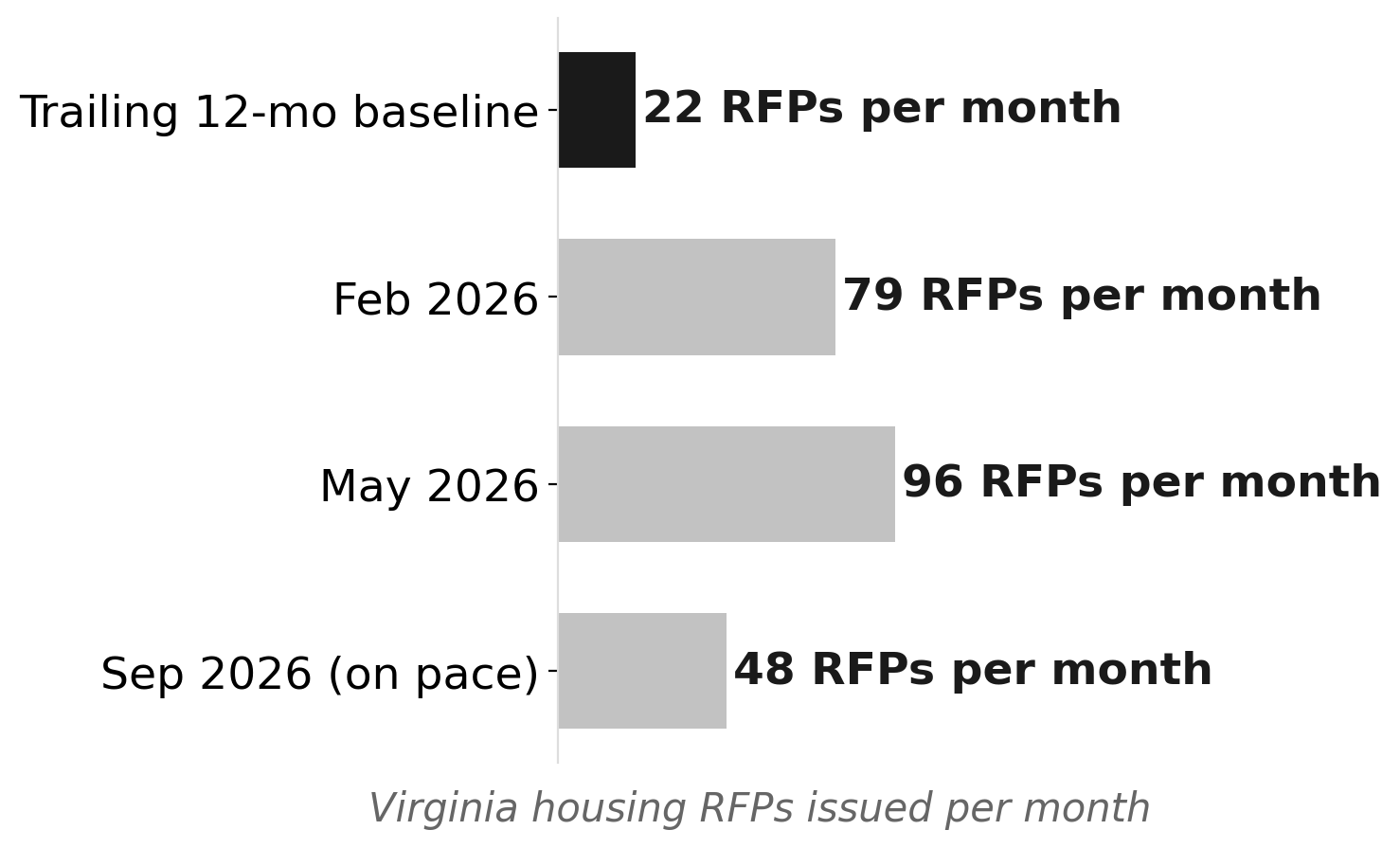
Virginia localities filed housing-related RFPs at nearly double their baseline pace during the active months of the 2026 General Assembly session, 79 in February and 96 in May, and the underlying reason is less about any single program than about a structural feature of Virginia government: the Dillon Rule. In Virginia, localities cannot act on housing until the state explicitly hands them each tool. On July 1, 2026, the state handed them several at once.
The procurement calendar maps almost exactly onto the legislative one. February's spike coincided with bills moving through committee. May's peak of 96 RFPs came as Governor Spanberger's office was finalizing signatures on the first wave of housing legislation, signed April 8 and again in June. Once those laws took effect July 1, localities that had been drafting plans for months finally had the legal authority to execute them. The result is a procurement wave broad enough to span Northern Virginia's high-cost suburbs, the Richmond metro, and coastal cities from Norfolk to Alexandria.
Four enabling statutes sit at the center of this. HB594 creates a fast-track rezoning path for qualifying affordable projects. HB867 and SB74 give localities the option to establish their own local affordable housing programs, a tool Virginia localities simply did not have before. HB4 grants localities a right of first refusal when publicly supported housing with expiring affordability covenants comes up for sale, a mechanism with immediate stakes: roughly 18,000 affordable Virginia units are projected to lose their affordability status by 2030, according to a newly launched state dashboard. A fifth law, the Faith in Housing Act (SB388), eliminates rezoning requirements for affordable development on religious and certain nonprofit-owned land, with at least 60 percent of units required to remain affordable for 30 years, though it does not take effect until January 1, 2027, meaning a second procurement pulse is likely early next year.
Source: NationGraph.
The enabling statutes authorize action. Two state appropriations give localities the money to move on it. Virginia's FY2027 budget, passed mid-2026, allocates $60 million for a new mixed-income housing pilot program administered through DHCD and Virginia Housing, paired with new renter protections. A separate $12 million state appropriation funds eviction prevention for families facing financial hardship, also administered through DHCD. Neither of these is a federal program. They are state dollars flowing through state agencies, and their spend-down timeline is tied to the current budget cycle, which creates urgency. Localities that wait too long risk losing access to a funding window that may look different after the next General Assembly session.
The state also awarded $14 million from the Virginia Housing Trust Fund in March 2026 to 61 projects focused on permanent supportive housing, rapid rehousing, and homelessness services, a separate competitive program from the new pilot. That award landed during the February procurement spike, and its ripple effects are visible in the project pipeline now moving toward contracting.
One additional signal worth watching is federal. The 21st Century ROAD to Housing Act became law on July 11, 2026, after passing the Senate 85 to 5 and the House 358 to 32. It expands Community Development Block Grant funding, reauthorizes the HOME program, and lifts the Rental Assistance Demonstration cap by 100,000 units. Virginia already carries an active HUD portfolio of $272 million across 414 grants, with the Virginia Housing Development Authority and housing authorities in Fairfax, Norfolk, Richmond, Hampton, Newport News, and Alexandria among the largest recipients of new Section 8 Housing Choice Voucher tranches in 2026. The federal law opens new competitive pipelines those agencies are now positioning to enter, but its actual funding impact depends on future congressional appropriations not yet confirmed. The state laws and state appropriations, not the federal act, are the primary engines of the current procurement surge.
The Virginia Housing Alliance's 2026 legislative agenda framed this session as a generational opportunity to close authorization gaps that had accumulated across decades of Dillon Rule constraints. The 2026 General Assembly delivered more housing tools in a single session than the state has seen in a long time, fast-track rezoning, local program authority, right of first refusal, and faith-land development, and localities are responding with the kind of procurement activity that follows when a starting gun fires after a long wait.
The next signal to watch is September and October. The Faith in Housing Act's January 2027 effective date will push another round of site assessments and partnership agreements through housing agencies before year-end. And any locality that has not yet filed under the new HB867 local program authority will face pressure to move before the next budget cycle recalibrates available state funds. The window is open. How many localities clear the threshold before it narrows is the question the next several months will answer.